India is a global force with which the US will have to work closely on technologies of the future such as semiconductors and AI, while Pakistan is a country with which successive American administrations have collaborated to cope with regional issues such as the situation in Afghanistan, former secretary of state Antony Blinken said at the Hindustan Times Leadership Summit.
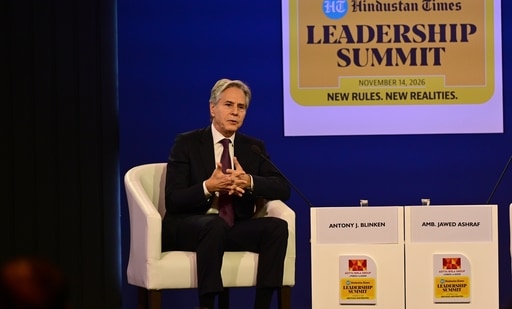
The de-hyphenation in the US’s relations with India and Pakistan is complete and there must be zero tolerance for terrorism and respect for India's right to defend itself when attacked, Blinken said during a conversation with former ambassador Jawed Ashraf. Blinken, who served as secretary of state under president Joe Biden, acknowledged that the US can do more to address the civil-military balance in Pakistan.
“India is a global force and our relationship, our interests, the things that we're working on together, the places that bring us together, the places where we sometimes have some differences, are really global in nature,” Blinken said. On the other hand, the US-Pakistan relationship is regional and there will be areas where the two sides need to work together, particularly counter-terrorism, he said.
“I'm still absolutely convinced that the relationship, the partnership, the strategic convergence between the US and India is an essential element of this new century and one that we have to continue to pursue and to deepen,” Blinken said. Successive Republican and Democratic relationships moved India-US relations over the past 25 years from estrangement over five decades to a unique partnership based on convergence of strategic interests and people-to-people connections.
{{/usCountry}}“I'm still absolutely convinced that the relationship, the partnership, the strategic convergence between the US and India is an essential element of this new century and one that we have to continue to pursue and to deepen,” Blinken said. Successive Republican and Democratic relationships moved India-US relations over the past 25 years from estrangement over five decades to a unique partnership based on convergence of strategic interests and people-to-people connections.
{{/usCountry}}Deep Dive
How did Antony Blinken distinguish US relations with India and Pakistan?
Why did Blinken call India a global force in US relations?
Does the US expect India to follow Washington’s position on every issue?
“Seeing the relationship with India…through the prism of Pakistan — that is over and done. There was a matter of expedience throughout the Cold War and dealing with the Soviet Union, and then Afghanistan after 9-11,” he said. “That's now all over and done with, and that's allowed a recalibration of how we see it.”
The US must have a “zero tolerance policy” for terrorism, including respect for India's right to defend itself when attacked, but also support for diplomatic efforts to ensure there is no escalation between India and Pakistan because of their nuclear arsenals which “would be so dangerous not only to each country but potentially to countries far beyond”, he said.
The US’s “expedience” with Pakistan for the Cold War and the imperatives in Afghanistan “probably caused us to have less of a critical hand” for the civil-military balance in the country. “There's certainly an opportunity for the US to do more, to try to see if that balance can't be changed,” Blinken said, adding that the final decision about the nature of governance will have to be made by the Pakistani people and the US can only provide support from outside.
The India-US relationship fundamentally changed when the two sides reached an agreement on civil nuclear cooperation, and the driving force for ties in the future will be cooperation on critical and emerging technologies. “Our ability to work together on producing semiconductors together, our ability to secure AI supply chains, our ability to work together in space, to work together in quantum — all of these things are a glue that will continue to get stronger,” Blinken said.
At the same time, the US shouldn't expect that India will follow it or do exactly what Washington wants, given New Delhi’s policy of strategic autonomy. “There are going to be places where we don't exactly have the same perspective,” Blinken said. “The trick is continuing to build the trust and the mechanisms to manage where those differences are.”
Citing the example of India-Russia ties, Blinken said the US doesn’t expect this relationship to end, though diversification on energy and military equipment will ensure that New Delhi isn’t “beholden” to Moscow going forward.
Blinken said some recent frictions in India-US ties were the result of “personalities to some extent”, besides tariffs, differences over Russia and energy, “although it looks a little hypocritical for the US to complain about that now, having waived energy sanctions on Russia”.
However, these pale in comparison to the larger strategic drivers that unite India and the US. “The strong shared interest in a free and open Indo-Pacific, the convergence of our economies, and the ongoing convergence of our people. So I remain very, very bullish about this unique relationship, this unique partnership, but it doesn't just happen, it takes a lot of hard work,” Blinken said.
India-US relations hit their lowest point in more than two decades last year when US President Donald Trump hit Indian exports with 50% tariffs and repeatedly contended that he had helped end a four-day conflict between India and Pakistan by using economic pressure. The two sides reached an understanding early this year on slashing tariffs but have been unable to finalise a bilateral trade agreement.
Trump’s burgeoning relationship with Pakistani Field Marshal Asim Munir, whom he hosted in the White House, has also emerged as an irritant for India-US relations.
Blinken said he believed that it is in Pakistan’s interest to be positively integrated with everything going on in South Asia. “That's the huge upside but it requires Pakistan to make some basic decisions,” he said.