
 E-Paper



Vikram-1, India’s first private orbital rocket to launch this month
Skyroot Aerospace announced that Vikram-1 Test Flight-1: Mission Aagaman is fully stacked at India’s historic First Launch Pad (FLP) at the Satish Dhawan Space Centre, Sriharikota.

 Prefer HTon Google


Skyroot Aerospace is preparing to launch later this month the Vikram-1, India’s first privately built orbital rocket, marking the moment the country’s private space industry attempts to cross a threshold it has never crossed before. The seven-storey, multi-stage launch vehicle is designed to carry small satellites weighing up to 350kg to Low Earth Orbit, with its maiden mission targeting an altitude of 450km at a 60-degree orbital inclination.
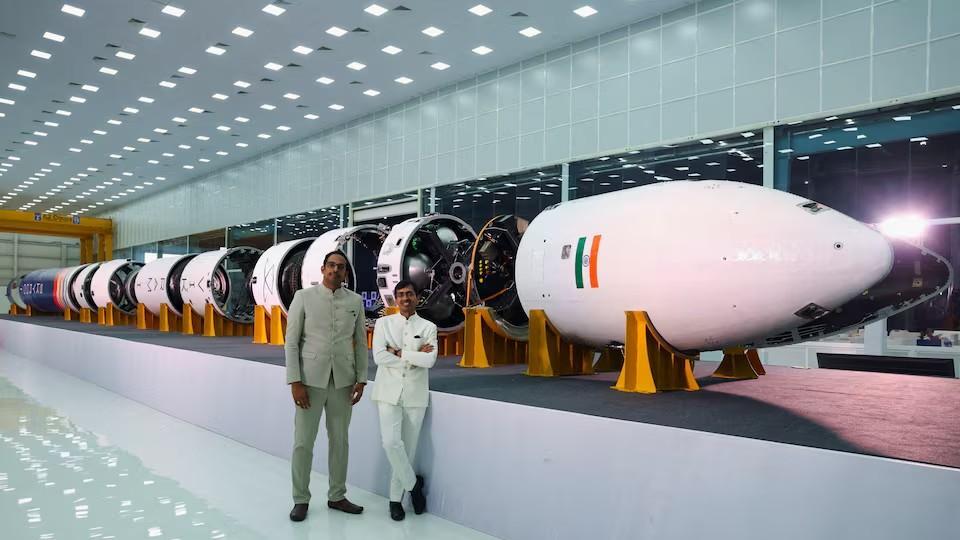
The rocket is built with an all-carbon composite structure and powered by in-house propulsion systems, including 3D-printed engines and high-thrust solid-fuel boosters. The technology is indigenously developed, Pawan Kumar Chandana, co-founder and CEO of Skyroot, told HT from Sriharikota, where he is currently stationed.
“It is 100% designed in India, 100% manufactured in India. We have built it from scratch. That means hundreds of systems have to be developed and tested. Everything has to work together to a level where right now we’re able to stack it up on the launch pad, and ready to go off and shoot it,” he said. “Building a rocket is the toughest feat in engineering, and it is a very deep technological product. That’s why it is called rocket science.”
The mission will gather data across propulsion, stage separation, guidance, navigation, control and overall vehicle performance, supporting Skyroot’s evolution into a commercially operational launch company, according to a company statement.
“The single most important objective of Mission Aagaman is to capture the real in-flight performance data from every system on Vikram-1. We want to understand how the vehicle performs from lift-off through every phase of ascent,” Chandana said.
“This data cannot be fully replicated through ground testing. It will help us validate our designs and inform subsequent vehicle development as we build a reliable, high-cadence commercial launch programme. The moment Vikram-1 lifts off, India’s private space industry will cross a threshold it has never crossed before.”
Skyroot did not disclose the cost of developing Vikram-1. Raising capital was one of the biggest challenges, Chandana said, when HT asked.
Naga Bharath Daka, co-founder and COO of Skyroot, said the mission is designed as both a technology demonstration and a learning exercise. “From a dream to build a launch vehicle in India to now attempting an orbital flight has been a journey like no other. With Vikram-S in 2022, we validated the foundation of our technology stack; with Vikram-1, we take our biggest step yet toward a reliable, high-cadence launch programme built in India, for India and the world,” Daka said.
“This has been made possible by the collective confidence of the Government of India, IN-SPACe, ISRO, our investors, our customers and a dedicated team of 1,000+ individuals.”
Vikram-1 will fly as a partially commercial mission, with Skyroot planning full commercial flights after one or two successful orbital demonstrations. The rocket will carry test payloads from domestic and international customers, Chandana said, though clearances are still pending. “We are awaiting a few clearances. We will be announcing it soon.”
Mission Aagaman — meaning “the arrival” — is Skyroot’s second mission, following the suborbital flight of Vikram-S on 18 November 2022, the first private rocket to reach space from Indian soil.


