The Union environment ministry has identified 20 wetlands and nine wetland clusters for conservation as they are congregation sites for several migratory water bird species.
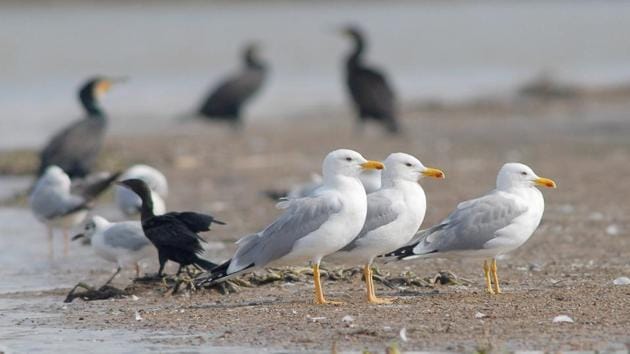
These wetlands include Keoladeo in Rajasthan, Coringa in Andhra Pradesh, Bhitarkanika in Odisha, Point Calimere in Tamil Nadu, Sunderbans in West Bengal, Harike in Punjab, Gulf of Mannar, and Nal Soravar in Gujarat. These wetlands will be protected as part of the Centre’s Central Asian Flyway Action Plan launched on Monday.
The plan states that the boundaries of these wetland clusters will be demarcated and notified under the Wetlands Rules 2017. Additional water will also be allocated whenever needed to maintain the ecological health of these wetlands.
Millions of birds including ducks, geese, falcons and warblers, of at least 370 species, and from three flyways, visit India.
The flyways are the Central Asian Flyway (CAF), the East Asian-Australasian Flyway and the Asian- East African Flyway. Of these 370 species, 310 are water birds.
The action plan proposes that scientists undertake and publish national inventories of the stopover and wintering sites of migratory birds and their population status; implement single-species action plans for 20 species which includes Greater Flamingo, Great Knot, Lesser Flamingo, Eurasian Curlew, European Roller, White-headed Duck, Yellow-Breasted Bunting, and Ferruginous Duck.
The action plan states that threats to migratory birds such as feral dogs, sand and boulder mining, and land use changes will be assessed, periodic disease surveillance will be carried out, impact of night light and electrocution risks evaluated, and local communities encouraged to participate in the conservation of these bird species. It states that the CAF includes several important migration routes over the high Himalayan passes where “unique, high altitude migration such as those of Bar-headed Goose takes place… breeding ranges of some species, including the critically threatened Siberian Crane and Slender-billed Curlew are largely restricted to the CAF”. Neither of the last two species is currently seen in India.
{{/usCountry}}The action plan states that threats to migratory birds such as feral dogs, sand and boulder mining, and land use changes will be assessed, periodic disease surveillance will be carried out, impact of night light and electrocution risks evaluated, and local communities encouraged to participate in the conservation of these bird species. It states that the CAF includes several important migration routes over the high Himalayan passes where “unique, high altitude migration such as those of Bar-headed Goose takes place… breeding ranges of some species, including the critically threatened Siberian Crane and Slender-billed Curlew are largely restricted to the CAF”. Neither of the last two species is currently seen in India.
{{/usCountry}}Birders and scientists have welcomed the plan, which will be implemented between 2018 and 2023, but have cautioned that hundreds of wetlands that act as stopovers for these species are still unprotected and extremely vulnerable to land use change.
“There are 460 wetlands of ornithological importance, about 190 of them meet the Ramsar criteria of wetlands of international importance. In the action plan 20 wetlands and some wetland clusters have been proposed to be protected. Some of these are also Ramsar sites. So it’s a start but there is much more to be conserved,” said Sathiyaselvam P, assistant director, Wetlands Programme at the Bombay Natural History Society.
Wildlife biologist and birder Shashank Dalvi agrees : “Wetlands act as important stopovers which is why wetland clusters are even more important for their conservation.”