A study that reconstructed droughts and famines across India over the last 146 years says lack of moisture in the soil for extended periods of time can be linked to some of the most devastating famines.
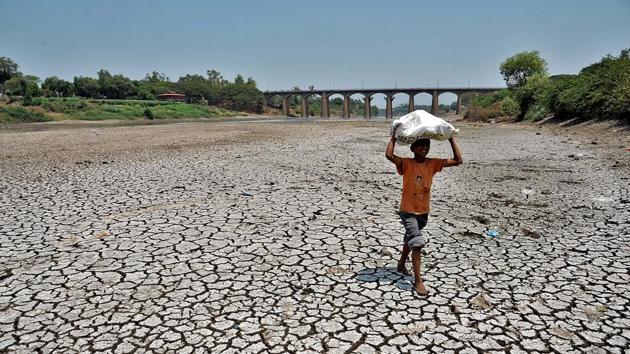
Previous attempts to study 18th and 19th century droughts have been limited to meteorological droughts caused by failure of rains. The latest study -- by Indian Institute of Technology, Gandhinagar (IIT-Gn), University of California, and the India Meteorological Department, Pune — for the first time links decline in soil moisture to droughts and famines. It is important because groundwater, which can improve soil moisture during drought, is being depleted rapidly.
“Drought causes depletion of soil moisture and groundwater. Moreover, to replenish soil moisture, groundwater abstraction increases during drought, which further negatively impacts groundwater storage,” said Vimal Mishra of the department of civil engineering, IIT-Gn, co-author of the study.
The study found that between 1870 and 2016 India witnessed seven major soil moisture droughts or agricultural drought periods (1876-1882, 1895-1900, 1908-1924, 1937- 1945, 1982-1990, 1997-2004, and 2011-2015) based on their analysis of severity, area, and duration. Three droughts in 1877, 1896, and 1899 were linked to El Nino when warm temperatures in the Pacific Ocean cause below-normal rains, but barring the famine of 1943, five major famines during 1873-74, 1876, 1877, 1896-97, 1899 were caused by large-scale and severe soil moisture droughts driven by June-September monsoon failures.
“Over exploitation and changing rainfall patterns have led to the depletion of groundwater, which is a threat to food and freshwater security. Lean-density rain over India, which is favourable for recharging groundwater, has declined in the last 30-40 years, and high intensity rainfall has increased,” said Mishra. “Historically ground water has been the saver in times of droughts in most regions of India,” said Mishra.
{{/usCountry}}“Over exploitation and changing rainfall patterns have led to the depletion of groundwater, which is a threat to food and freshwater security. Lean-density rain over India, which is favourable for recharging groundwater, has declined in the last 30-40 years, and high intensity rainfall has increased,” said Mishra. “Historically ground water has been the saver in times of droughts in most regions of India,” said Mishra.
{{/usCountry}}India is the world’s largest user of groundwater extracting 250 cubic kilometres every year – more than one-fourth of the world total. The South Asian Network on Dams, River and People estimates that ground water is vital for two-thirds of irrigated area, 85% of rural population and more than half of urban and industry.
As per the Central Ground Water Board, water level in only 30% wells rose more than two metres between 2007 and 2017, while there was a 30% decrease in 43% wells. “It’s in India’s national interest to bring net groundwater extraction into balance, i.e., recharge equal to withdrawals,” said Dennis P Lettenmaier, co-author and professor at the department of geography, UCLA.
The study, Drought and Famine in India, 1870-2016, was published in Geophysical Research Letters in January.