
 E-Paper



Zelensky invokes 9/11 air attacks,Pearl Harbour in ‘no-fly zone’ push
“I am proud to greet you from Kyiv, a city that is under attack from Russian air strikes…but does not give up…Russia has not just attacked us…not just our land…It went on a brutal offensive against our values…our right to live freely…,” Zelensky told US lawmakers.


Evoking the memory of the Pearl Harbour and 9/11 attacks on the United States (US), interspersing his remarks with images of destruction across Ukrainian cities, and appealing to America’s view of itself as the “leader of the free world”, Ukraine’s President Volodymyr Zelensky asked the US to impose a no-fly zone, provide Ukraine with more military equipment, sanction all of Russia’s politicians, and pressure all American companies to exit Russia.
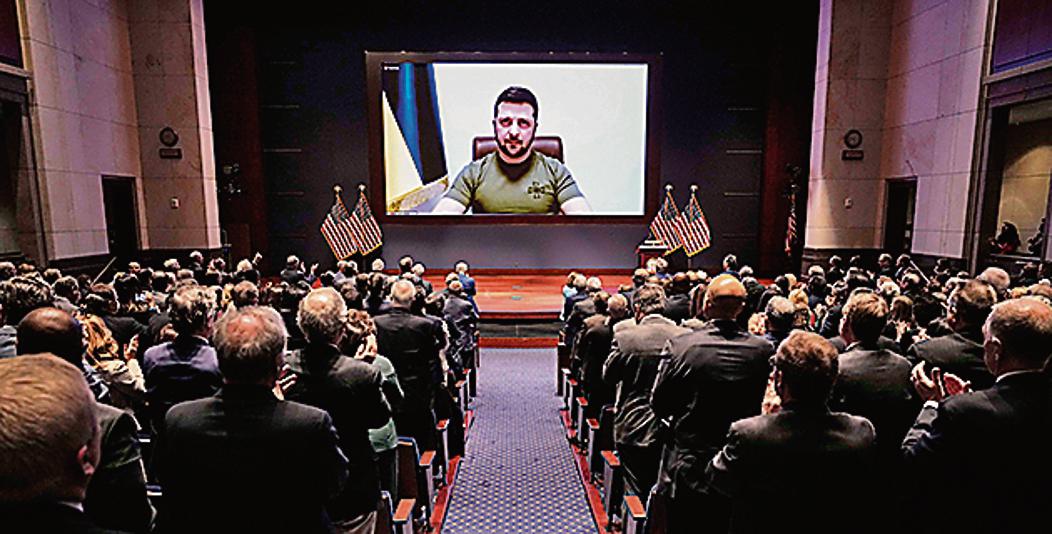
In an address to a joint sitting of the US Congress from Kyiv, Zelensky, a satirist-turned-politician who has emerged as the face of the Ukrainian resistance, said that while Ukraine had been resisting Russian aggression for eight years – in 2014, Russia-backed separatists took over provinces in the east and Russia annexed Crimea – the “full-scale Russian invasion” since February 24 led to his country going through its “darkest times”. Ukraine, he said, needed help to defend democracy and freedom and save human lives.
Also Read | US President Biden announces $800 million worth of defence support to Ukraine
“I am proud to greet you from Kyiv, a city that is under attack from Russian air strikes and missiles every day but does not give up…Russia has not just attacked us, not just our cities, not just our land…It went on a brutal offensive against our values, our freedom, our right to live freely, our desire for happiness, our national dreams…the same dreams that you have,” Zelensky told US lawmakers.
Claiming that Russia had fired 1,000 missiles and turned Ukrainian skies into a source of death, Zelensky turned to Pearl Harbour – “when your sky was black from planes attacking you” – and 9/11 – “when innocent people were attacked from the air” – to rally American public opinion for greater air support for Ukraine. The Joe Biden- administration has been walking a fine line between aggression and restraint; it has inflicted costs on Russia in the form of sanctions and military support to Ukraine, but refrained from imposing a no-fly zone or offering fighter jets, steps that the US claims could lead to an escalatory spiral and direct conflict between Russia and NATO.
‘This is a terror Europe has not seen for 80 years. We are asking for an answer to this terror from the rest of the world. Is it a lot to ask to create a no-fly zone over Ukraine to save people? If this is too much to ask, we offer an alternative. You know what kind of defence systems we need…how much depends on the ability to use aircrafts to defend our people.”
Invoking Martin Luther King Jr’s famous speech, Zelensky said, “I have a dream. I have a need. I need to protect our skies.”
Also Read | Russian forces destroy Mariupol theatre sheltering hundreds of people
Since the invasion, Zelensky’s public messaging has focused on two constituencies. At home, by being on the ground and rallying citizens against the Russian invasion, he has sought to keep up motivation levels as Ukrainians fight an asymmetrical war against a bigger power. Outside, he has spoken to other foreign parliaments, engaged with western leaders, and mobilised global civil society to provide more support to Ukraine against Russia. The address to the US Congress was a part of that effort, and came in the backdrop of the Congress passing a $13.6 billion aid package for Ukraine that included both humanitarian and military components. Later on Tuesday, President Biden was scheduled to announce more military support for Ukraine.
Acknowledging American military, economic, humanitarian support and Biden’s leadership, Zelensky said that Ukraine was grateful for support, but needed more. This included sanctions on a weekly basis “until the Russian military machine stops”, restrictions on all Russian politicians who remain in their offices, exit of all American companies from the Russian market “because it is flooded with our blood”.
He also said that institutions meant to prevent war had failed, and the world needed more institutions, proposing a new alliance for peace. The Ukrainian president also showed a video that gave a glimpse of Ukrainian cities in peacetime, with contrasting images of recent bombardments, cries for help, children in hospitals, and scenes of destruction, suffering and tears. Speaking in English at the end of the speech, Zelensky reiterated his pitch for more support, and told US lawmakers, “To be the leader of the free world means to be the leader of peace”.
Also Read | ‘Which side of history do you want to be on?’: White House asks India on Russia
US lawmakers lauded the speech, with House Speaker Nancy Pelosi terming it “quite remarkable” and Senate minority leader Mitch McConnell terming it an “incredibly effective speech”. But while Pelosi sought to highlight Zelensky’s acknowledgment of US support to Ukraine, McConnell highlighted the Ukrainian President’s appeal for help as a message to Biden to “step up”. There is concern about imposing a no-fly zone across party lines, but Republicans opponents of the administration used the speech to pushed Biden to provide more air defence systems to Ukraine.
Observers compared Zelensky’s speech to Winston Churchill’s remarks to the US Congress in 1942. Writing in the Washington Post, veteran political journalist, Dan Balz, said that the Ukrainian President had “become a beacon to the world, a wartime leader rallying his country, a symbol of courage in the face of personal danger, a politician who has shown anew the power of words and language”.


