India’s first space observatory Astrosat has started capturing images of the outer space, the first of which was released on Twitter by Indian Space Research Organisation (Isro) on Monday.
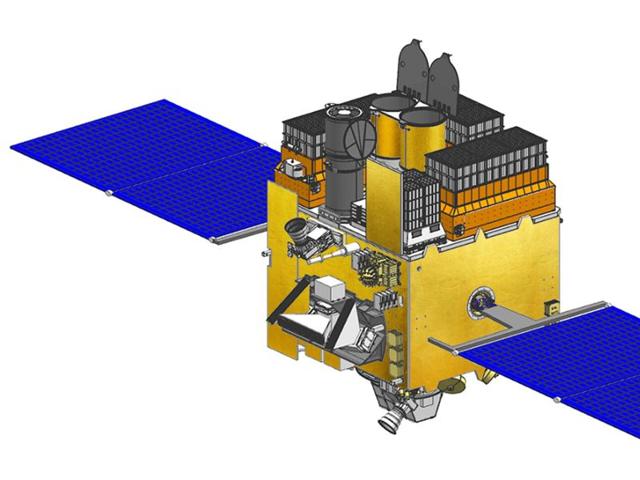
The multi-wavelength mini Hubble-type space observatory captured the image of Crab Nebula, a remnant of a supernova and the brightest hard X-ray source in the sky, last Friday.
The nebula was not detected during Astrosat’s first orbit because the satellite ‘happened to pass through the South Atlantic Anomaly (SAA) region when Crab was in the field of view’, Isro said in a blog post.
The SAA, also called the ‘Bermuda triangle of space’, can produce ‘glitches’ in astronomical data, problems with the operation of on-board electronic systems, and premature aging of computer, detector and other spacecraft components.
The detectors were switched off during this interval in the initial days of Astrosat operation.
Isro also wrote about the difficulties faced by the team after Astrosat failed to capture the Crab Nebula in its first orbit.
“A quick look at the first orbit image showed that Crab Nebula was not detected. Most likely, the data pruning was erroneous,” the blog post said.
“A tense session of self-introspection followed. Questions followed one after the other to explain the strange behaviour. Did the Mission Operation team make any error in orienting the satellite? Well, CZT-Imager has a wide field of view and it is too embarrassing to even pose the question whether they made such a large mistake in pointing,” it added.
{{/usCountry}}“A tense session of self-introspection followed. Questions followed one after the other to explain the strange behaviour. Did the Mission Operation team make any error in orienting the satellite? Well, CZT-Imager has a wide field of view and it is too embarrassing to even pose the question whether they made such a large mistake in pointing,” it added.
{{/usCountry}}But later on October 9, the Crab Nebula was finally detected and observed parallely by both Mission Operation Centre in Bengaluru and Payload Operation Centre of the IUCAA in Pune.
The following is an image of Crab Nebula in hard X-rays above 25 keV. The bright spot near the centre indicates Crab.
Isro is now planning to use Astrosat to look at some black hole sources like GRS 1915+105, Cygnus X-1, Cygnus X-3 in November. The space agency said all X-ray instruments (CZTI, LAXPC and SXT) would be made operational in the following month and space observatory will be ready to study other celestial bodies.
India launched Astrosat on September 28 to become the member of a select group of space organisations to have a lookout in orbit after the US, Japan, Russia and Europe. The satellite launch came just a year after Isro’s first interplanetary mission, Mangalyaan, entered the orbit of Mars.