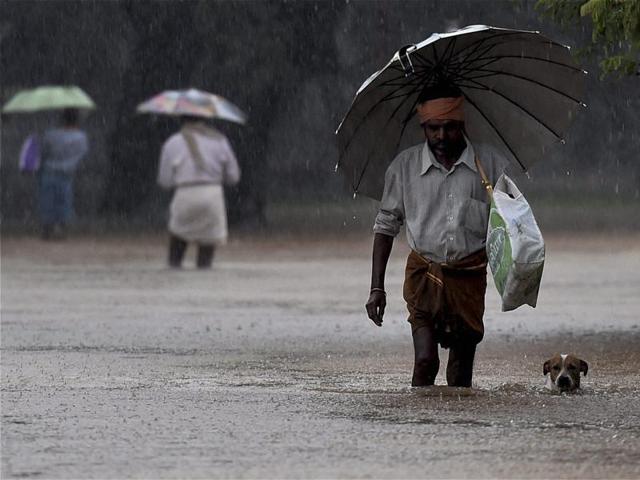
Chennai rain creates ripples in Paris, Javadekar sees no climate link
The massive flooding in Chennai created ripples at the Paris climate talks where Prime Minister Narendra Modi had highlighted India’s vulnerability to extreme weather, though environment minister Prakash Javadekar said the record rainfall was not linked to climate change.
The massive flooding in Chennai created ripples at the Paris climate talks where Prime Minister Narendra Modi had highlighted India’s vulnerability to extreme weather, though environment minister Prakash Javadekar said the record rainfall was not linked to climate change.
Rescue workers and volunteers use an inflatable boat to take residents through floodwaters in Chennai. (AFP Photo)
{{^htLoading}} {{/htLoading}}
Harjeet Singh of Action Aid India used pictures of the inundation in southern cities to tell the world that India was among the nations most in danger because of climate change and such natural disasters should be covered under a new compensation mechanism being formalised at the conference.
{{^usCountry}}{{/usCountry}}
Under Loss and Damage, developing countries would be able to seek financial assistance from the developed world for “measurable” losses by extreme weather events whose frequency has increased in countries like India, government weather data for the last 100 years show.
“Climate may not be directly responsible for the flooding in Chennai but it has definitely contributed,” Singh told Hindustan Times, reacting to Javadekar’s statement.
The environment minister, who will be back in Paris on Sunday for the ministerial talks, said in New Delhi that what has happened in Chennai over the last ten days is “absolutely” serious but it cannot be “directly attributed” to climate change.
{{^htLoading}} {{/htLoading}}
{{^usCountry}}
“It is natural calamity but needs to be tackled effectively,” he said.
{{/usCountry}}
{{#usCountry}}
“It is natural calamity but needs to be tackled effectively,” he said.
{{/usCountry}}
A few days ago, Laxman Singh Rathore, chief of the India Meteorological Department (IMD), had told HT the emerging weather patterns fit the larger picture of climate change predicted by Indian scientists as well as global reports with reference to an earlier phase of flooding in southern India.
He had, however, cautioned that individual events should not be directly linked to the broader issue of climate change without evidence. The inundation in southern India does not fall into the category of “individual events”.
Singh said the Chennai flood pictures showed India was not just the world’s third biggest carbon emitter but among the countries at highest risk due to climate change and the world needs to understand that.
{{^htLoading}} {{/htLoading}}
His remarks came against the backdrop of India being considered unwilling to shun its coal-dependent economic growth without rich nations understanding the reality of India’s energy story.
“Coal is not our passion but compulsion,” Singh said.
At another event, experts from the World Health Organization identified India as among the countries most susceptible to climate change including its adverse health impacts.
“Disaster brings diseases and we are seeing an increase in its frequency in vulnerable countries across the world including India,” said a WHO representative who did not disclose his name.
Chetan Chauhan is the National Affairs Editor looking into all aspects of news and features from across India. A Chevening scholar with over three decades of experience in reporting and news management, Chetan has extensively covered all important aspects of the social sector, political economy, environment and climate change nationally and internationally. He did a journalism course at the Reuters Institute of Journalism in Oxford and Digital Media training at Nanyang Technological University in Singapore. He started as a reporter with The Statesman in 1996 and joined the Hindustan Times in 2000 in the metro bureau covering environment, crime and Delhi politics. He covered hot local news, from the Jessica Lal murder case to the rebellion of Delhi Congress MLAs against then Chief Minister Sheila Dikshit, to the replacement of toxic vehicle fuel with cleaner compressed natural gas (CNG) in the national capital. Some of his stories on air pollution became part of the Supreme Court’s landmark MC Mehta versus Government of India case in the National Capital Region (NCR), forcing the government to take corrective measures. As part of the national political bureau since 2004, he covered important central sectors such as environment, education, social justice, labour, rural development, water resources, renewable energy, agriculture, broadcasting and the Planning Commission for more than a decade producing several exclusive and investigative breaking stories. His specialisation is the environment, having covered at least a dozen United Nations global conferences on climate change, biodiversity and wildlife including climate summits in Paris, Copenhagen and Bali. He also covered India’s two five-year plans ---11th and 12th and reported on drafting and execution of right based laws such as Right to Education, Right to Information and rural job guarantee law, MG-NREGA, now being introduced in new format as VG-RAM-G Act. He has in-depth knowledge of social sector issues. He was one of the first to report on tigers vanishing from Sariska and Panna wildlife reserves in 2004 and 2008, respectively, leading to the setting up of the National Tiger Conservation Authority (NTCA) and the introduction of stringent penal provisions for poaching. He has written extensively on the rising human-animal conflict in India and the degradation of India’s biodiversity hotspots because of mining and other activities. Since 2004, Chetan has covered Parliament comprehensively and participated in training on the nuanced coverage of Parliament proceedings. He has travelled extensively across India to cover national and provincial elections since 1998, especially in the Hindi heartland states, considered India’s road to power. He writes a regular column for Hindustan Times, Ecostani, on important national politics, economy, Himalayan ecology and environmental issues. His other responsibilities include providing inputs for edits and edit page articles for the publication, apart from managing news flow from across India.
Get Latest News, breaking headlines, and top India News, and today real-time updates from across the nation. Stay informed on politics, government policies, crime, Today Weather, and major developments on Hindustan Times
Get Latest News, breaking headlines, and top India News, and today real-time updates from across the nation. Stay informed on politics, government policies, crime, Today Weather, and major developments on Hindustan Times