Giant whales and octopuses floated serenely over the wide pebbled beach in Dieppe, Normandy. The blue-green Atlantic sea, flanked by sheer white cliffs on one side and a port on the other, made a beautiful setting for Le Festival International de Cerf-Volant de Dieppe, or the International Dieppe Kite Festival. India was the country of honour this year along with Indonesia, another kite flying country. There were hundreds of kites in the sky, ranging from creative and combat categories to luminous ones, flying in competition held at night. This international bi-annual festival spread over nine days started small in the 1980s. It has now become one of the biggest kite-flying events in the world and draws participants from 35 countries and more than half a million visitors.
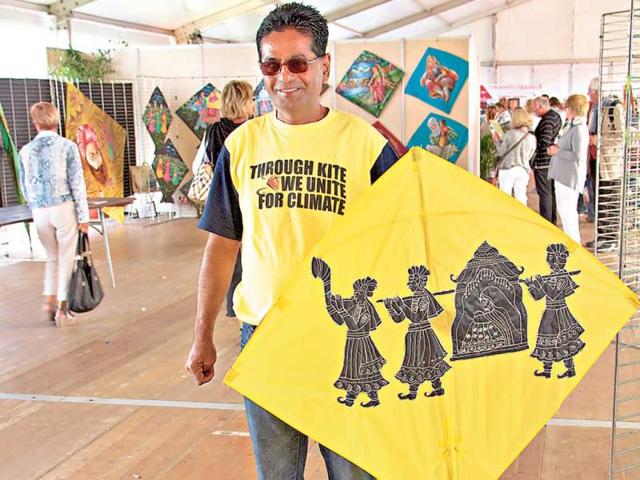
The Indian kites, though, stood out from the rest with their marked traditional appearance. Team Mangalore, a hobby group representing India, flew most of the big non-combat Indian kites. The group holds the record in the Limca Book for the largest Indian kite, Kathakali, which is 36 feet high and 10 feet wide. “As a guest-of-honour country, we led the opening parade here and got a big tent. The festival sponsored our flights, food and stay,” says Shashank Shetty, an event manager and member of the India team. “We know that visitors were expecting more shows from India here. But because of the lack of Indian sponsors and government funds, we couldn’t bring a bigger team and more kites. Five of us packed 15 big kites in our luggage because we didn’t have money for excess baggage. We’ve been wearing practically the same clothes every day!”
Shetty soon got busy with Satish Rao, a trekker and animation expert from his team, preparing the kites for their afternoon show. Vibhishana, the 32-metre-high kite took four people to manoeuvre, though the afternoon breeze was around the ideal 8 km per hour. Team India drew curious onlookers. Unlike the factory-made kites that most Europeans were flying, the Indian kites were painstakingly handmade with tiny bits of coloured parachute material stitched to bamboo spars. While the other factory-made kites were tied to sand bags like balloons and left unattended, the Indian kites needed constant surveillance.
{{/usCountry}}Shetty soon got busy with Satish Rao, a trekker and animation expert from his team, preparing the kites for their afternoon show. Vibhishana, the 32-metre-high kite took four people to manoeuvre, though the afternoon breeze was around the ideal 8 km per hour. Team India drew curious onlookers. Unlike the factory-made kites that most Europeans were flying, the Indian kites were painstakingly handmade with tiny bits of coloured parachute material stitched to bamboo spars. While the other factory-made kites were tied to sand bags like balloons and left unattended, the Indian kites needed constant surveillance.
{{/usCountry}}Traditional Indian combat kites were also on display at a separate stall where delicious cutting chai was being served as a conversation starter. The single sachets on sale were a bit steep at 2 Euros per piece but were quite a hit among connoisseurs of masala chai. Those unfamiliar with India’s kite culture learnt from the festival handbook that the word gurdhi meaning ‘kite’ was first used in a song by the composer Santnambe in 1300 AD. The poet Manzan used the word patang in 1542 AD, and Nawab Asaf-ud-Daula Bahadur was holding patangbazee — competitions where pench ladana or combat kite flying was popular — in 1775.