India successfully tested its first reusable satellite launch vehicle in Sriharikota early Monday morning, marking another milestone in its frugal but innovative space programme.
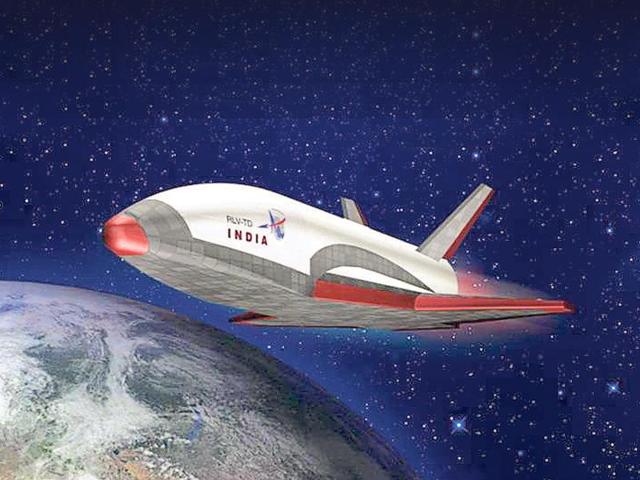
Re-usable tech
The 6.5-metre Reusable Launch Vehicle — Technology Demonstrator (RLV-TD) — weighed about 1.7 tons. Built over five years by a team of 600 scientists, the project cost around Rs 95 crore.
State-run Indian Space Research Organisation (Isro) used a mini-rocket with a booster to fly the winged reusable launch vehicle -- looking a lot like US space shuttles -- into lower earth orbit to demonstrate the feasability of the technology.
“Mission accomplished successfully,” an Isro spokesman said soon after RLV-TD HEX-01 was flight tested with the take-off at 7am.
Read | India’s very own space shuttle launched successfully by Isro
10 minutes is all it takes
This is the first time Isro has launched a winged flight vehicle, which glided back onto a virtual runway in the Bay of Bengal, some 500 kilometres from the coast.
Known as hypersonic flight experiment, it was about 10 minute mission from liftoff to splashdown.
The RLV-TD is a scaled-down model of the reusable launch vehicle.
{{/usCountry}}The RLV-TD is a scaled-down model of the reusable launch vehicle.
{{/usCountry}}It is a series of demonstration missions considered a first step towards realising a two stage to orbit (TSTO) fully re-usable vehicle, which is 10 to 15 years away
A money-saver
Dubbed as India’s own space shuttle, RLVs are being seen as the unanimous solution towards achieving low cost, reliable and on-demandspace access.
The successful launch is expected to cut cost of launching rockets for carrying satellites by 10 times as competition mounts in the burgeoning commercial space launch industry.
On an average, space agencies worldwide spend around $20,000 to make and use medium-to-heavy weight rockets to launch satellites
Nearly 70% cost of a launch vehicle lies in its structure and avionics. RLVs are ideal to cut costs as they can be recovered, refurbished and of course, reused.
The other players
Nasa grounded its space shuttle programme in 2011 after using its reusable vehicles such as Discovery, Endeavor, Columbia and Challenger for over three decades to launch various missions, including the International Space Station (ISS) and the Hubble telescope.
Billionaire entrepreneur Elon Musk and his privately owned Space Exploration Technologies are leading the quest for a cheaper and reusable rocket.
In April, SpaceX blasted off Falcon 9 rocket to the International Space Station and its reusable main-stage booster landed on an ocean platform minutes later in a dramatic spaceflight first.