Prime Minister Narendra Modi on Sunday suggested a multi-pronged approach for combating international terrorism – ending sanctuaries and cutting off funding for terrorists while working within societies to wean youngsters away from extremism.
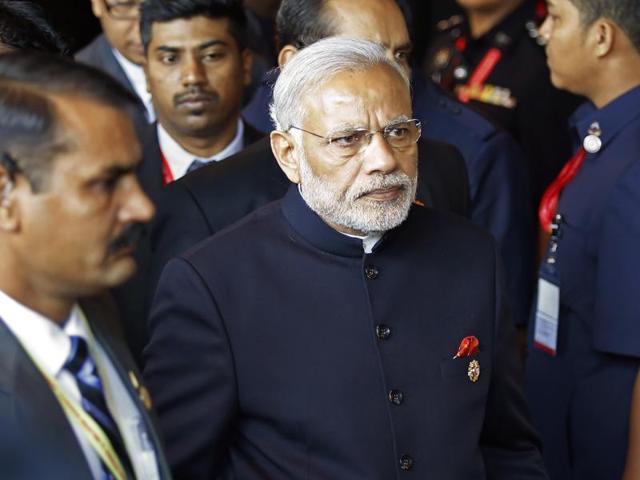
Making an intervention at the East Asia Summit in the Malaysian capital, Modi said terrorism is “no longer a peripheral problem” for the region and the recent assaults in Paris and Ankara have demonstrated that terror groups had a worldwide reach, both for recruiting members and choosing targets.
Modi reiterated his calls made at the recent G20 Summit in Turkey and the ASEAN-India Summit in Kuala Lumpur on Saturday for coordinated action against international terrorism while delinking it from religion.
“We must build new global resolve and new strategies for combating terrorism, without balancing it against political considerations,” he told the summit chaired by his Malaysian counterpart Najib Razak.
“No country should use or support terrorism. There is no distinction between groups. There are no sanctuaries. There are no funds. There is no access to arms. But we also have to work within our societies and with our youth.
“I welcome the commitment to delink religion from terrorism and the efforts to promote human values that define every faith.”
{{/usCountry}}“I welcome the commitment to delink religion from terrorism and the efforts to promote human values that define every faith.”
{{/usCountry}}Terrorism, he said, is no longer a peripheral problem for the region because its shadow stretches across the world.
“In this forum, we often thought of terrorism as a peripheral problem for the region. The barbaric terrorist strikes in Paris, Ankara, Beirut, Mali and on the Russian aircraft is a stark reminder that its shadow stretches across our societies and our world, both in recruitment and choice of targets,” he added.
Modi described the East Asia Summit as a “historic” gathering and applauded ASEAN members for realising the vision of the ASEAN Economic Community and for charting the path to 2025.
“Since my government entered office, no region has seen greater engagement than the Asia Pacific and the Indian Ocean Region,” he said. “The world still looks to the region to address our global challenges. The East Asia Summit is the key forum to shaping our collective future.”
Modi also listed five elements for making the 21st century an “Asian Century”, a theme he has addressed several times since he arrived in Malaysia on Saturday.
The countries of the region should support a regional architecture for security cooperation that is inclusive, balanced, transparent and open, he said.
The oceans should be a “pathway to peace and prosperity”, and India shares ASEAN’s commitment to freedom of navigation, over-flight and unimpeded commerce in line with accepted principles of international law, he added.
The ASEAN nations and East Asia Summit partners should forge stronger cooperation in non-proliferation, cyber-security and outer space, Modi said.
The countries should also work for the early conclusion of the Regional Comprehensive Economic Partnership negotiations and development cooperation should be “at the heart” of the East Asia Summit grouping, he said.
Read
ASEAN creates new economic community that’s larger than EU
ASEAN Summit: PM Modi calls for enhancing counter-terror cooperation