E-Paper



Number Theory: What's behind RBI's decision to hold rates
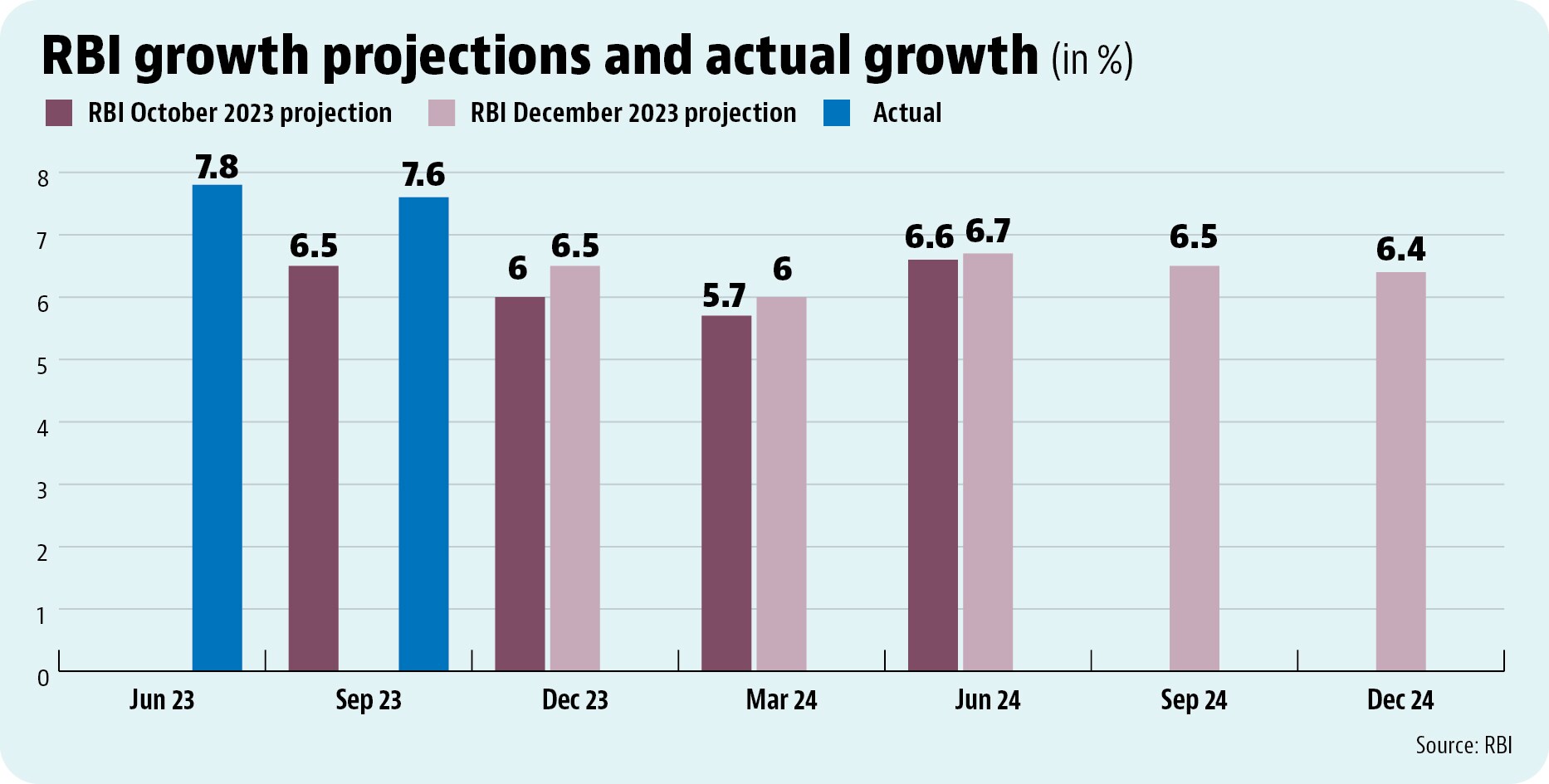
MPC’s latest GDP growth projections for quarters ending December 2023 and March 2024 now stand at 6.5% and 6% compared to 6% and 5.7% projections in its October
Updated on: Dec 9, 2023, 11:32:02 IST

 Prefer HTon Google
Share via


Copy link

The Monetary Policy Committee (MPC) of the Reserve Bank of India has not made any change to the basic contours of monetary policy in its last meeting for 2023. The policy rate has been retained at 6.5% and the stance of monetary policy continues to be focused on withdrawal of accommodation. Both of these decisions are in line with expectations. Here are three charts which explain the rationale behind the MPC’s course.
Economic growth is expected to be much better even for the rest of 2023-24
 RBI growth projections and actual growthMPC’s basic mandate, under India’s inflation targeting framework, is to maintain a balance between growth and inflation. The former, as far as the MPC sees it at the moment, does not seem to be a problem at all. A stronger-than-expected GDP growth in the quarter ending September 2023 – it came at 7.6% compared to 6.5% and 6.8% projections by RBI and a Bloomberg poll respectively – was expected to lead to an upward revision in the RBI’s growth projection for 2023-24. The MPC’s latest resolution shows that not only has RBI made up for having underestimated India’s growth rate in the first half of the year but also expects the Indian economy to do much better than what it was expecting in the second half of 2023-24. MPC’s latest GDP growth projections for the quarters ending December 2023 and March 2024 now stand at 6.5% and 6% compared to 6% and 5.7% projections in its October resolution. This has led to an upward revision in the 2023-24 GDP forecast from 6.5% to 7%. With growth rate expected to be strong until December 2024, the MPC sees no reason to be concerned about whether or not its anti-inflation stance is hurting economic activity.
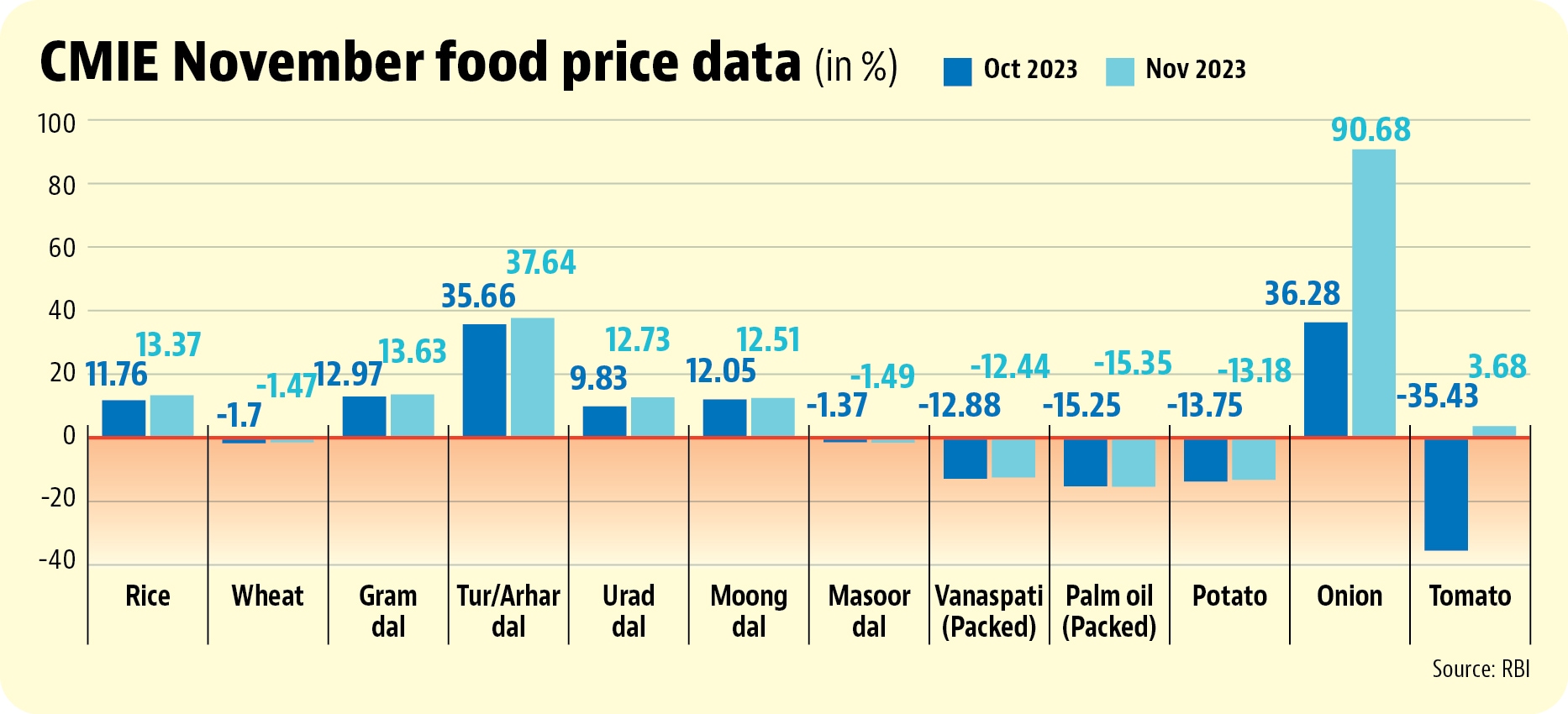
November and December might see food inflation tailwinds to the headline inflation number
- CMIE November food price dataWhile India’s benchmark inflation rate, as measured by the Consumer Price Index (CPI) has fallen significantly from 7.4% in July to just 4.9% in October, a lot of the relief was on account of moderation in food inflation, even though it is above comfort levels. Food and non-food components of the CPI basket saw their inflation prints falling from 11.8% to 6.6% and 4.8% to 3.7% between July and October 2023. Food items account for 39% of the overall CPI basket. High-frequency price data from the Centre for Monitoring Indian Economy (CMIE) database shows that food prices might lead to a jump in the headline inflation number in the months of November and December due to a pick-up in inflation for rice, onions and some varieties of pulses. Analysts are echoing a similar sentiment. “We estimate that CPI inflation rose in November to 6.15% y/y, a sharp reversal from the moderating trajectory over the past couple of months (October: 4.9%, September: 5%). The rise will be driven primarily by higher food inflation, where the rise in vegetable prices (onions, tomatoes) and persistence in few non-perishable items (pulses, in particular) will likely pressure the headline,” Rahul Bajoria, MD and head of EM Asia (ex-China) Economics, Barclays, said in a November inflation preview noted issued on December 6. Bajoria’s December 8 note adds that headline CPI will be “possibly” be higher than 6% in December as well. While there is not much RBI can do to control food prices, its hawkish tone on the volatility this brings to the headline inflation number and more importantly, inflation expectations, can be described as an attempt to buttress its own inflation targeting credentials, and more importantly, signal to the fiscal arm of economic policy that it must do what it can to control the situation by supply-side management.
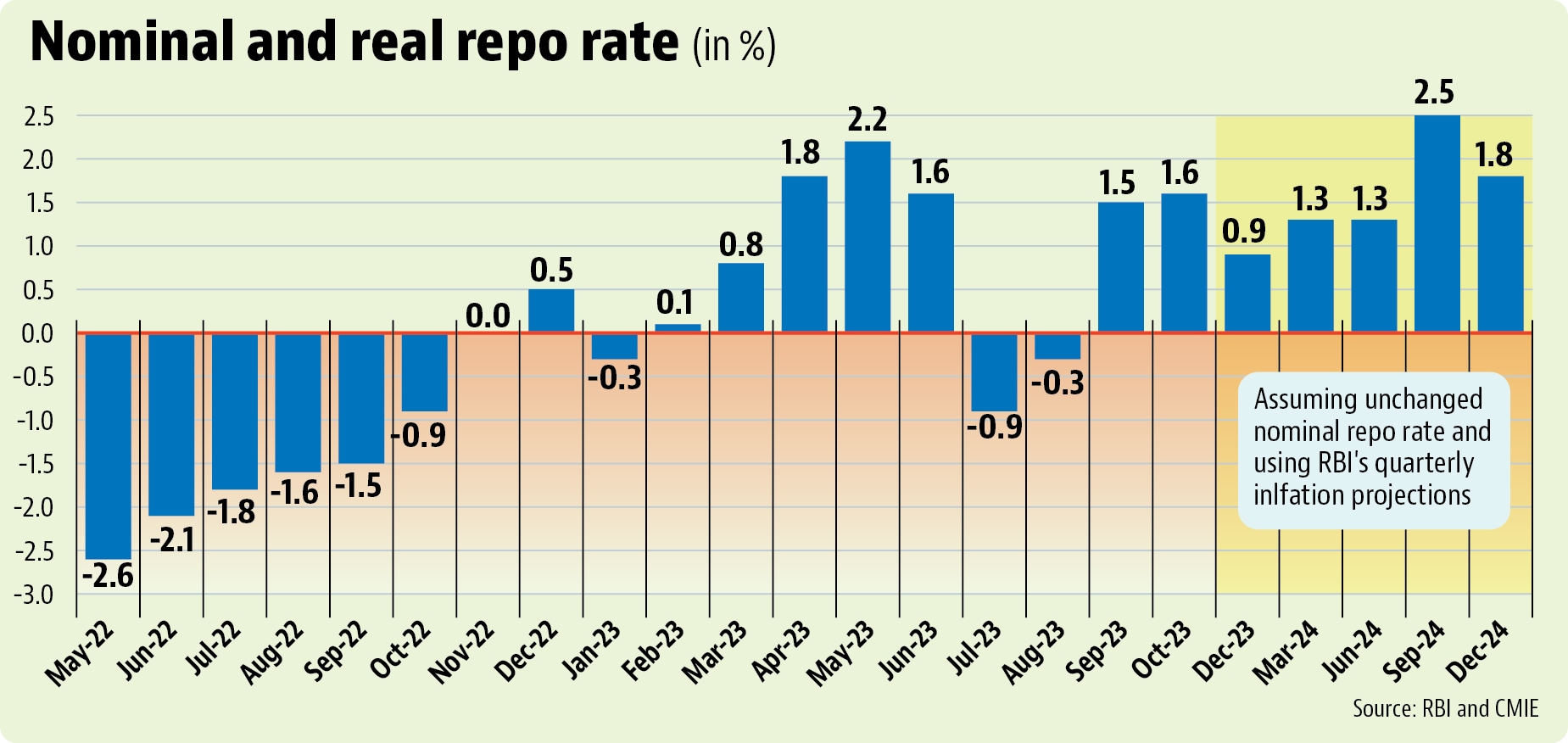
The question of real interest rates
- Nominal and real repo rateWhile the nominal repo rate has been kept unchanged at 6.5% since February 2023, the real rate varies with changes in the inflation rate. An examination of real rates since May 2022, which is when the MPC started raising rates, shows that they reached a peak of 2.2% in May 2023, came in negative territory when inflation increased for a while, and have risen again to 1.6% in October 2023, the latest month for which inflation data is available. If RBI’s inflation projections hold, and the nominal repo rate remains where it is at the moment, the real rate will increase to 2.5% in the quarter ending September 2024. This is exactly why analysts are expecting RBI to begin cutting rates in the second half of the next fiscal. “The MPC members have often expressed comfort on a real rate of around 1.0%. If inflation does glide down to ~4.5% levels by next year, the 6.50% nominal repo rate would likely result in a real rate of close to ~2.0% – which would be restrictive in times of a growth slowdown. Hence, we stick to our view that the RBI will deliver 100bp of rate cuts cumulatively starting in August. We expect 75bp in rate cuts in 2024 and another 25bp in Q1 2025, with risks skewed towards earlier cuts,” Nomura economists Sonal Varma and Aurodeep Nandi said in a note.