With increasing territorial disputes because of space crunch in wildlife habitats, tigers at Ranthambore Tiger Reserve (RTR) in Rajasthan’s Sawai Madhopur are moving to new areas on their own, officials said.
RTR’s male tiger, T-91, was relocated to Mukundara Hills Tiger Reserve (MHTR) in Kota early this month. Exploring new territories, the tiger was living in the peripheral forests near Bundi for the last few months. In India’s first relocation of big cats to decongest a wildlife habitat, the state forest department shifted the tiger to MHTR, a protected location.
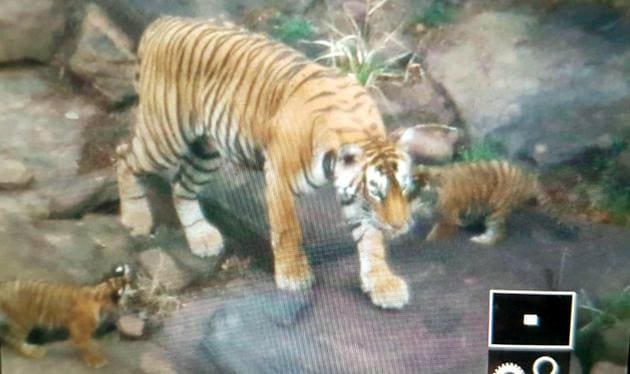
On Saturday, Village Wildlife Volunteers working at RTR have reported that a tigress has given birth to two cubs in Keladevi sanctuary. With the two cubs, the tiger population at RTR has reached 70, officials said. The reserve had around 14-18 tigers in 1973.
“After three decades, tiger cubs are born in Mandrael area of Keladevi sanctuary in Karauli district, which is part of RTR. Four-and-a-half-year old tigress T-92, daughter of T-11, has given birth to two cubs -- T-24 (male) and T-39 (female) – after mating with T-72,” said YK Sahu, field director, Ranthambore Tiger Project, Sawai Madhopur.
Sahu said T-72 migrated from Sultanpur area of Ranthambhore to Mandreal, when he was threatened by T-24. “There are two cubs, about three and half months old. These cubs and tiger movement have been reported by the Village Wildlife Volunteers.”
{{/usCountry}}Sahu said T-72 migrated from Sultanpur area of Ranthambhore to Mandreal, when he was threatened by T-24. “There are two cubs, about three and half months old. These cubs and tiger movement have been reported by the Village Wildlife Volunteers.”
{{/usCountry}}In 1983-84, Sawai Mansingh and Kailadevi sanctuaries were included in RTR for tiger conservation, but they remained unexplored by big cats. In 2016-17, four tigers -- T-80 (M), 47 (M), 72 (M) and 92 (F) -- made movements in Kaildevi area, and two cubs were born from T-72 and 92.
T-72 visited Jhiri forest area in Dholpur, adjoining district to Karauli, twice in 2017. Tigers are exploring new territories in a natural manner, Sahu said.
“Even T-91, which was recently shifted, had reached very close to MHTR and was just assisted to the protected areas by the forest department as it was in a hostile environment.”
The tiger had reached Taleda forest area, which was around 35km from MHTR, but returned as it couldn’t find its way further. In 2010, a tiger reached Sultanpur area in Kota and died due to natural causes; another tiger, Broken Tail, migrated to MHTR and died in a rail accident.
“Migration and repopulation of tigers are happening in a natural manner, which was the objective of the Project Tiger – developing a network of protected areas, which act as source areas,” said Sahu.
Territorial disputes are rising with increasing tiger population in Rajasthan and reducing space. Normally, a tiger demarcates 10-12 square km as its territory not allowing a rival to enter.
‘Lightning’ spotted with two cubs
In April this year, Ranthambore tigress, T-83 aka ‘Lightning’, was spotted with two cubs. She is granddaughter of India’s most iconic and endearing big cat, Machhli, which died of old age in August 2016. In February-end, ‘Lightning’ and sister ‘Arrow head’ (T-84) were spotted with two cubs.
.