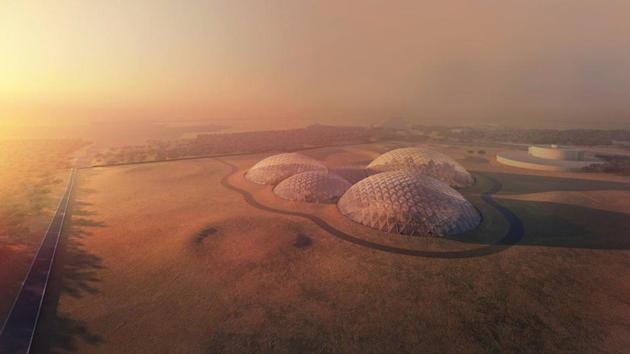
The “city,” revealed this week by the United Arab Emirates government, will be made up of a series of futuristic domes, whose walls will be 3D-printed using Emirati desert sand. Laboratories for food, energy and water will simulate the terrain and conditions on Mars using heat and radiation insulation as well as 3D-printing technology.
A museum is also planned for the Science City and will display humanity’s space achievements alongside education areas for young visitors. The project is part of the UAE’s Mars 2117 strategy, which aims to build a settlement on Mars in the next 100 years, according to the government’s announcement.
Plans for the Science City include an experiment in which a team will live in the simulated city for a year. While addressing questions about self-sufficiency and sustaining life in a hostile environment, the project also aims to address challenges on earth related to food, water and energy security.
{{/usCountry}}Plans for the Science City include an experiment in which a team will live in the simulated city for a year. While addressing questions about self-sufficiency and sustaining life in a hostile environment, the project also aims to address challenges on earth related to food, water and energy security.
{{/usCountry}}Bjarke Ingels Group (BIG) is behind the design. Its architects are set to collaborate with a team of Emirati scientists, engineers and designers on the project, for which a timeline has yet to be revealed.
Follow @htlifeandstyle for more
Catch your daily dose of Fashion, Taylor Swift, Health, Festivals, Travel, Relationship, Recipe and all the other Latest Lifestyle News on Hindustan Times Website and APPs.
Catch your daily dose of Fashion, Taylor Swift, Health, Festivals, Travel, Relationship, Recipe and all the other Latest Lifestyle News on Hindustan Times Website and APPs.