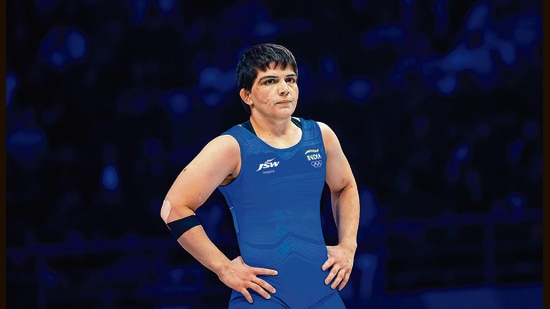
Indian women’s wrestling took a leap forward at the Wrestling World Championships that concluded on November 1, with a record-breaking performance that included the making of our first women’s world champion, a best-ever haul of four medals (a gold, two silvers and a bronze), and a fifth-place finish among 24 countries, our best standing ever at this event.
All four medallists are (no prizes for guessing this) from Haryana, a state where, two decades ago, women were not allowed into
Indian women’s wrestling took a leap forward at the Wrestling World Championships that concluded on November 1, with a record-breaking performance that included the making of our first women’s world champion, a best-ever haul of four medals (a gold, two silvers and a bronze), and a fifth-place finish among 24 countries, our best standing ever at this event.
All four medallists are (no prizes for guessing this) from Haryana, a state where, two decades ago, women were not allowed into wrestling akhadas, and were largely barred from attending a dangal or bout.
All that changed in 2016, when Sakshi Malik, then 23, became the first Indian woman to win an Olympic medal (a bronze) in the sport.
She had been one of a handful to defy Haryana’s strictly enforced patriarchal norms around this sport. If the state is now a changed place when it comes to this arena, much of the credit goes to women like her, Geeta Phogat, Babita Kumari, Suman Kundu, Alka Tomar and Vinesh Phogat.
After all, kushti is integral to the culture of Haryana. When these women breached the sport’s all-male bounds, and then began to win internationally, it captured the cultural imagination.
The film Dangal (2016; Aamir Khan, Sanya Malhotra, Fatima Sana Shaikh) told this story for the screen, and gave the movement a catchphrase that summed up the challenge: “Mhari chhoriya chhoro se kam hai ke? (Are my girls any less than your boys?).”
Ten years later, it might be time for a sequel. If Dangal was about the Phogat family’s social battle to open the doors of this sport to women, Dangal 2 could trace how a subsequent generation has become a global powerhouse of the sport.
It could include the story of new world champion Manisha Bhanwala, at 29, a veteran of the dangal scene. She comes from a sporting family in Jind: her brother is a national-level kabaddi player, her sister-in-law is a wrestler. Her father, a farmer, introduced her to the sport.
In 2022, the morning she was due to leave for the Asian Wrestling Championships in Mongolia, her father died of a heart attack. He would have wanted you to keep going, her family said; so she did. She returned with her first international medal, a bronze. It was the beginning of a run that saw her win three more at the Asian championships, in 2023, ’24 and ’25, and now a gold at this year’s Worlds. There, she celebrated by holding up a T-shirt with a photograph of her father on it.
India’s only other world champion in wrestling, the male double-Olympic-medallist Sushil Kumar, won the world title in 2010. Among the women, only Anshu Malik had reached a world championship final before this year; she won silver in 2021.
Of the three finalists this year, Neelam Sirohi ended up facing the greatest woman wrestler of all time, Yui Susaki, and was crushed as the Japanese Olympic champion marched on to her fifth world title. Susaki has only been beaten once in her senior career, by Vinesh Phogat, at the Tokyo Olympics in 2021.
The third Indian finalist, 18-year-old Kajal Dhochak, lost a closely fought bout.
Antim Panghal, one of the best in the country for the past few years, was out injured this year. Vinesh Phogat is on the comeback trail. If the entire group can make it to the LA Olympics in 2028, India’s women could seriously dominate.
(Email Rudraneil Sengupta on rudraneil@gmail.com. The views expressed are personal)
One Subscription.
Get 360° coverage—from daily headlines
to 100 year archives.
Archives
HT App & Website