
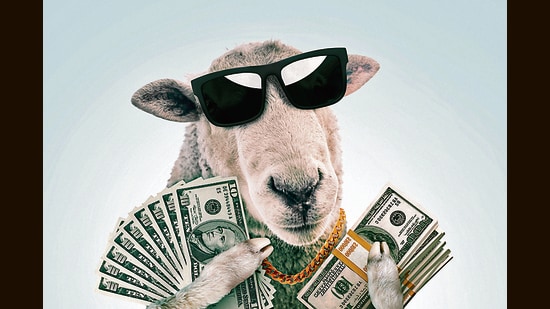
Fetti, pasta, lobster, watermelon. That sounds like a weird recipe, but it’s really a collection of slang terms and popular nicknames, for money. It’s a list that I find endlessly fascinating, made more so by how rapidly the list evolves. And how even the most familiar terms have intriguing histories.
Moolah, for instance, is believed to come from ancient versions of “mool”, which in languages ranging from Gaelic and Sanskrit to Spanish and Romanian, means “value”.
Bread and dough are
Fetti, pasta, lobster, watermelon. That sounds like a weird recipe, but it’s really a collection of slang terms and popular nicknames, for money. It’s a list that I find endlessly fascinating, made more so by how rapidly the list evolves. And how even the most familiar terms have intriguing histories.
Moolah, for instance, is believed to come from ancient versions of “mool”, which in languages ranging from Gaelic and Sanskrit to Spanish and Romanian, means “value”.
Bread and dough are obvious: the idea of the breadwinner, and staple foods — the most essential commodity one could buy — became a term for the notes themselves.
A lot of contemporary English slang around money is drawn from hip-hop culture, which has for decades been finding new ways to sing about oppression, and success. Here, a hundred-dollar bill is a C-note (the C referring to the Roman numeral for 100). A whole lot of dollars is “guap”, from the Spanish “guapo” for handsome or pretty; so, a pretty penny.
A thousand dollars, meanwhile, is a “band”, from the paper bands used to tie notes together in such bundles. And an absolute windfall is “fetti”, from “confetti”, and the very rap-video idea of notes falling down like rain.
Around the world, food remains a common reference point.
Money, in Spanish slang, is pasta; in French, it is blé or wheat; and in Italy, grana or grain. This is mainly because healthy food stores were the original measure of wealth. In Mexico, in the same spirit, money is also called lana or wool.
Australia, with its colourful notes and even more colourful slang, has an array of distinct nicknames. The pink five-dollar is a “prawn”, the 10-dollar note a “blue swimmer” (named for the popular and delicious flower crab); the red 20-dollar is a “lobster”; the yellow 50-dollar, a “pineapple”; and the green 100-dollar note, a “watermelon”.
Perhaps the best nicknames for money, though, are two terms so widely used, we barely think about where they come from, and yet each has an evocative story.
“Buck”, for one US dollar, can be traced to the 18th-century fur trade, when deerskins or buckskins were used in lieu of currency, particularly in remote areas where trapping and hunting were far more prevalent than banks. A single skin was considered the equivalent of $1. Hence, “buck”.
Likewise, the term “quid” for £1 is thought to be traceable to the Latin “quid pro quo”, meaning, quite simply, a thing exchanged for something else of equal value.
(Adam Jacot de Boinod is author of The Meaning of Tingo. The views expressed are personal)
One Subscription.
Get 360° coverage—from daily headlines
to 100 year archives.
Archives
HT App & Website