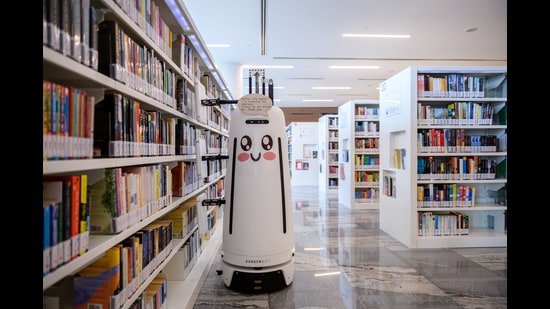
At first glance, libraries haven’t changed much. They still have shelves, reading nooks and that familiar quietude of heads buried deep in pages, but with a few significant plot twists.
Robots trundle between rows of books to deliver readers their requested titles. Artificial intelligence-guided “librarians” answer questions or offer recommendations, while invisible sensors quietly adjust the lighting and the temperature of reading nooks.
Versions of this sci-fi dream are already playing out across the world.
*Visitors walking into a reading
At first glance, libraries haven’t changed much. They still have shelves, reading nooks and that familiar quietude of heads buried deep in pages, but with a few significant plot twists.
Robots trundle between rows of books to deliver readers their requested titles. Artificial intelligence-guided “librarians” answer questions or offer recommendations, while invisible sensors quietly adjust the lighting and the temperature of reading nooks.
Versions of this sci-fi dream are already playing out across the world.
*Visitors walking into a reading room in Changning District Library in Shanghai, China are greeted by Xin Ye, a digital human avatar on a screen. The AI-powered virtual assistant can scan members’ faces or library cards; sift through their borrowing records to pick out books they’d possibly enjoy; book a suitable seat for them; and even have a robot deliver the titles to their seats.
*In the country’s capital, the 75,000-sqm Beijing Library is fashioned like a giant ginkgo tree – a 290 million-year-old species native to China. Its automated storage and retrieval system can plod through its collection of over 8 million books to deliver a reader’s chosen title in less than 15 minutes. The library’s interiors, designed like rolling hills, have sensor-enabled columns that can regulate climate, lighting and acoustics, as well as harvest rainwater.
*Meanwhile, book-delivering robots have roamed the halls of the National Library of Public Information (NLPI) in Taiwan for about a decade. In 2023, the country’s first generative-AI-guided “librarian” stepped in to help the staff. Called Xiao-Shu (meaning well-versed in Chinese), it appears on a screen in human avatar and offers reader consultation, book recommendations and sometimes just a friendly chat.
*At Singapore’s National Library Board-operated libraries, shelf-reading robots have been helping the staff solve a notoriously familiar problem: spotting misplaced books.
Every night, the robot paces up and down to scan books – equipped with RFID (Radio-Frequency Identification) chips – to make sure they’re in the right place and in the right order. By morning, it delivers a report to the library staff about titles that are out of place, saving up to 3,500 staff hours per year. Most of the 28 libraries within the network also have auto-sorting machines that whisk returned books via a system of slick conveyor belts to their designated spots.
Across the world, libraries are gradually adopting or experimenting with AI, machine language, national language programmes and other technological interventions to make storing, cataloguing, curating collections, as well as borrowing and reading easier.
What does that mean for the idea of this institution that has traditionally served not just as a repository of knowledge, but also a safe space for privacy, plurality, democracy and discovery?
We’ll come to that in a bit. First, a quick recap.
TECH TURNS
Libraries have reinvented themselves through ages, by responding to changing technology.
Across millennia, librarians have confronted essentially the same problem: how does one make the overwhelming amount of human knowledge stored in books easily accessible ?
At the oldest known library, in the royal palace of the Assyrian king, Ashurbanipal, in 7th-century BCE Iraq, some of the earliest attempts to answer that question began.
Administrative accounts, mathematical, medical and literary texts were organised and preserved on clay tablet catalogues.
Over time, these catalogues shapeshifted to include papyrus scrolls by the 3rd century BCE in Egypt, and then codex – handwritten and handbound stacked sheets of paper – in the Middle Ages.
Organisation systems over time included grouping books by size, acquisition date, fixed location on the shelves.
More than a millennium later, as books became cheaper and more plentiful, libraries needed better ways to keep track of rapidly growing collections.
A breakthrough arrived with American librarian Melvil Dewey’s classification system. First published in 1876, it offered a simple solution: group books by subject and assign them numbers, printed on the spines, making them easier to organise and find.
Card catalogues, reflecting the name of the book, author, subject and number, complemented this system, by functioning as a sort of search engine. Instead of wandering about the shelves, librarians could quickly look up the card corresponding to each book to locate it.
By the ‘60s and ’70s, computers began speeding things up.
American computer programmer Henriette Avram’s MARC (Machine-Readable Cataloging) rendered catalogue records readable and shareable by computers. So, libraries no longer had to catalogue the same book from scratch; a record created by one library could be used by another.
Electronic catalogues eventually replaced drawer cards altogether. Readers could search thousands of titles in seconds by author, subject or keyword, and later do so from home, too via library apps or websites. Barcodes and RFID, meanwhile, accelerated the process of borrowing, returns and stock-taking.
And digital databases of journals, books, magazines unlocked access to material far beyond the reach of physical shelves.
While some readers enjoy spending an hour wandering through shelves, others may want to locate a book within minutes, points out Surjodoy Chatterjee, head of information and library, Goethe-Institut / Max Mueller Bhavan, Kolkata. “Neither is necessarily the superior library experience. The system should serve every type of reader,” he adds.
That library, like many others across the world, uses an app that allows readers to scan through their collection, reserve titles, collect them and return them via a self-service station.
BOT TWIST
The more interesting conundrum centres around what libraries are asking AI to optimise.
Is it workflow, organisation, storage and retrieval, or something more human, such as recommendation?
Libraries such as the ones in China and Taiwan are already experimenting with the idea of AI librarians.
Algorithm-driven recommendation systems that draw on one’s past likes, dislikes or borrowing data are good at giving us more of what we already like.
However, a library has another function: introducing us to books we never knew we wanted to read. After all, how often do we walk into the library looking for a cosy dramatic read, only to leave, after a librarian’s recommendation, with a thrilling piece of historical fiction, or poetry?
If libraries made information accessible, the internet, and now generative AI, has made it abundant. The challenge at hand is identifying what to trust.
Libraries will continue to play a central role in media and digital literacy, helping readers separate fact from fiction, spotting loopholes and accurately tracing a claim back to its source, says Lotta Muurinen, director of regional library services, City of Helsinki, Finland.
They will also function as a safe haven from digital spaces, adds Noora Hirvonen, professor, information studies, University of Oulu, Finland. “As technology and the digital world saturate our lives, libraries, much like parks, will be crucial – organised as they are around reading, culture, civic participation, community and encounters with other people who may or may not share the same worldviews as us,” she adds.
This is essential as more of us increasingly get locked in our own bubbles, where we seek and receive information that confirms our beliefs, no matter what they are.
RETAINING THE JOY
Getting that balance right will require guardrails, especially around privacy.
Libraries have traditionally offered considerable privacy around what somebody chooses to read.
Algorithmic systems, on the other hand, operate differently. The more the system knows about your searches, borrowing history and behaviour, the better it can predict what you want next, says Kashyap Kompella, a tech industry analyst and author.
Data privacy is one of the major reasons why libraries across Finland are still evaluating integrating AI into their workflow, even as others around the world, in the US, Canada, Australia, China are experimenting with it.
Then there is the question of how much efficiency is too much efficiency?
Searching a database is faster than wandering down rows of books. An AI summary, prompted by just a word or two, is even faster.
But speed and efficiency can come at the cost of something more valuable.
The unexpected book waiting on the next shelf. A sudden conversation that shifts perspectives. A rare space to simply be.
One Subscription.
Get 360° coverage—from daily headlines
to 100 year archives.
Archives
HT App & Website