What did it take to bring the wizarding world to life on screen? From a meticulous map of Hogwarts and Hogsmeade drawn by JK Rowling to nearly-600 sets crafted over the course of 10 years, take a look.
* Harry, then and now: The search for the boy wizard began before Harry Potter and the Philosopher’s Stone (2001) had a director attached. The team reportedly went through 1,000 audition tapes, and hundreds of callbacks.
Then producer David Heyman ran into
What did it take to bring the wizarding world to life on screen? From a meticulous map of Hogwarts and Hogsmeade drawn by JK Rowling to nearly-600 sets crafted over the course of 10 years, take a look.
* Harry, then and now: The search for the boy wizard began before Harry Potter and the Philosopher’s Stone (2001) had a director attached. The team reportedly went through 1,000 audition tapes, and hundreds of callbacks.
Then producer David Heyman ran into Daniel Radcliffe, aged 10, at a theatre.
The child had already starred in the BBC adaptation of David Copperfield (1999) and made his film debut in The Tailor of Panama (2001). Director Chris Columbus saw a clip of him as Copperfield and was sold.
Radcliffe’s parents were initially unsure about committing to a franchise of this scale, but agreed to a screen test.
The films would upend his life in a range of ways. The level of fame he immediately gained made staying in school unfeasible; he faced intense attention and some hostility, when he tried it. Instead, he studied on set with private tutors.
Playing the boy wizard until he was 21 likely contributed to the dramatic break from fantasy fiction that followed, as he shrugged off the cloak and went avant-garde instead.
Now 37, Radcliffe has talked about how his earnings from the films mean he doesn’t have to work. This leaves him free to pick only projects that fascinate him. These have included a Broadway musical for which he won a Tony award; a role as a flatulent corpse; and a turn as Weird Al Yankovic, in a 2022 biopic that won him a BAFTA nomination and a Critics’ Choice Award.
* The golden trio: Amid a country-wide search in the UK, Emma Watson and Rupert Grint found their way into the Harry Potter films in arcs that rather mirror their characters’ stories.
Watson, then nine, had no professional acting experience. It was her school’s theatre teacher who suggested she submit an entry.
Grint, an ardent fan of the books and desperate to stand out, sent in a rap-video audition tape that pleaded: “Hello there my name is Rupert Grint / I hope you like this and don’t think I stink.”
Watson has since shone in films such as Little Women (2019), The Perks of Being a Wallflower (2012), My Week with Marilyn (2011), and the live-action musical Beauty and the Beast (2017). She pursued creative writing at Oxford university and has become a globally recognised advocate of women’s rights, climate action, and sustainable fashion.
Since the films, Grint has explored far-darker roles, including in the psychological horror series Servant (2019-2023) and this year’s horror release Nightborn. Now a father of two, he is set to play Ron Weasley again next year, in a Broadway production of Harry Potter and the Cursed Child, set 19 years after the last book.
* Recreating the magic: Despite the scale of the books, sets, rather than green screens, were used as extensively as possible, in the making of the films.
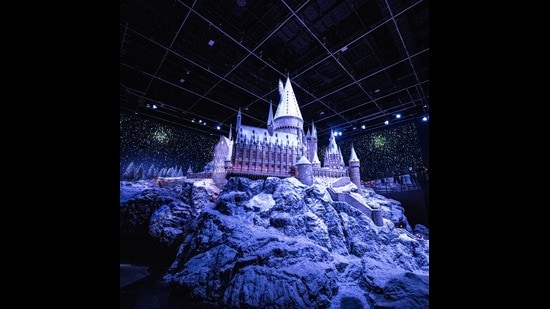
Several scenes set within Hogwarts, for instance, were shot in cathedrals and castles across England and Scotland. Exterior shots zoomed in on an intricately detailed scale model, 50 ft wide, that featured real electric lights in the hallways, lanterns and torches; real gravel and plants; miniature trees, even greenhouses, an owlery and a boathouse.
The model was updated through the making of the films, and is now part of the Making of Harry Potter Warner Bros Studio Tour in London.
* A living, breathing world: It helped that Rowling, who was consulted extensively, particularly on the early films, had such a sense of the world she had built that she drew a map of Hogwarts for Stuart Craig, who headed production design on the films, while they were chatting in a hotel lobby.
It included the lake, forest, station, and the road winding through the village. “I was still referring to that map 10 years later, on the eighth film,” Craig told The Guardian in 2011.
Together, the production teams would eventually create 588 sets, 40 editions of the wizarding world newspaper The Daily Prophet (each copy stained with a bit of coffee and left to dry for that wrinkled effect), hundreds of portraits for the Hogwarts walls (some reportedly featuring members of the crew), several versions of the Invisibility Cloak, and painstakingly handwritten Hogwarts acceptance letters, among several other details large and small.
Many of the potion bottles, for instance, have intricate labels listing their ingredients.
In a measure of their emotional investment, Craig said in interviews that the “severest critics” of the films were children.
Speaking at the London theme park in 2012, he recalled how a little girl visiting one of his sets saw a version of Hagrid’s hut and said: “This is wrong! This can’t be Hagrid’s hut. This is made of stone and Hagrid’s hut catches fire!”
Craig explained that it was just a version, meant for use in certain scenes. He took her inside to show her interiors made entirely of timber, but isn’t sure she was convinced. “It was a lesson,” he said in the interview, that with these films, “it is the children who tell you whether you got it right or not.”
.
MISCHIEF MANAGED: Potter by the numbers
* 500: hardback copies and about 5,150 paperbacks were all that printed in the first run of the first book, Harry Potter and the Philosopher’s Stone (1997).
* 8.5 million: copies were printed in the first run of JK Rowling’s fifth book in the series, Harry Potter and the Order of the Phoenix (2003). It was the largest first-edition print run ever, at the time. Rowling broke her own record a few years later, with Harry Potter and the Deathly Hallows (2007), which had an initial print run of 12 million copies.
* 600 million+: copies of the seven core Harry Potter novels have sold, in all, as of 2023.
* 12: publishers rejected Harry Potter and the Philosopher’s Stone, before it was accepted by Bloomsbury.
* $216,000: is the price a hardback first-edition copy of the first book fetched at auction, in 2024. Few are in personal collection; most are owned by libraries.
* $7.7 billion: is the combined revenue earned by the eight Harry Potter films, worldwide, at the box office.
* 588 sets: ranging from built-to-scale towers and turrets representing Hogwarts and streets such as Diagon Alley, to a small-scale model of the school of magic, were created at the Warner Bros Studios Leavesden in the UK, over the course of 10 years.
* 160: pairs of prop eyeglasses and 80 wands were used by Daniel Radcliffe through the eight films. Some of these have been auctioned for Rowling’s charity, Lumos, which works for orphan welfare, and have fetched as much as $50,000.
One Subscription.
Get 360° coverage—from daily headlines
to 100 year archives.
Archives
HT App & Website