
The gourd of the traditional tanpura is still often made from a hollowed-out pumpkin.
But scores of musical instruments have lost their sustainable roots. Not many drums are wrapped in animal hide; they tend to use plastics and synthetic polymers instead. String instruments use synthetic materials too.
Meanwhile, about 2.6 million guitars are produced annually in the US alone. Those that aren’t made from plastics use rare woods (mainly mahogany, ebony and rosewood), in a process that involves tremendous amounts
The gourd of the traditional tanpura is still often made from a hollowed-out pumpkin.
But scores of musical instruments have lost their sustainable roots. Not many drums are wrapped in animal hide; they tend to use plastics and synthetic polymers instead. String instruments use synthetic materials too.
Meanwhile, about 2.6 million guitars are produced annually in the US alone. Those that aren’t made from plastics use rare woods (mainly mahogany, ebony and rosewood), in a process that involves tremendous amounts of waste.
A handful of composers, researchers, and independent instrument-designers or luthiers are now working to create sustainable alternatives. These include guitars made of fish skin, corn husk and mycelium (the web of thread-like filaments in fungi); violins crafted from scrap that sound so good, they have been used alongside Stevie Wonder and Megadeth at rock concerts; and a flute made from wheelchair parts that has gone on tour with an orchestra. Take a look.
SCALES FOR THE FUTURE?
In Rhode Island, Rachel Rosenkrantz uses mycelium, fish skin and corn husk to make biodegradable guitars with a distinctly musical but rather unique twang. Her brand, Atelier Rosenkrantz, sells them in generic and bespoke versions.
For the industrial designer-turned-luthier, the aim was to try to grow resources rather than extract them, thus reducing the use of rare woods. She started by replacing the protective plastic veneer around the body of the guitar with treated fish skin.
She then began to use dehydrated mycelium to build a lightweight, biodegradable instrument, with dried fibres such as corn husk added to make it more rigid. The shell and neck are made from compressed paper and resin. Scraps of upcycled wood are used for the sides.
‘NEW SOUNDS FOR A NEW WORLD’
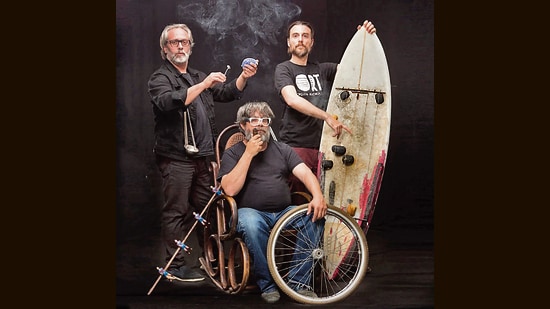
The Barcelona jazz band Orquesta Reusonica Trío plays a guitar made by fitting a surfboard with strings, a flute made from parts of a wheelchair, and a banjo made from a treated polystyrene box and elastic bands.
Rocco Papia (strings and vocals), Antonio Sanchez Barranco (percussion) and Xavi Lozano (wind instruments) have been touring Europe with their version of “world jazz” since 2019. They also run a programme called New Sounds for a New World, where they teach children how to recycle, on a smaller scale, in order to create instruments that work.
FROM SCRAP TO HEAVY METAL
The Recycled Orchestra of Cateura in Asuncion, Paraguay, is a group of children from a waste-recyclers’ settlement who have been trained to play instruments made from scrap gathered at the Cateura landfill.
The aim is to use music as a reminder that all things and all people have dignity and purpose. The motto of the initiative, accordingly, is: “The world sends us garbage and we send back music.”
The group was set up by Paraguayan musician, composer and orchestra director Luis Szaran, and music instructor Favio Chavez. Pipes, scrap metal and wood, even old shoes and x-ray scans are used as components of violins, flutes, guitars and cellos.
Szaran, who is also a music researcher, worked with Chavez to define how such materials could be used to generate appropriate sounds.
The orchestra has performed with Stevie Wonder (in 2015) and Megadeth (in 2013).
In 2015, a documentary titled Landfill Harmonic told their story. In June this year, a musical titled Basura (Spanish for Trash), based on that film, debuted on Broadway.
What could such instruments, together, do to the sound of music? What should we expect, if we move more definitively towards sustainable instruments?
As Papia of the Barcelona jazz trio has pointed out, humans once made musical instruments from bones.
“I think people can certainly get used to different sounds,” notes Australian composer and music producer Cornel Wilczek (best known for his experimental scores for films such as A24’s Bring Her Back [2025] and Talk To Me [2022]). “I have guitars made from plywood derived from recycled woods. They might not sound like traditional guitars but to me that is what makes them special.”
Since 2020, companies such as Verso in Germany have been making avant-garde electric guitars from metal rather than wood, he adds. “Design-wise that is quite significant, as it marks a reduction in a range of non-biodegradable materials.” This could be the future.
“A good cello player will tell you that the best instruments were made in Germany and Italy… in the 18th century,” Wilczek says. “But I have a cello with a really unique sound, made from recycled plastic. It’s light. I can carry it around without stress. And it helps me experiment.”
One Subscription.
Get 360° coverage—from daily headlines
to 100 year archives.
Archives
HT App & Website
ABOUT THE AUTHOR
Madhusree is a feature writer who loves Kolkata, is learning to love Mumbai. She loves to travel, write and bake