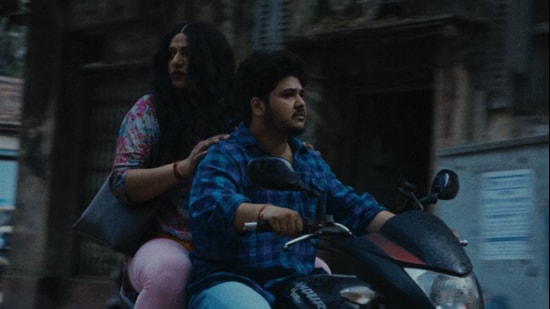
Kabir Maan, the 34-year-old actor who plays the titular role of Aman—a film that won the best short film award at the recently-concluded British Film Institute (BFI) Film Festival—speaks to Hindustan Times about the taboos of trans representation, how he almost didn’t make it to the film’s world premiere because of the difficulty he faced in getting a passport, and why livelihood remains a precarious issue for transgender people, including him. Edited excerpts.
Is this the first time you have acted in a film?
Yes, this is my debut film!
How did you come across this script and what did you think about it when you first came across it?
I’ve been working in the education and social sector since 2018. I first spoke to Rahul Roye (the director) in 2024. That was a particularly tough time for me. I was dealing with heartbreak while also struggling to transition and establish my teaching career. When Rahul reached out, he told me about the role—they were looking for a pre-operative trans man on HRT (Hormone Replacement Therapy)—and asked for some photographs. When I sent them, he called me back the same day and said, ‘you’re it, the whole crew loves you’.
The film shows a trans man, Aman, being intimate with a cis-gender man, and shortly before his gender affirming surgery, learns he is pregnant. These aren’t issues that we talk about at all in queer/trans spaces. Did the script make you pause?
{{/usCountry}}The film shows a trans man, Aman, being intimate with a cis-gender man, and shortly before his gender affirming surgery, learns he is pregnant. These aren’t issues that we talk about at all in queer/trans spaces. Did the script make you pause?
{{/usCountry}}I mean, my whole life, I’ve been fighting for society to accept my identity and not see me as a girl. This character gets intimate with a man, has a sexual orientation different from mine, and gets pregnant—all of this made me wonder if, by doing this role, I would be enacting the roles society forced me to play. Then there was the fact that the film also showed my character in a binder, and binding, as you know, is such a sacred practice that we, as transmen, do behind closed doors. What would it be like showing it on screen? I thought a lot about it. I realised that I am a trans man, and I am doing the work of educating people, whether it is my parents and friends or the officials I encounter for getting my documents. So why not do this too? This is my chance to educate the wider world.
What was the director’s reaction when you told him you’ll do the film?
He asked me if I smoked. I said yes, but I was just about to quit. He immediately told me not to, because Aman is a chain smoker! When we started the acting workshops remotely, he would often call me Aman. At one point, I had to stop attending the workshops. Rahul told me to take my time but also said that he wouldn’t be able to find another Aman, and I had to come back and do the film because it was important. In general, trans lives are very challenging. Till the very last day, before I was supposed to fly to Kolkata to shoot, I wasn’t sure if my mental health would permit me to go. There is a scene in the film when I check if I’m pregnant with a pregnancy kit. I told Rahul that I needed 30 minutes to mentally prepare for this scene. I tried to recall all the bad incidents that have happened to me, and I realised that that’s 95% of my life. The 5% good is that I am alive.
That’s method acting. Using the memory of an emotion to emote in a scene.
I think ever since puberty hits, the life of a transgender person is a roller-coaster journey. After we shot the bathroom scene, I was crying, the dialect coach was crying, and Rahul entered the bathroom and hugged me and cried. That was the first time I realised that we all are doing something that had the potential to change [perceptions].
After we wrapped shooting the film, I realised that each scene that required me to cry, I was actually crying. I wasn’t acting. And that was also very cathartic for me—this film gave me an opportunity to channelise my trauma and pain.
You have been vocal about your struggle in getting appropriate documentation when the amended Transgender Persons (Protection of Rights) Act was passed earlier this year. Can you please tell us a little bit about it.
I am a trained teacher and special educator. Last year, the Kendra Vidyalaya opened some posts, for which I wanted to apply. At the same time, I applied to take the Central Teaching Eligibility Test.
Now, to apply for the KV teacher’s post, I needed to supply my Class X board certificate. The Central Board of Secondary Education (CBSE), which I studied under, has not corrected the documents of any trans person that I know of. Were I to provide my CBSE enrollment number, my deadname would come up. That’s what happened when I applied for the KV teacher’s post. I had to fill the form using my deadname and gender.
The moment I added my transgender identity, the age relaxation that I am granted on the basis of my caste identity, is immediately nullified. So I had no choice but to fill the form with my deadname and gender identity. I spoke to a few friends, who advised me to write an application to the CBSE. I attached the Nalsa judgement, the Transgender Persons (Protection of Rights) Act, but I have not got any response as yet.
When I went for the CTET exam, the form once again had to go in my dead name and gender identity. At the exam centre, the head invigilator humiliated me. She told me, ‘don’t teach me about transgender issues’. She said my admit card and TG card were all very well, but she couldn’t fathom what to make of me. Finally they let me take the exam one hour late, and placed me in a different seat where someone could keep an eye on me. I passed the exam. The irony was that the Delhi Pride was taking place that very day barely two kilometres away.
I faced a similar struggle when I tried to get my passport renewed to visit Toronto, when the film premiered at the Toronto International Film Festival (TIFF) in September.
I applied for the passport in ‘Tatkal’, which they refused to give me because of the changes to my name and gender. When I gave them documents to show my gender change—the gazette notification, aadhaar card, PAN card—they asked for documents like my birth certificate to prove my male gender.
One official asked me for a document from a doctor stating the date from which my gender changed. I spent over a month making several trips to the office, meeting at least 15 different officials, to convince them that they couldn’t ask me questions about my facial hair, or whether I have had bottom surgery. The trouble is that officials don’t have any knowledge [of trans people].