
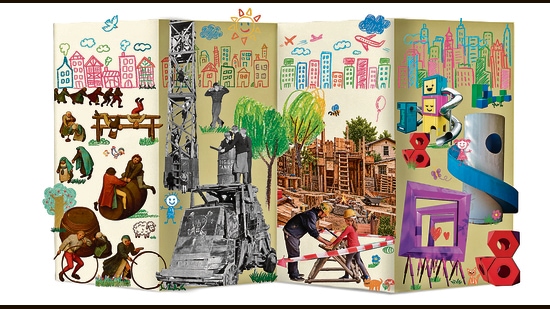
* At Berlin’s Kolle 37 playground (named for the street it is on), children as young as six learn to light fires, tend to herb gardens, and care for animals such as rabbits and guinea pigs.
* At Tokyo’s Komazawa Harappa or “open-lot” play park, they are encouraged to dig into dirt and build things. In place of swings and seesaws, there are piles of wood, real tools, and plenty of room for the imagination.
* At The Yard in
* At Berlin’s Kolle 37 playground (named for the street it is on), children as young as six learn to light fires, tend to herb gardens, and care for animals such as rabbits and guinea pigs.
* At Tokyo’s Komazawa Harappa or “open-lot” play park, they are encouraged to dig into dirt and build things. In place of swings and seesaws, there are piles of wood, real tools, and plenty of room for the imagination.
* At The Yard in New York, children six and older saw through wood and hammer nails into boards. Many tend to build and scale rickety “forts”.
The aim of such “adventure playgrounds” is to let children decide what their recreational space should look like, says Kristiina Kumpulainen of University of British Columbia (whose research examines how children learn and build identities in informal spaces such as parks).
The unfinished quality lets them learn to assess risk, solve real problems, and take genuine ownership of their environment, adds New York-based play designer Naomi Heller, whose Bricolage Studio creates sensory-rich, open-ended playspaces. “Children today have far less independence than previous generations did, and spend much of their day under close adult supervision. Adventure playgrounds give them back a measure of control,” she adds.
Trained staff, known as playworkers, ensure safety thresholds aren’t crossed. They also administer first aid.
But because there are no set rules, the children learn to negotiate, share resources such as space, water, wood and tarpaulin, and find ways to resolve conflicts with peers.
A group trying to get water from one end of a sandpit to another, for instance, has to figure out what kind of channel to use, and how to get other children to allow such a shape through their own little lots.
They may eventually decide it is a river, running through an imaginary village, Kumpulainen says.
A MINOR REVOLUTION
Children have always sought adventure in the playground, and routinely turn even the standard template of swings, slides and roundabouts into forts, kitchenettes and battlefields, or simply abandon manicured parks in favour of a vacant building nearby, points out environmental historian Jon Winder, a professor of modern British history at University of Kent.
In his book, Designed for Play: Children’s Playgrounds and the Politics of Urban Space (2024), he points out that the first “junk playgrounds” came about as a result of this subversion. That term was coined by Danish landscape architect Carl Theodor Sorensen in the 1940s, when he noticed that, amid the carnage of Nazi occupation, children seemed drawn to abandoned buildings, junkyards, and bombed-out lots in Copenhagen.
Based on their imaginative use of the timber, bricks and tyres they found there, he designed the Emdrup Junk Playground in 1943, within a housing complex for workers. Here, he offered log piles, spare building materials, a replica of a sailboat, and had caves dug into the perimeter.
Parents could leave their children under the supervision of trained workers (employed by the cooperative housing society). The space kept children from wandering into wartime ruins.
The radical approach was difficult to sustain at the time, particularly given the high staffing costs. But, by the 1970s, the format was making a comeback.
In the US, sculptor Isamu Noguchi created Playscapes, consisting of mounds, slopes and abstract forms that carried no fixed purpose; their meaning depended entirely on how children chose to use them.
Komazawa Harappa in Tokyo, with its wood and tools, opened in the 1980s. Kolle 37 in 1990. The Canada government sponsored the Terra Nova Adventure Play Environment in 2014. Its amalgam of hollow logs, tubes, ropeways and hilltop slide serve as a literal scaffold for the imagination. The Yard in New York opened in 2016.
NO GROUND RULES
The key, Heller says, is a balance between flexibility and structure.
When a space has no structure at all, children often don’t know where to begin, and play fizzles out. When everything is fixed and prescribed, it becomes repetitive.
“Creativity flourishes in the in-between: in sensory-rich landforms with loose materials, nooks to retreat into, edges to climb, all shaped so that children can explore, build, imagine and invent,” Heller says.
For instance, her firm designed a set of large, nested cubes for collaborative building, in a school yard in the US. At first, children used them as expected, climbing inside them or stacking them up. A month later, though, Heller found that they had carried one of the cubes indoors, lined it with pillows and named it the Peace Area, a place for anyone who wanted to be alone.
“We had designed for energetic play, and the children showed us they also needed somewhere to retreat and recharge. It was an important lesson for us,” Heller says.
That is the kind of engagement adventure playgrounds seek to encourage. “What I would always want to preserve,” as Kumpulainen puts it, “is the child’s freedom to pick up a tool, put it down, or take the play somewhere the designer never imagined.”
One Subscription.
Get 360° coverage—from daily headlines
to 100 year archives.
Archives
HT App & Website
ABOUT THE AUTHOR
Anesha George writes long-form features for HT Wknd. Her stories explore culture, science, technology, and the odd internet rabbit hole. She finds youth culture particularly fascinating because it lets her pretend she hasn't aged out of the conversation. Yet.