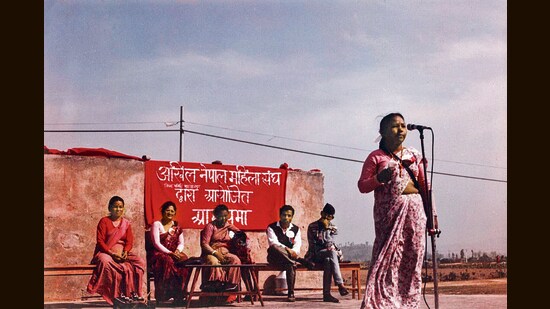
Labour leader Bishnu Ojha addresses workers in 1981. (From the Bishnu Ojha Collection, via NPL)
Advertisement
There are photos from across nearly a century, and snapshots from letters and notebooks too. One contains just three words in English: Please please please.
A revolutionary living underground during the Nepal Civil War (1996-2006) writes to her daughter, who has just had her first period. “My dear ovulating lady,” Hisila Yami, a future union minister, says, having explained the essential experience. “Once you know the source, you can easily tackle the pain.”
{{^htLoading}} {{/htLoading}}
There will be other kinds of pain to come, she adds, as you make your way through puberty.
Images of the letter appear in The Public Life of Women, a new photobook
An unnamed Tharu tribal who helped lead a peasant revolt against landlords in 1980. Anti-monarchy rebels Prem Kumari Tamang and Lal Maya Tamang in prison in Kathmandu, 1961. (From the Premkali Chaudhary and Shanta Shrestha Collections, via NPL)
Elsewhere, images from 1982 show future doctor Aruna Uprety, then a student in Ukraine, in the midst of a trip across Europe with fellow student Munu Pandey. The images are accompanied by a letter from Uprety to her future husband, the psychiatrist Bishwa Bandhu Sharma.
{{^htLoading}} {{/htLoading}}
The mood shifts from section to section of the book. In one, are snapshots of letters written by Rajani Shahi in 2012, asking other activists for help. She had been taken to a “rehabilitation home” after her estranged husband Pradip Shahi reported her as homosexual (an orientation that was decriminalised in 2007). Shahi’s letters, handwritten in Nepali, contain only three English words, in a line in the post script: “Please please please”.
The Public Life of Women is the second photobook by NPL, a photo archive established in 2011 by photographer NayanTara Gurung Kakshapati and cultural conservationist Bhushan Shilpakar, to preserve counter-historical narratives and the voices of marginalised, minority segments of Nepali society.
The first book, Dalit: A Quest for Dignity (2018), was a photographic record of Dalit lives and resistance in Nepal over six decades.
{{^htLoading}} {{/htLoading}}
“We wanted this to be an intersectional account of our feminist history, which often meant looking beyond institutional characters which tend to be limited by class, privilege, caste, achievements and empowerment,” says Diwas Raja Kc, lead researcher on the archive’s Feminist Memory Project. “As we worked on the archive, one of the conundrums we faced was how some of the really important moments in history don’t necessarily furnish photographs. So we relied on the broader definition of the visual and tried to include the visual and aesthetic dimension of documents.”
Four activists – Kabita Poudel, Yamuna Ghimire, Dil Maya BK and Maiya Bhattarai – pose at a studio after being released from prison in Palpa, 1990. (From the Rambha Poudel Collection, via NPL)
Work on the book began in 2018, as the archive combed through its own collection and reached out to individuals, institutions and NGOs. By the end of that year, a bulk of the eventual 8,000 images had been gathered from across 150 sources. Selections have since been exhibited, at Photo Kathmandu 2018, and at the Kochi-Muziris Biennale in 2022. About 500 of the pictures feature in the book.
{{^htLoading}} {{/htLoading}}
By next year, NPL hopes to have a new website with a fully searchable database for the Feminist Memory Project and, slowly, over the years, the entire NPL archive.
For now, alongside stalwarts of the women’s movements in Nepal – such as Mangala Devi Singh and educator Sahana Pradhan – the book features lesser-known, often-forgotten rebels.
A 1961 image shows Prem Kumari Tamang and Lal Maya Tamang behind bars at the Dillibazar Prison in Kathmandu, after they were arrested for an anti-monarchy agitation.
“We often hear about women from marginalised communities participating in anti-autocratic movements against the state, but we rarely see archival records of it,” says Raja Kc.
Another rare find included in the book is a series of portraits of indigenous Tharu women who led a peasant revolt in 1980, against harassment and intimidation by local landlords.
{{^htLoading}} {{/htLoading}}
“We managed to trace some of the women who had participated in that movement, and spoke to them.”
So much history fades unless it is captured and preserved in material form. Many of these tales are not being retold. “It now feels more urgent to preserve images even from something like the Maoist movement in Nepal, which wasn’t that old when we began work on the Feminist Memory Project,” says Raja Kc.
All Access. One Subscription.
Get 360° coverage—from daily headlines to 100 year archives.
Explore the latest Lifestyle News on health, fashion, travel, relationships, food and festivals. Find useful tips, expert advice, trends and inspiring stories for everyday living.
Explore the latest Lifestyle News on health, fashion, travel, relationships, food and festivals. Find useful tips, expert advice, trends and inspiring stories for everyday living.