In a flat in Manchester in January 1980, Ian Curtis (yes, that Ian Curtis, a few months from becoming post-punk’s most mourned voice at 23) of the band Joy Division sat gluing coarse sandpaper onto record covers.
What he and a few others were building, sheet by sheet, was an audacious prank / experiment by the music label Factory Records: the sleeve for The Return of the Durutti Column, the debut album of the band of that name.
The Durutti
In a flat in Manchester in January 1980, Ian Curtis (yes, that Ian Curtis, a few months from becoming post-punk’s most mourned voice at 23) of the band Joy Division sat gluing coarse sandpaper onto record covers.
What he and a few others were building, sheet by sheet, was an audacious prank / experiment by the music label Factory Records: the sleeve for The Return of the Durutti Column, the debut album of the band of that name.
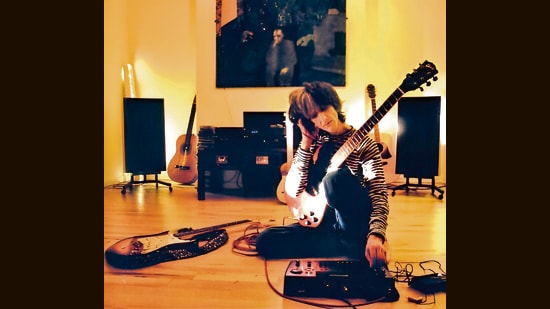
The Durutti Column was, at the time, essentially made up of one shy, depressed guitarist named Vini Reilly. The idea for the sandpaper came from label co-founder Tony Wilson, inspired by a prank / artistic statement from decades earlier: a 1959 book by French philosopher Guy Debord that was bound in sandpaper so it would scrape and ruin whatever books sat next to it on a shelf. Wilson wanted to now do the same with vinyl.
Every copy of The Return of the Durutti Column was designed to destroy the records on either side of it. It was a joke, a dare, a piece of Dadaist theatre masquerading as packaging.
Reilly himself had nothing to do with it, and later said he was mortified when he found out.
Here is the first thing worth pondering, before we get anywhere near the music: that sleeve is one of the most talked-about objects to emerge from the post-punk era, and it is attached to an album that sounds absolutely nothing like the ploy implies. There is no confrontation. No noise. No sneer. Just Reilly’s clean, fingerpicked, echo-drenched guitar, drifting and melodic, occasionally complemented by Martin Hannett’s synthesisers and turned into something closer to chamber music than to punk’s antagonism.
That contradiction, it turns out, is the story of the band.
NOT PART OF THE CROWD
Post-punk, as a genre, is largely a tale of voices with something to say. There is Joy Division’s darkness, Gang of Four’s Marxist sloganeering, The Fall’s gnarly sneer. This is music built on lyrical seriousness and rhythmic aggression.
Reilly opted out of the argument altogether. There is barely a lyric to be found across The Durutti Column’s early records. Where his Manchester peers used space and starkness for tension, he used it for delicacy.
Even his one obvious point of overlap with the scene — producer Martin Hannett, the man who gave Joy Division their addictive, cavernous sound on their debut album, Unknown Pleasures (1979) — worked in the opposite direction here, turning Reilly’s playing spacious and bright rather than bleak.
And then he simply kept not settling. Across five decades, The Durutti Column absorbed jazz, flamenco, ambient textures and even, on 1996’s Fidelity, sampling and dance beats, with a restlessness that had little in common with punk’s insistence on economy and speed.
No hit ever arrived to tempt him to a formula. He just kept moving, largely unbothered by whether anyone was listening.
A CULT FOLLOWING
The Durutti Column’s audience has never been large, but it has been startlingly loyal, a following built less around chart positions than private discovery.
LC (1981), with Sketch for Dawn-I and Sketch for Dawn-II, is the record long-time fans invoke the way other people revisit a favourite photograph: as a mood they can access on demand. Without Mercy (1984) pushed toward something almost classical. And when Wilson of the sandpaper idea died in 2007, Reilly’s response was A Paean to Wilson (2010), a tribute so personal it seemed, for a long time, like a closing statement.
Ill health slowed him down considerably after that. For 15 years, this looked like where the story ended: a quiet catalogue, kept alive by reissues and devotion rather than new work.
AND THEN…
On July 31 this year, The Durutti Column released Renascent, their first collection of new material since A Paean to Wilson.
It is produced by long-time collaborator Keir Stewart, and is still built around Reilly’s guitar, moving between ambient atmosphere and more structured songwriting, with guest vocals from a younger generation: Caoilfhionn Rose and Lucas Elliot.
Renascent is a masterful return. Reilly’s luminescent guitar work effortlessly blends the band’s post-punk roots with ambient minimalism. The album captures a poignant, romantic nostalgia while feeling entirely progressive. Standout tracks feature ethereal vocals from Rose, balancing delicate, dreamlike arrangements with unexpected rhythmic shifts.
If you’ve never heard The Durutti Column, this is, genuinely, as good a time as any to begin.
Start with Sketch for Summer (from their debut album), then sit with whichever Renascent track catches you first. If you’ve been following them since the sandpaper days, you already know what 15 years of silence, finally broken, sounds like, and don’t need me to tell you to go and listen.
Nearly 50 years on, The Durutti Column remains something unusual in pop music’s history, an outlier who never became a nostalgia act, a scene member who was never really part of the scene, and a cult that kept its faith without ever needing to race for the charts. Renascent isn’t a comeback so much as a continuation of a story that had been quietly paused.
(To reach out, email sanjoy.narayan@ gmail.com. The views expressed are personal)
One Subscription.
Get 360° coverage—from daily headlines
to 100 year archives.
Archives
HT App & Website