...
...
Next Story

Sprout of the ordinary: Have we completely misunderstood what plants are?

Updated on: Oct 12, 2024, 15:36:19 IST
By
Prefer HTon Google
PREMIUM(HT illustration: Jayanto)
(HT illustration: Jayanto)
Advertisement

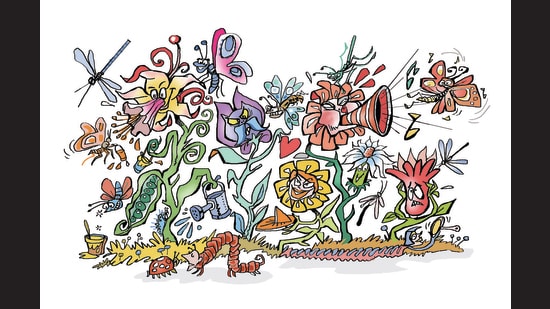
It turns out they are territorial, almost clannish. Certain vines can make caterpillars eat each other. How did we miss all this? Take a look.

Botany is a field in turmoil, says Atlantic writer and climate science journalist Zoe Schlanger (who has a degree in environmental studies, journalism and politics from New York University).

Her new book, The Light Eaters (HarperCollins), examines the latest epiphanies, and how they are prompting researchers to rethink how they view their subjects.

What kind of “intelligence” allows vines to blend their leaves into the shrub on which they climb? How do tomato plants manufacture their own insect repellent, and

(HT illustration: Jayanto)

Root causes

Why has it taken this long for researchers to notice these behaviours? A key reason is that plants exist on a much slower timescale than our own, Schlanger writes.

As a result, humans suffer from what, in botany circles, is called plant blindness: “the tendency to view plant life as an indistinguishable mass, a green smudge, rather than as thousands of genetically separate and fragile individuals, as distinct from one another as a lion is from a trout.”

“This is precisely why it is important to understand plants as individuals in the way botanists are doing now,” says Prasanna NS, a botanist and TN Khoshoo Postdoctoral Fellow at the Ashoka Trust for Research in Ecology and the Environment (ATREE), in Bengaluru. “It brings in new perspective and lets people engage with plants through their unique behaviours, beyond their umbrella settings such as forests or grasslands.”

It’s important not to overdo things though, Prasanna points out. “When it comes to botany, things can go down a very slippery slope, as they did in the 1970s, with The Secret Life of Plants,” he says.

That 1973 book by journalist Peter Tompkins — cited as an example of what not to do, in Schlanger’s book too — drew on controversial, pseudoscientific experiments, and then oversimplified them, to suggest that plants could “feel” and “hear” and “enjoy Beethoven”. It suggested that they could read minds and respond to polygraph tests. It was all just a “beautiful collection of myths,” Schlanger writes.

The book set the field of botany back by decades, as researchers became wary of broaching the idea of any kind of “plant intelligence”.

This must not happen again, Prasanna says. “We must be careful not to anthropomorphise these behaviours as we have done with animals — and we shouldn’t have done it there either.”

All Access.
One Subscription.

Get 360° coverage—from daily headlines
to 100 year archives.

E-Paper
Full
Archives
Full Access to
HT App & Website
Games
 
Explore the latest Lifestyle News on health, fashion, travel, relationships, food and festivals. Find useful tips, expert advice, trends and inspiring stories for everyday living.
SHARE THIS ARTICLE ON