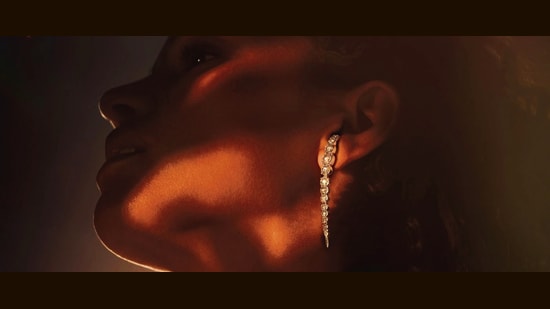
It can feel hard to answer the question “Is that the real thing”, while wearing a lab-grown diamond. Technically, it has the chemical composition of a diamond. Visually, it sparkles. So, why the hesitation?
Because we know the story; and the story marks the difference.
A lab-grown diamond can be made in days or weeks, depending on the processes used. These processes include the use of immense pressure and temperature, and the use of chemicals, to turn a seed (a fragment of an earlier natural or lab-grown diamond) into a fresh stone…
What story does this crystallised carbon tell?
One cannot say: “Oh yes, this is from Canada, where it lay in the earth for hundreds of millions of years, as a whole planet took shape around it.”
The more one zooms into a natural diamond, the more of a story it tells. The colour can hold clue to the conditions around it as it formed. Yellow, for instance, is caused by the presence of the guest element nitrogen in the crystal.
By analysing the arrangements of the nitrogen, researchers can approximate the amount of time the gemstone would have lain within the Earth.
{{/usCountry}}By analysing the arrangements of the nitrogen, researchers can approximate the amount of time the gemstone would have lain within the Earth.
{{/usCountry}}The jewel would have lain deep within the mantle, where immense yet incredibly precise natural pressures and temperatures turned carbon into this glittering gem. No two natural diamonds were formed under exactly the same conditions. This makes each one as unique as a fingerprint. No two are exactly alike.
Under ultraviolet light, many even reveal distinct tree-like growth structures.
Things work rather differently in a lab. One still needs the heat and pressure. There is no way around that. As a result, it takes immense amounts of energy to “grow” a diamond in a laboratory.
It doesn’t take very long, though. In high-pressure, high-temperature (HPHT) production, a diamond seed, carbon source and metallic flux are subjected to these pressures and temperatures, in a process that can take days. In the chemical vapour deposition (CVD) method, where a reactor activates carbon-containing gases, and carbon deposits onto diamond seeds, a growth cycle takes a few weeks.
These stones also hold evidence of how they were made. The process, whether HPHT or CVD, determines the stone’s morphology, fluorescence patterns and other characteristics. Because of the repetitive growth patterns and synthetic inclusions, tests can tell that a gemstone was made in a lab.
Similar material. Different stories.
STORIES TO TELL
What does this mean for you?
That depends quite a lot on the story you’d like to tell.
Is it: “Hey, I got something sparkly. It didn’t even cost very much.”
Or: “I decided to splurge on myself / my fiancé / my mother / my child. Yes, these are natural diamonds.”
Capitalising on the latter sentiment, De Beers, the world’s leading diamond company, is among the natural-diamond giants increasingly placing geological origin at the centre of their messaging.
The De Beers Tracr platform traces diamonds through its supply chain. Its 2022 campaign, Where It Begins, highlighted aspects of this journey, from source to finished jewel. Other campaigns similarly link the idea of natural diamonds and their history with the idea that a diamond is forever.
The argument here is that something manufactured in a machine in a matter of days conveys less evocatively the idea of permanence, fealty and eternal love, whether between siblings, partners, parent and child, or in an heirloom passed down through generations.
De Beers India, for instance, launched Love, From Hubby this month, to position the empty-nest phase of marriage as a new occasion for gifting natural diamonds to a partner. The campaign is designed for couples whose children have left home, encouraging husbands to mark this next chapter with a natural diamond solitaire from the Love, From Hubby solitaire collection.
The campaign frames the gesture as a second proposal, encouraging couples to use a timeless precious gem to reconnect and celebrate their relationship beyond conventional milestones.
PEERLESS JEWELS
There is another factor at play, of course, when it comes to natural diamonds: commercial value.
Both natural and lab-grown diamonds are diamonds, but their origins — and the idea of rarity vs abundance — affect how they are marketed, priced, and perceived.
Particularly within Indian families, where jewels are meant to serve as investments and as heirlooms, a natural diamond comes with a hardy promise of future value.
Demand, grading, documentation and the availability of comparable stones all influence what a future buyer might pay. So, when it comes time to buy, it is worth asking: What do I want from my investment?
Labs are proliferating, with more and more such gems being produced. Earth, meanwhile, doesn’t throw up any more of these gems. Natural diamonds aren’t just rare; they are finite. This is a big part of what makes them precious.
Geological age and family history measure longevity differently. Together they help explain why some objects become heirlooms while others do not.
All heirlooms, after all, tell a story. How far back do you want yours to go?