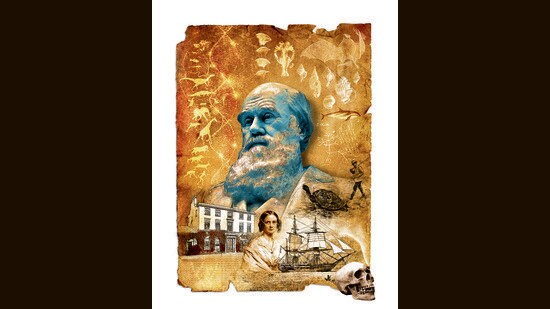
In 1859, a single man changed forever how we use the word evolved.
The term migrated to English as a way to indicate significant movement (as with military manoeuvres). Its roots were in the Latin evolutio, for the unfurling of a scroll.
Now, Charles Darwin was suggesting that all living creatures had “evolved” through the inheritance of small variations that helped them compete, survive and reproduce.
“There is grandeur in this view of life, with its several powers, having been
8. The journey towards his theory of evolution hinged on three primary clues, says Darwin scholar and science historian John van Wyhe. First, the discovery of “great fossil animals covered with armour like that on the existing armadillos” in central Argentina, embedded in which he found mammalian and molluscan remains.
Second, the way in which, as he put it, “closely allied animals replace one another in proceeding southwards over the Continent”. And third, the gradual modifications he saw in species across the Galapagos Islands alone, species that were separated only by the minor differences in their habitats. “The subject haunted me,” Darwin later wrote.
9. Once the Beagle returned to England, he continued his research, sending questionnaires to other scientists voyaging to distant lands, as well as to farmers, livestock breeders and gardeners. He wanted to prove through direct evidence that a species had been “modified”.
He only published On the Origin of Species 23 years later, in 1859. Historians have speculated that, even then, he only felt he could because the English naturalist Alfred Wallace had presented a similar theory in an essay the previous year.
Some historians refer to this period as “Darwin’s delay”, and suggest that he was afraid of being ridiculed, feared persecution, or feared upsetting the social order.
van Wyhe believes there is no truth to this. He points to the first page of On the Origin of Species, where Darwin writes that he started working on the theory of evolution in 1837, “drew up some short notes” in 1842 and enlarged on these in 1844, and that “from that period to the present day I have steadily pursued the same object”.
10. Now, in Wallace, 14 years his junior, Darwin found a protegee, sounding board and friend. Both had spent years studying natural history in South America. Wallace’s observations impressed Darwin.
According to the Darwin Correspondence Project, an online repository created by University of Cambridge, Wallace trusted Darwin and valued his opinion enough to share with him a draft of his own theory of descent, in 1858. Soon after, Darwin wrote to the geologist Charles Lyell, “I never saw a more striking coincidence... if Wallace had my M.S. sketch written out in 1842 he could not have made a better short abstract!”
The two men presented a joint paper on evolution at the Linnean Society of London meeting that year.
“You are the only man I ever heard of who persistently does himself an injustice & never demands justice,” Darwin wrote to Wallace in 1869. The latter maintained that the theory of natural selection was “actually yours and yours only”. “You had worked it out in details I had never thought of, years before I had a ray of light on the subject, & my paper would never have convinced anybody or been noticed as more than an ingenious speculation, whereas your book has revolutionised the study of Natural History, & carried away captive the best men of the present Age,” Wallace wrote to Darwin, in 1864.
11. Some historians argue that Darwin put off publication out of respect for his wife Emma Wedgwood Darwin, a devout Christian. He was 30 when they wed; she, 31. They lived well, first in London, then in Kent. A few months before they were engaged, however, Darwin scribbled the still-famous list of the pros and cons of marriage. “Constant companion, (& friend in old age) who will feel interested in one”, “children—(if it Please God)”, “object to be beloved & played with”, went the pros. Cons included the loss of “freedom to go where one liked”, “ the expense & anxiety of children”, and the sentiment “how should I manage all my business if I were obliged to go every day walking with my wife”.
12. Still, by all accounts, theirs was a happy marriage. Emma also stood by him and his work. In an 1861 letter to him, she refers indirectly to the fracas his theory caused. “I cannot tell you the compassion I have felt for all your sufferings for these weeks past. Nor the gratitude I have felt for the cheerful & affectionate looks you have given me when I know you have been miserably uncomfortable,” she writes.
13. In his diaries and autobiography, there are indications that Darwin struggled to reconcile his theory with his own religious beliefs as well. He notes that he was quite orthodox while on board the Beagle, but slowly grew to question the holy texts.
14. Through his life, Darwin was somewhat troubled by bouts of ill health, relating mainly to his digestive system. Of the 10 children he and Emma had, three were lost in childhood and he worried that he had passed his “poor constitution” down to them all. He wrote often, in his diaries, of being unable to work when they were ill.
A week after the death of their second child, Anne, aged 10, he wrote: “We have lost the joy of the Household… Occasionally she had a pretty coquettish manner towards me; the memory of which is charming: she often used exaggerated language, & when I quizzed her by exaggerating what she had said, how clearly can I now see the little toss of the head & exclamation of “Oh Papa what a shame of you”.
15. In his professional life, Darwin faced criticism not just from the clergy and the devout, but from women as well. Much of this relates to views expressed in The Descent of Man, and Selection in Relation to Sex (1871), in which he argues that evolution made men superior to women. “Man is more courageous, pugnacious, and energetic than woman, and has a more inventive genius,” he wrote. “If two lists were made of the most eminent men and women in poetry, painting, sculpture, music… history, science, and philosophy, with half-a-dozen names under each subject, the two lists would not bear comparison.”
Among his most vocal early opponents on this front was Antoinette Brown Blackwell, the first woman minister in the US. In 1875, she published The Sexes Throughout Nature, a first-of-its-kind feminist critique of Darwin.
16. Around the world, meanwhile, his larger theory of evolution would be embraced for reasons ranging from the personal and political to the geopolitical. The theory became a matter of prestige in an Arab world contending with colonial rule. “Darwin, in Egypt, became a way to counter imperial cultural hegemony with one of its own weapons: science,” says science historian Jahnavi Phalkey.
17. In addition to the origins of species, Darwin was fascinated by the role of expressions in communication and evolution. Scientists were then just beginning to ask: Why is it that we “know” what someone is feeling, from an expression; are expressions thus universal?
Darwin studied “expressions” in monkeys, dogs, cats and horses, and kept some records of his children’s expressions and gestures too. Some are universal and have an evolutionary basis, as they aid in survival, reproduction and communication, he noted, in The Expression of the Emotions in Man and Animals (1872), in a finding that has since been verified by science.
18. As Darwin aged, his ailments intensified, confining him to bed for weeks or months at a time. He consulted specialists, tried special diets, had a special bath constructed in his home and dabbled with ice therapy. His health reportedly improved whenever his wife was able to urge him to take a holiday. But, he would write in his diary, idleness did not sit well with him. Science was “the only thing that makes life endurable”.
19. When his health permitted, he enjoyed attending soirees and otherwise socialising with close friends, among whom were the poet Alfred Lord Tennyson, the mathematician and inventor Charles Babbage and the novelist George Eliot.
20. Darwin died in 1882, aged 73, at his home in Downe, Kent. He was laid to rest at Westminster Abbey. Already, by this time, he was one of the most influential voices in the history of science. In its obituary, The Spectator noted that “England has lost the most original, as well as far the most celebrated, of modern men of science.”
The Times drew parallels between his contribution and that of Isaac Newton (1642–1727). “Through his influence the whole method of seeking after knowledge has been changed,” this obituary stated, “and the increasing rapidity with which the results are every day developed becomes more and more bewildering.”
One Subscription.
Get 360° coverage—from daily headlines
to 100 year archives.
Archives
HT App & Website
Sukanya Datta is principal correspondent at HT Wknd, the Sunday features section of Hindustan Times. She writes on science, climate, art, culture, communities and anthropology. Outside the newsroom, she likes to swim, try out Instagram recipes and daydream about her next trip.