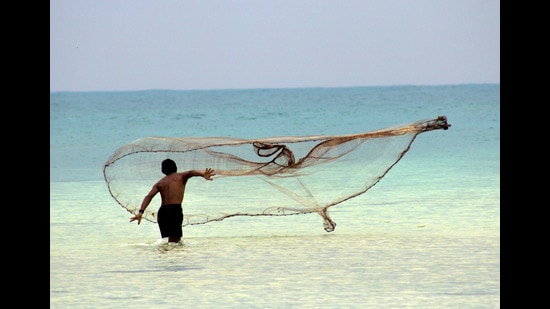
It was a weak monsoon this year. The fishermen have offered coconuts to the sea in gratitude nonetheless.
On Narali Poornima, the fishing communities of Maharashtra set out in their boats for a new season. This is a socio-religious tradition and an ecological one. Similar customs prevail across faiths. Christian fishermen in Goa, for instance, resume fishing after the feast of Saint Lawrence, celebrated annually on August 10.
For several weeks before these dates, fisherfolk everywhere abstain from plying their boats, not just because of the turbulent seas amid the monsoon, but because these are the months when marine life is breeding. Such customs were practised all along our coastlines long before modern bans were enacted. They came from an understanding that humans are intertwined with nature’s rhythms.
***
For more than 2,000 years, with its coastal and oceanic habitats spanning the Arabian Sea, Bay of Bengal, Andaman Sea and Indian Ocean, India has been at the centre of the maritime world.
Lothal in Gujarat has one of the world’s earliest known dockyards, dating to the Harappan Civilisation (c. 2400 BCE), providing physical evidence of maritime trade between the Indus Valley and Mesopotamia. There was trade in sea turtles with the Roman Empire too, going back more than 2,000 years.
The Chola dynasty famously had a maritime legacy that flourished between the 9th and 13th centuries CE. Originating in Tamil Nadu, these rulers strategically pivoted from an agrarian culture to a maritime power, expanding their hegemony across South India, Sri Lanka and South-East Asia. They saw the seas as channels through which to exert influence and power.
{{/usCountry}}The Chola dynasty famously had a maritime legacy that flourished between the 9th and 13th centuries CE. Originating in Tamil Nadu, these rulers strategically pivoted from an agrarian culture to a maritime power, expanding their hegemony across South India, Sri Lanka and South-East Asia. They saw the seas as channels through which to exert influence and power.
{{/usCountry}}Long before European colonial forces came to militarise the routes, maritime trade flourished between the peoples of regions such as Gujarat, Malabar and Bengal, and those of West Asia and beyond.
Historically, Indian civilisations understood the ocean as central to identity and political strategy.
***
One could argue that India now suffers from a deep amnesia about its seafaring past.
A mental model sets us up as a land-based civilisation. We are more likely to celebrate the Guptas and Mauryas than the Cholas, who represent our own blue-water imperial ambitions. Despite having a coastline of about 11,000 km (a revision from the older figure using higher spatial data, including islands), the modern State has treated our waters as an afterthought, especially when it comes to livelihoods, conservation and sustainability.
Even though about 16 million people depend directly on marine fisheries for their primary livelihood, fisheries until recently came under the Ministry of Agriculture, and marine conservation remains but a footnote in a conservation agenda designed around tigers and forests.
India’s Exclusive Economic Zone (EEZ), which gives the country rights extending up to 200 nautical miles from the coasts, covers about 2 million sq km.
India accounts for about 6.4% of global marine biodiversity across its coral reefs, mangroves, seagrass meadows, estuaries and mudflats. More than 20,000 animal species and 1,100 plant species have been recorded across the country’s marine ecosystems.
We have five of the world’s seven sea turtle species in our waters. They are a keystone species, controlling jellyfish populations, maintaining coral-reef health, and transporting nutrients between marine and terrestrial ecosystems.
India is among the world’s top three shark- and ray-fishing nations.
Our EEZ holds roughly 170 species of sharks, rays and chimaeras, including about 30 that are endemic to the Arabian Sea and adjacent waters. As predators, they help keep marine food webs in balance. They also support the livelihoods and food security of numerous communities. Nevertheless, sharks and rays are among the most threatened groups in Indian waters, and catches have declined steadily across decades.
Meanwhile, despite these treasures, only about 5% of the country’s coastal and marine areas are designated as protected according to the Sixth National Report under the Convention on Biological Diversity. India is rushing to meet its commitment to get 30% of its waters declared as protected areas under the Kunming-Montreal Global Biodiversity Framework, but so far we are nowhere close.
***
On the research front, marine science remains neglected and siloed across different institutions and we have barely any long-term monitoring of ocean life.
This is concerning, given that commercial fishing now operates at a very different scale from the artisanal fishing it competes with, and needs a more rigorous application of fish biology and scientific evidence. Different states have different policies, permissions and patrolling around fisheries. Recent research suggests that even the annual fishing ban overlaps with the breeding periods of only 40% of commercially fished species, leaving the other 60% unprotected.
The current government is more ambitious when it comes to our oceans.
We already have the Sagar Mala, which is the port-led development project, and the Maritime India Vision 2030, which aims to place the country among the world’s top five shipbuilding nations. The government has now articulated a new maritime doctrine for the Indian Ocean: Mahasagar, short for Mutual and Holistic Advancement for Security and Growth across Regions. Its stated aim is to link economic development with regional security and environmental stewardship.
The government is ably supported by the country’s premier ocean science institute, the National Institute of Oceanography (NIO), headquartered in Goa. Established in 1966 under the Council of Scientific and Industrial Research (CSIR), it documents marine biodiversity and pollution and conducts multidisciplinary research, including deep-sea mineral research, notably polymetallic nodule exploration, a long-running programme to extract value from the ocean floor.
Part of the State’s new ambition is a ₹81,000-crore project to develop Great Nicobar Island (GNI). The plan includes a mega port, new city, international airport, military base, and industrial park. This is explicitly framed as a way to strengthen India’s strategic position in the region. This project is a centrepiece in the country’s shift from a defensive to a power-projecting maritime posture, harking back perhaps to the Chola empire.
The government has spoken of the development projects in both the Andaman and Nicobar Islands as a blue economy hub. This idea covers fisheries and aquaculture, and coastal and marine tourism. It acknowledges the unique marine biodiversity there yet desires deep-sea mineral exploration and oil and gas extraction in the North Andaman Basin.
There are in-built contradictions here that will require meaningful trade-offs between development and the environment. It may also need a fresh economic assessment of potential stranded assets in a seismically and climatically vulnerable region.
These are among the more contested infrastructure projects in India today. GNI has one of the last remaining pristine rainforests in the country, and hosts the Shompen, one of the last tribes living in voluntary isolation. Both indigenous communities and environmentalists oppose the project for its estimated ecological and human costs.
Mainland Indians, partly because of our lack of knowledge about our strategic maritime assets and about the way of life of offshore islanders, may not understand what the fuss is all about. We may well believe that the trade-offs are worth the strategic advantage to be had.
Does India not need strategic self-reliance in turbulent global waters? If some low-lying islands may be submerged in a few decades from global warming and sea rise anyway, is it not a good idea to exploit their potential now?
These questions may be valid, yet the developing context broadens the issues way beyond the GNI project.
India’s coast faces a polycrisis. We cannot speak separately about climate change, biodiversity loss, rising sea levels and food insecurity. The oceans force us to bring it all together.
The tropical Indian Ocean has warmed faster than other oceans and marine heatwave days are expected to rise tenfold by 2050. We already know that this year’s El Nino might be a once-in-a-thousand-year event. If the projections are close to reality, this Super El Niño will destroy many coral reefs and coastal fisheries.
In the low-lying atolls of Lakshadweep, coral reef cover has already fallen by about half. Many “sensitive taxa” are already gone and only slow-growing and structurally simple corals remain. After this El Nino, marine ecosystems may take far longer to recover, as the ability to self-repair and grow is further compromised.
The provisioning services and protection that marine ecosystems give and that we take for granted are weakening before our eyes.
If business continues as usual, Lakshadweep may be among the first internally displaced territories of India before the end of the century. And while it might be difficult for people far away on the mainland, with worries of their own, to care about a small island and its few-thousand residents, Lakshadweep might be our canary in the coal mine.
***
Many of India’s most densely populated cities, including Mumbai, Chennai, Kolkata, Surat, Visakhapatnam and Kochi, are clustered in low-lying areas around the coast, increasingly vulnerable to rising sea levels, cyclone intensification, coastal ingress and salinity.
Our coastline is more densely populated and more vulnerable than it has ever been.
Meanwhile, fish remains one of the cheapest sources of animal protein available for millions. Fish protein is a critical part of India’s nutritional security. Yet we have a crisis of overfishing even before the problems from warming seas hit us.
Our fish catch has plateaued at about 3.5 million tonnes, despite serious efforts to raise it. Fishermen send out more boats and spend longer hours at sea, and still return with less. Catch from trawlers is periodically of such low quality, it is only fit for animal feed and fertiliser.
A primary challenge, when it comes to improving fisheries management, is the lack of robust, long-term, accessible data, exacerbated by limited monitoring capacity and the scattered nature of fisheries.
There are very few civil-society organisations focused on marine research and protection, on coastal livelihoods, and on policy intervention. Among them are Nature Conservation Foundation and Dakshin, both of whom my philanthropy supports. Coming from diverse perspectives, they have worked for decades to support sustainable livelihoods and community-based adaptive resilience, engaged in maritime research, and helped conserve species and ecosystems. They need much more philanthropic support as they continue their work in this critical field.
They write of the lived experiences of fisherfolk, which stand testimony to deep imbalances and vanishing species. They warn us that aquaculture, promoted as a solution to the overfishing crisis, still needs wild-caught stock to feed farm operations. These organisations and others like them ask pertinent questions about how we can prioritise development but better accommodate societal well-being and generational futures.
***
There are difficult trade-offs ahead, with no easy answers.
Yet people do want better solutions. What is a compromise between doomsday prophecies and irrational optimism?
Many government institutions, policymakers and conservation organisations are looking for fixes that can disrupt and be replicated at scale. A prevalent techno-optimism is predicated on the idea that we can use technology to fix the mistakes we have made.
A blue-carbon economy is emerging and the government’s narrative around it is spreading fast. Funds have been poured into marine restoration targeted at replanting mangroves, restoring coral reefs and seagrass meadows, and repairing coastal dunes. Marine scientists worry that these well-intentioned, expensive efforts might be palliative at best.
Maybe we need to imagine a future that does not try to restore a fictionalised perfect past.
***
I have gone on amateur snorkelling excursions in the Indian Ocean since the 1980s, specifically in Goa and the Andaman Islands. On recent such trips, it has felt as though the life and colour were drained out of a vibrant painting.
I don’t know if the coral-reef diversity of my past can be revived in my lifetime. Can it be revived in my grandson’s lifetime? That seems like a question worth asking.
Can we harvest now, urgently, the traditional knowledge held by elders? Can we learn from communities that have thrived alongside the oceans for thousands of years?
We acknowledge, in spheres such as technology, that adaptive design can be learned from past endeavours. We know that a resilient future lies in strong local institutions. There are examples from around the world of governments and local communities working together for sustainable management.
Can we better use the lessons we have already learnt, as well as cutting-edge technology, large datasets, satellite-based observation and even AI, to protect the structural complexity that keeps these massive ecosystems alive and productive?
Equally important: Can we inspire the next generation to engage with our maritime past and future?
We must retain hope and faith in the resilience of nature, and of our oceans.
As a nation we have been singularly successful in land-based conservation. Our tigers, rhinoceroses and numerous other species have rebounded in number. As a people, if we can look towards our shores instead of turning our backs on them, we could create similar success stories and protect our marine treasures.
In Odisha, on the upcoming Kartik Purnima in November, the tradition of Boita Bandana will be observed. The day is still considered auspicious as it commemorates ancient Odia maritime trade voyages. Families of merchant sailors would perform rituals for a safe journey. Even today, boats are worshipped and offerings made to the sea, and sometimes to Varuna, god of the oceans.
India’s oceans and coastal areas are critical to our economy, but also to our well-being.
Perhaps we need new rituals that will reconnect us with a powerful ancient imagination. With tales of a Samudra Manthan that can be a source of both poison and panacea, and was churned to produce amrut, the nectar of immortality, which today we can translate as sustainability.
Amid the strongest El Nino in maybe 1,000 years, we must hold on to every bit of hope. Or find it in us to become the Kurma avatar, the strong foundation on which an emerging future can rest.
(Rohini Nilekani is chairperson of Rohini Nilekani Philanthropies and author of Samaaj, Sarkaar, Bazaar: A Citizen-Based Approach)