
 E-Paper



Drawing Room: Why Pinaki Ranjan Mohanty loves Jagannath Panda’s art

 Prefer HTon Google


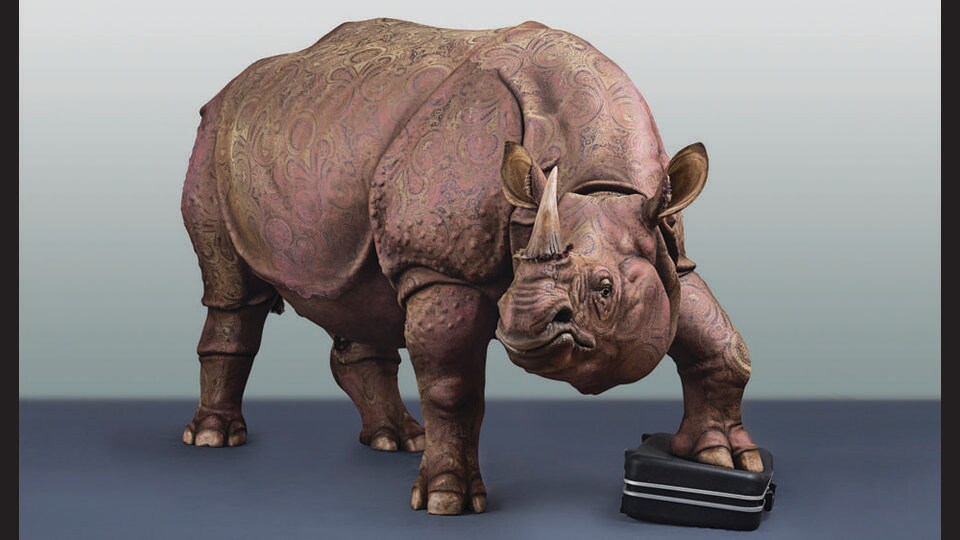
An embroidered rhinoceros crushes a suitcase. A Ferrari is mangled by a tree. In Jagannath Panda’s work, nature spars with man, and always wins
To understand Jagannath Panda’s work, perhaps it’s best to use one of his own lines: “The past refuses to end, and the future keeps arriving early.” Panda has been creating mixed-media art for three decades focusing on how the changing nature and scope of urban India affects its long-existing agrarian and nature-based ecosystems.
Panda spent his early life in Bhubaneswar, Odisha, studied in London and Tokyo, and now lives in Gurugram. He has, for years, stayed rooted in the traditional cultural practices of his home state, but gave it a contemporary identity. He experiments with materials by pairing them in unusual ways. Textiles and fabrics often mimic the hides of animals, barks of trees, or clothing of mythological figures. Terracotta, bronze, stone and papier-mâché have shown up in his larger-than-life assemblages.
His 2009 sculpture, The Being, is one of my favourite works, and a rich introduction to what he really does with materials and ideas. It features a majestic rhinoceros crushing a small suitcase with its left foot. Look closely at the ridges and folds of its hardy skin – they are made with an ornately embroidered brocade with a distinct gold sheen. Such delicacy is at odds with the monumental nature of the animal, but somehow the ornamentalism adds softness. As for that suitcase, viewers might see it as a sign of encroaching urbanism, commercialised tourism, or merely nature fighting back against man.
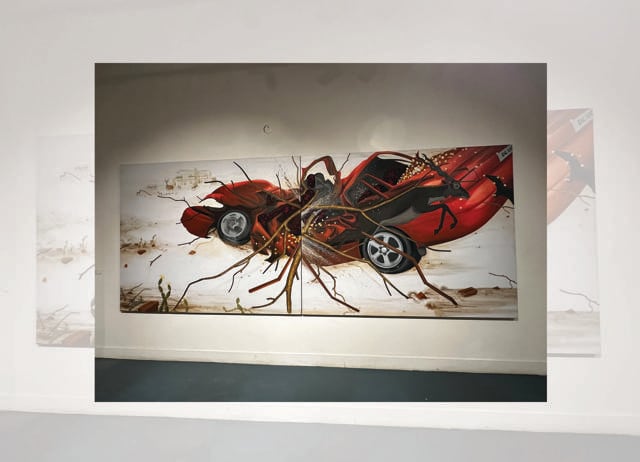
I also admire the large 2009 mixed-media painting, The Lost Site. It has an unusual theme: A red Ferrari crashing into a tree. The car is well and truly totalled, almost turning into itself with the force of the impact, the branches of the tree almost enveloping it. The car’s windows and headlights are smashed, debris falling out of them. Those signature red interiors – Panda renders them in brocade – are on fire. In the distance, a deer, standing in front of a building, presides as witness.
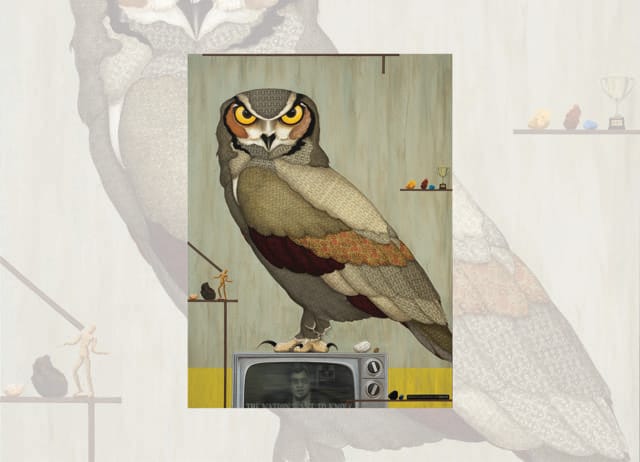
I’d like to think that both works hint at the same thing: The violent effects of human encroachment on nature, with nature coming out on top.
Over time, I’ve found that Panda’s work has become more intricate, more layered. Arch of Metropolis – II (2025) is a 4ft x 5ft embroidered work made in collaboration with artisans. It shows peacocks and other birds reigning over an urban sprawl. Geometric patterns and architectural fragments typical of Delhi’s baolis exist companionably alongside the birds. It’s an expression of hope in the continuity of heritage and natural splendour, in the face of a transforming urban landscape.
Panda’s work has an arresting quality to it. He has also provided a new direction for young artists from our region, showing us how to respond to urgent contemporary issues such as the effect of urbanisation on ecology, human migration and displacement and its influence on India. There is a lot going on. Yet it never overwhelms. There is beauty and optimism in his art – one feels compelled to believe in the alternate reality he presents.


