
 E-Paper



Cover Story
Main-character energy: See how these trailblazing entrepreneurs did it
Updated on: Nov 17, 2023, 08:08:05 IST

 Prefer HTon Google
Share via


Copy link


Starting a business, breaking from tradition, building a fan base. See how three entrepreneurs figured it out on their own as they forged their own paths

Nushu is the menstrual brand urban Indian women didn’t know they needed. It sells period underwear – not ugly granny knickers, but pretty briefs with built-in padding that women can wear all day, wash and reuse for up to two years.
The brand is just over one month old. But for founder Avisha Jhunjhunwala Brauner, 32, it’s been a long journey already. Jhunjhunwala Brauner grew up in Delhi and Hong Kong. She watched her father take over his father’s watchmaking business and convert the factory into a boutique hotel when demand dipped. She’s seen her mother run an Indian restaurant and a café in Hong Kong. “People in my family look at other entrepreneurs with so much respect that we put them on a pedestal,” she says. “We all bring work home.”
Period panties, however, stump even experienced business folks. Jhunjhunwala Brauner first tried them on the recommendation of a friend in 2021. They didn’t leak, didn’t stain, didn’t cause a rash. “When I had to wear a tampon the next day, I knew there was no going back,” she says. She had a degree in fashion marketing. She knew Indian women would want them. “The sustainability aspect added to its appeal.” she says. Her mother and maternal grandmother invested in Nushu. But Indian buyers are harder to convince.
Women remain largely secretive about their menstrual cycles in India. Bleeding is associated with shame and impurity. Pads and tampons are bought on the sly. So, Jhunjhunwala Brauner’s brand sells online, playing up the product’s stylishness as much as its functionality.
Having entrepreneurs in the family is a mixed bag, she says. Families might pitch in with money, but they’re also likely to pull the plug instead of sticking it out longer. “For me, there are preconceived notions of success and the way of doing things. But there’s no right or wrong,” she says.
There is, however, a litmus test. First-time entrepreneurs must ask themselves what they’re contributing to the world. “You will get complaints. Resolve them and keep your eye on the mission,” she advises. “For me, if I can rid society of a taboo with a product, it will be my biggest achievement.”
By Karishma Kuenzang
Breaking away in style
Pranay Baidya. 37. Fashion designer.
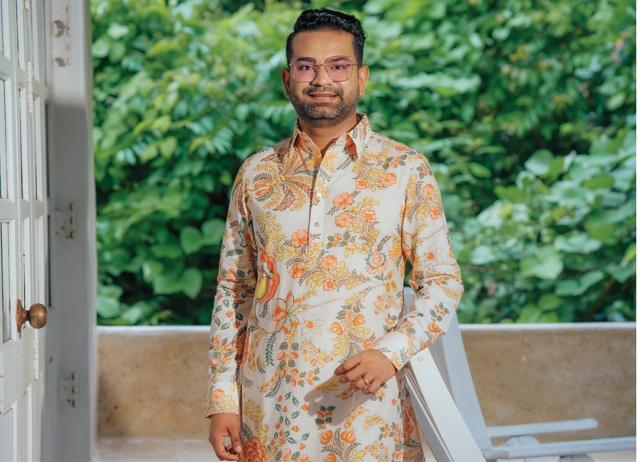
Pranay Baidya’s grandfather was a lawyer, and both his parents worked in finance. All through his childhood in Kolkata, it was pretty much expected he’dstudy either law or finance. But it was his maternal grandmother, Bani Majumdar’s saris that interested Baidya more.
“She had a room full of Godrej almaris, with saris from every corner of the country. That was my fashion education-- colours, patterns, motifs, textiles and touch – without me realising it.” he says.
While still in school, he’d trawl through textile shops in the old bazaars, picking out fabric for his shirts. “The clothes I wanted to wear, especially printed or colourful or floral, weren’t available, so I’d get a tailor to whip them up,” he recalls. Friends and family members started asking about them – his first step towards pursuing a fashion-design degree and creating his own label, Atelier Pranay Baidya, in 2013, for womenswear, menswear and jewellery.
Breaking from family tradition is tricky. On the one hand, there’s less baggage. “You can innovate, not just creatively but logistically and run a production differently, smartly,” Baidya says. “But when it came to bookkeeping and the financial side, I had no experience. I had to turn to my mother.”
Running a business for a decade; shuttling between home and the factories and weavers in Jaipur, Benares and Madhya Pradesh, heading to Delhi for business; and creating collections that are a critical and commercial success is tricky. “I gave up a high-paying job in New Zealand to come back,” he says. “My only fear is not being successful, commercially.”
The fear pushes him on.Baidya has friends who come from large textile businesses, and are so set in their beliefs that they struggle to be objective and innovative. He draws on advice from his great grandfather. “I never met him, but he’d often say, ‘Amader bhasha aar amader poshak hoeche’. Essentially, that our language and our costume is our identity. For me, that has played a huge role. Everything ultimately revolves around Indian weaves and crafts,” says Baidya.
His brand’s success has helped his family come around to his profession. “Newspapers are an integral part of life in most Bengali households. We’d get The Statesman, Telegraph, ABP, Bardhaman and more. The features written about me – an event opening, a dancer that I’d styled – that’s their marker of fame and success. My grandparents would read at breakfast and when I came downstairs, they would tell me how happy they were for me.”
By Urvee Modwel
Focusing on the quest
Akshat Rathee. 43. Managing director and co-founder of Nodwin Gaming.

Akshat Rathee was 25, trained in computer engineering but sticking it out at a multinational accounting firm, when one drunken evening changed his life. “I ended up asking a 52-year-old colleague his annual salary,” Rathee recalls. It was a couple of crores. “I didn’t want to wait that long for that little. I quit the next day.”
Rathee, 43, didn’t have a safety net. His father had been a cop and a lawyer. His mum worked as a psychologist and a teacher. All Rathee knew what that he’d enjoyed being a geek in this youth. At college in Manipal, he’d buy CDs in bulk, burn music on to them and sell them for a profit. He set up LAN connections so hostel students could play Quake, Red Alert and Counter-Strike on their TVs.
“I’ve had a good relationship with technology,” Rathee admits. “But my superpower is the ability to see trends coming, and to realise that time is my resource. With those ventures, I’d seen the demand. I had time. But I also knew that I was offering nothing unique.”
So when he started out on his own, Rathee played to his strengths and drew on his experiences. He loved gaming. But he also noticed how popular mobile phones were getting. How cheap internet had just started to roll out. How e-sports events of the time were an unorganised mess. “An explosion had happened, people just hadn’t heard it yet.” He worked his way up, setting up Nodwin Gaming in 2015.
It’s now the leading e-sports company in South Asia, connecting gamers, developers, platforms, tournaments and businesses as far away as the Middle-East and Africa. The company made ₹381 crore in the last fiscal year – Rathee easily makes more than his former colleague did. But he’s aware of his privileges. “My father bought us a PC in 1992. People who say they started from nothing tend to forget that they started with family. That’s the first round of support, which lets you build experience, and offers a safety net. Think of their confidence in you as your first angel investment.”
By Rachel Lopez
Hammering it in The first-time entrepreneur’s tool kit
* EXAMINE your business. Successful brands are cheaper, better or newer than competitors, says Akshat Rathee of Nodwin. Amazon does it cheaper, by being effecient. Apple does it better with design. Tesla is newer because of its R&D. Figure out what business you’re in.
* MEASURE it out. “Don’t think of what you should do”, says Pranay Baidya. “If there is a market, create the product and feed the demand. Question your commercial viability every day, a creative business is still a business.”
* TIME it right. For Indian men, an entrepreneurial leap between the ages of 27 and 32 has been shown to work, Rathee says. There’s enough rigor and maturity, but scope to fail and learn from it. The next best time is after one’s kids have turned 20.
* BALANCE it all. For women, the best time for risk is between age 22 and 26, before marriage, Rathee says. “Pick a partner who is supportive of entrepreneurship.” Childcare takes up less time once the child is in Class 5. “It’s another good time to start a business.”
* FIX the niggles. Indians see opportunity in adversity more than those in the West, Rathee says. Account for diversity, for multiple consumer cultures, varied working styles. “It will help you scale up and stay on. A new market is not us versus them, it’s us and them.”
* COMPLETE the quest. In life, as in a game, you can’t immediately rescue the princess. There’s a boss to fight. And that means skills to learn, resources to collect, problems to solve, quests to complete. There’s no shortcut. “We are the sum of our experiences,” Rathee says.


