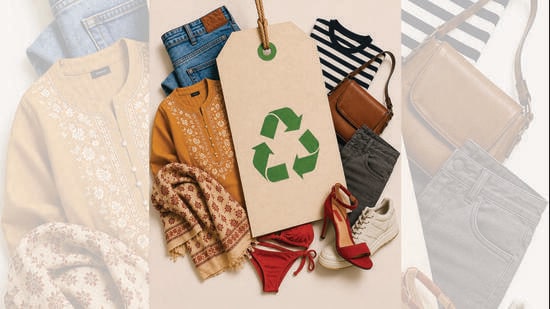
A red dress in Mumbai has already lived three lives.
Its first owner wore it the evening she met the man she would marry. Its second and third each wore it to a date that went exceptionally well. That’s when it got its nickname on the resale-tech platform Relove (which lets fashion brands run secondhand marketplaces on their own websites): The lucky red dress.
Put like that, who wouldn’t want to wear it next?
The dress and its story offer an interesting snapshot of major shifts in the resale and preloved markets in India, over the past decade.
We’ve gone from informal second-hand wear that felt like a punishment to the era of discount bins for designer lehengas (which let the buyer acquire something they could never have afforded fresh off the mannequin), to an era of Instagram influencers dumping a whole summer’s worth of resort wear online, because they can’t post in it any more.
Buyers have levelled up too, figuring out when to look for “lightly worn” and when to settle for “shows signs of use” (designer bags, for instance), and exactly how much to pay in either case.
{{/usCountry}}Buyers have levelled up too, figuring out when to look for “lightly worn” and when to settle for “shows signs of use” (designer bags, for instance), and exactly how much to pay in either case.
{{/usCountry}}This is also an era of trusted platforms that prioritise curation, repair and price expertly, and are careful about what castoffs to accept and how to resell them.
So who’s buying, what’s changing and how can you cash in?
The glow-up
Perhaps the biggest shift is that preloved has become aspirational. A rare pre-loved find is something to boast about; a prestige piece is a gentle flex.
It helps that the segment has shifted globally too, from largely old-people things at flea markets (crockery, leather jackets, formal shoes, generally high-quality but well-worn) to young brands and silhouettes, barely-used shoes, premium resort wear, etc.
Meanwhile, in trend-setting South-East Asia, branded workwear, trending backpacks, Stanley cups and sneakers make thrifting fun, even for the initially-wary Indian traveller. In Bangkok and Kuala Lumpur, some malls now devote entire floors to pre-loved items, with high-value bags in locked cases.
This has changed how collectors engage.
On a recent trip to Japan, Nitinn R Miranni, 47, an artist, fashion choreographer and stylist, bought a vintage Christian Dior tie for his 300-strong collection. He has contributed to the community too.
The self-confessed ex-hoarder has handed over Louis Vuitton jackets, Alexander McQueen suits and rare Air Jordans. Women have bought his McQueen suits, he says, and turned them into entirely new outfits.
“Thrifting isn’t about ‘buying old things’,” Miranni says. “It’s about giving good things a new chapter.” There is a romance to it, he adds. “Sometimes you look at a garment and wonder about the person who wore it before you. Then you become part of that garment’s continuing legacy.”
Kimaya Singh, entrepreneur and founder of the upcycled fashion label Mirchi, shops regularly, for her own wardrobe, on the thrifting platform My Almari.
She likes to offer a reminder that India, in its own way, wrote this chapter first.
“We’ve always treasured heirlooms. Jewellery and sarees are passed down with pride,” she says. She has been shopping in her grandmother’s closet since she was a child, she adds. “If I need a new pair of sunglasses, I go to her wardrobe. She has pairs from the ’50s and ’60s.”
Racks to riches
“Gen Z has normalised pre-loved fashion by valuing individuality and conscious consumption,” says Roshni Vora, 28, who started the online thrift store Aesthriftics while in college in Mumbai, in 2020. (It has since evolved into Bron, which sources new pieces from major labels with minor defects, and sells them at a fraction of the retail price tag.)
An avid thrifter, her best find so far has been a branded top worth about ₹6,000, bought for ₹700.
Being able to brag about a find like that is now a fashion goal.
That’s what helped sisters Sana Khan, 37, and Alfiya Khan, 29, launch Bombay Closet Cleanse. They pooled clothes from their closet and hosted their first thrift pop-up in their living room in Mumbai six years ago. BCC is now also a store in Bandra, with plans for pop-ups in Goa. Varun Dhawan and Mrunal Thakur are among those who have consigned items to their collections.
“Thrifting has become aspirational,” says Sana.
Fitted Y2K tops and vintage denim vanish almost instantly. “What sits are skinny jeans,” adds Sana, laughing. “They’ve been waiting patiently for their comeback.” (Some unsold pairs are eventually upcycled as bags.)
Trust is vital, she says. Buyers need to know that the logos are real, the stories, authentic.
Storytelling is the entire business model at Unfound, a thrifted-fashion concept store in Bandra founded by Candice Pereira.
Here, pre-loved items get the gallery treatment: each contributor gets a dedicated rack, with a curatorial note introducing the owner, and detailing memories linked to various pieces. “Traditionally, once a garment enters the resale market, its story disappears. We wanted to do the opposite,” Pereira says. As buyers style their finds and tag the first owners; the garment’s tale continues to unfold.
Watch out
At the luxury end of the scale, the shift has taken a bit longer.
“In India, luxury has always been associated with buying brand new. There was a stigma around anything pre-loved, and many people who owned luxury weren’t comfortable selling either,” says Niti Goenka, 41, co-founder of My Almari.
The turning point for her came when an early customer returned to consign different parts of her collection, first in 2024 and again in 2025, in Mumbai.
“Our buyers were becoming sellers, and our sellers were becoming buyers,” Goenka says.
Today’s buyer has done their homework. “Conversations don’t revolve around price and authenticity alone. People ask about types of leather, fabric, rarity.” Every order ships with a third-party Certificate of Authenticity, because counterfeits are now so sophisticated. Demand has risen in Jaipur, Ahmedabad and Hyderabad, Goenka says.
Entrepreneur and influencer Naimita J bought a Louis Vuitton x Murakami Cherry Speedy handbag from 2003 on My Almari last July, for about ₹60,000; comparable pieces now cost several lakhs. “Owning a vintage Vuitton or Hermès piece isn’t just about the label anymore. It’s about appreciating craftsmanship,” she says.
Fellow My Almari shopper Shubalaxmi has hunted down discontinued rarities, such as the Prada face-art bag. Her most prized find is a Bracher Emden bag worth ₹3 lakh that she snagged for just over ₹30,000.
The next resale frontiers are watches, sneakers and bridal wear, which tends to be high-value, worn once and built for a second act, says Divam Jain, associate professor and department lead at the Pearl Academy School of Business. Demand will come from a wider market. Non-metros already account a chunk of pre-owned luxury watch sales, she says.
Singh of the upcycled label Mirchi adds that she is particularly hopeful of what this could mean for shopping habits, and carbon footprint. “The goal shouldn’t be to convince people to buy more,” she says. “It should be to make things so thoughtfully that someone still wants them 20 years from now.”
From HT Brunch, September 5, 2026
Follow us on www.instagram.com/htbrunch