
 E-Paper



The art of the unwind: Holiday hacks and memories with Shivan & Narresh

 Prefer HTon Google



The designers have shown Indian women how to holiday in style. Their own vacays are epic, gathering inspiration at every destination
Think of Delhi designers Shivan Bhatiya and Narresh Kukreja as young India’s favourite beach boys. In a market blinded by shiny, embellished bridalwear, their resortwear label, Shivan & Narresh, has set fashion goals for women vacationing along the coast, by the pool, on a cruise and every sunny spot where they can let their hair down. The swimsuits carry unique prints and bold colours, beads and jewels. The ensembles draw inspiration from their travel adventures, art and artists. It’s sexy, flirty, whimsical work that somehow manages to keep the right curves reined in. It’s geared towards millennials and Gen-Zs, Kukreja says. It’s safe to say they know a thing or two about acing a vacation.
Tie ups
As collaborators, Bhatiya, 39, and Kukreja, 37, are distinctly separate. “If I am on a ten-day holiday, I will carry twelve looks with me,” Kukreja says. Bhatiya is the overpacker. “He will pack five bags and pack for others as well.” Bhatiya admits to this easily. “I carry my world in my bag when I step out of the hotel, Narresh doesn’t have a thing on him.” Kukreja tends to only carry his wallet and phone. “Even a wallet weighs me down!”
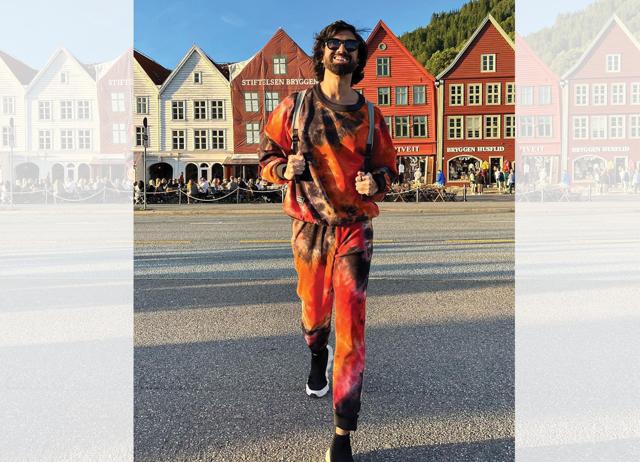
The label, however, is “50% Shivan and 50% Narresh”, says Bhatiya. It’s functionality and fantasy all at once. They launched it in 2010, after graduating from the National Institute of Fashion Technology, Delhi, and completing their Master’s at Italy’s prestigious Istituto Europeo di Design.
“In college, we would keep winning competitions in the swimwear and lingerie categories,” Bhatiya recalls. “We didn’t care about weddings,” Kukreja says. “We wanted to travel the world.” They figured, given India’s large young population, which prioritises taking a break and looks for excuses to travel, and with the rise of destination weddings, it was a no-brainer.
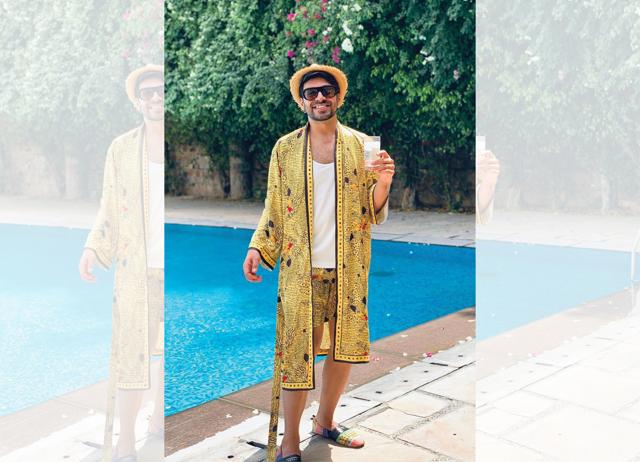
Getting Indians to dress better for the beach took some doing. “In our parents’ generation, women would either be seen in nighties or jeans at beaches,” Kukreja says. Swimwear – shiny, stretchy, garishly coloured, badly sewn – was reserved for hotel pools, gymkhanas and competitive events. It sat at odds with the rest of modern India’s holiday wardrobe. It reflected nothing of what was happening in Indian fashion. Shivan & Narresh hoped to change that.
Incoming stitch
Swimsuit fabric is stretchy, skimpy, unlined and light. It’s notoriously difficult to construct with and not easily available in India. “It wasn’t easy to find skilled Indian labour for them,” Kukreja says. So, when they returned from Italy, they had to train their craftspeople from the ground up, using reams of swimwear fabric they’d physically carried back. “We had learnt from Shivan’s pattern-maker, who worked at Dolce & Gabbana, and had to train our workforce in that kind of construction,” Kukreja adds.
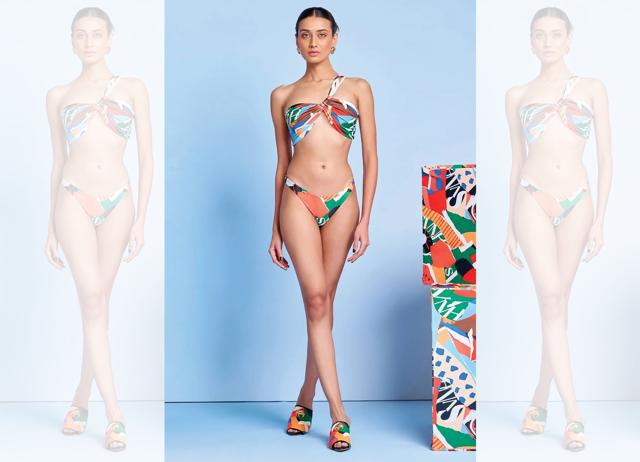
Four years after their launch, the duo launched bikini saris, reimagining the swimwear staple as something to wear to soirees and cocktails too. It took fashion by storm, catapulting them to international fame as celebrities such as Padma Lakshmi, Dita Von Teese and Nicki Minaj wore them to galas. They were also the first Indian label to showcase at the Mercedes-Benz Fashion Week Swim in 2012 in Miami.
If Indian women happily show off images of themselves in maillots and bikinis on Instagram today, it’s because Bhatiya and Kukreja helped make the garments more than generic and functional. The duo also believe that resortwear is the most “democratic and global” category for innovation, because “everyone thinks the same way on a holiday, no matter which part of the world they are from,” Bhatiya says. “We all want to feel desirable and look sexy as we vacation,” Narresh says.

The world could take a leaf out of the Indian holidayer’s book, and learn to dress their best while travelling, says Kukreja. Western tourists are traditionally averse to wearing bright colours, even at tropical destinations. Indians, on the other hand, love colour, and might do well to tone it down while they unwind, not just with their palette. “We really are the loudest everywhere we go,” Bhatiya admits, laughing. “I was recently in Bhutan. There were other visitors from India, and it was easily the loudest group there, so everyone knew that it was the Indians making the most noise. I couldn’t even say anything because I too was part of the same crowd.”
The Shivan & Narresh food trip
Where to go for...
Trendsetting meals: Norway. India spoils visitors with local delicacies in every region, Chinese, Italian and global foods “all averagely made,” Kukreja says. In contrast, Norway restaurants “would have only five to seven dishes on their menu – starters, mains and desserts. But all of it would be phenomenally made with local produce. The meals were the most expensive they’ve had in a while. They didn’t mind.
Unlikely combinations: Earlier this year, the duo travelled to Kenya for a safari holiday. “We loved the food at Masai Mara,” Kukreja says. But it was in Nairobi that they had their best meals. At Inti, they tried Japanese-Peruvian cuisine, at Cultiva they had a farm-to-table meal, at Talisman it was a mix of European, Asian and African cuisines.
The finer details: Japan.The designers couldn’t get enough of Tokyo and Kyoto. “The gyozas at Chao Chao Sanji Kiyamachi in Kyoto … Oh my god! They’re insane,” Kukreja says. It’s worth the three-hour queue. “And then there is the tempura at Ginza Ten-ichi in Tokyo,” says Bhatiya. Watching the chef prepare it, it seemed “like he was meditating; it was blissful to watch him at work, and then, of course, eat it. It was so fresh and light.”


