
 E-Paper



A world map of childhood obesity


 Prefer HTon Google



More children today are obese than underweight. Which countries are worst affected?
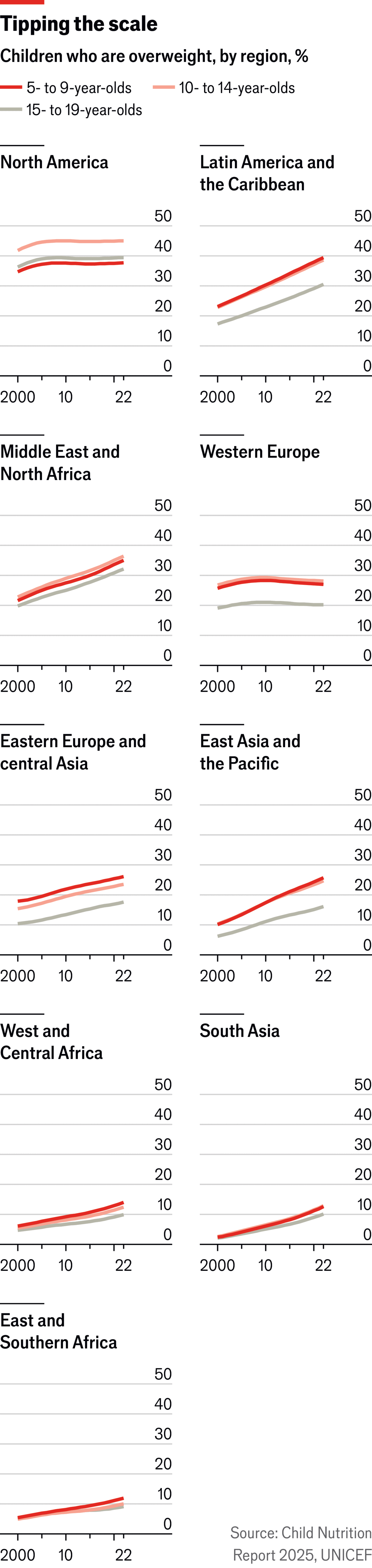
IN SOME PARTS of the West, children of healthy weight have become the exception. In poor countries, childhood obesity is spreading faster than ever before. The problem is not new: the percentage of overweight children around the world crept up in the 1980s, as junk food became a dietary staple. But the trend today is alarming. A report by UNICEF, the United Nations’ children’s agency, published on September 10th, found that the number of school-aged children who are obese is, for the first time, higher than those who are severely undernourished (see chart 1). One-fifth of children aged 5-19 are overweight; of them, half are obese.

UNICEF defines overweight as a body-mass index one standard deviation above the World Health Organisation’s median for healthy growth, and obese if it is more than two. In Niue and the Cook Islands nearly 40% of 5-19-year-olds are obese—the highest rates in the world (see map). The South Pacific also has some of the worst adult-obesity rates, fuelled by shifting diets and a culture that prizes size. America ranks in the top 20 countries for childhood obesity, with a rate of 20%. In Europe, Hungary leads with 15%.
Poor countries are particularly ill-equipped to cope. Health systems there were built to fight hunger, not obesity. Many babies are born underweight because of poor diets in pregnancy and scant antenatal care. That alters their metabolism and makes rapid weight gain, diabetes and other chronic diseases more likely in adulthood. In South America and parts of Africa and the Middle East the share of overweight children is already higher than in western Europe and is nearing the 45% seen in North America.
The reason is simple: cheap, heavily processed foods are now a daily part of children’s diets across the world, crowding out fresh fruits, vegetables and proteins. In a survey of 20 poor and middle-income countries, UNICEF found that in 13 more than half of infants aged 6-23 months had consumed sweet drinks or sugary foods the previous day. Even in Britain many ready-to-eat baby pouches marketed as healthy are far from it. In countries with lax regulation, the fare is worse. A study of hundreds of infant and toddler foods sold in seven South-East Asian countries found that half were ultra-processed, meaning they are laden with sugar, salt and ingredients not typically found in a home kitchen. A third contained additives that are not permitted under the Codex Alimentarius, the UN’s food-standards code.
But changing diets is hard. Ultra-processed foods are, on average, about 50% cheaper than fresh or minimally processed foods, according to the UN’s flagship report on food systems. A global survey of school meals in 2024 found that 25% of schools served processed meats, 21% served sweets, 19% served deep-fried food and 14% provided sugar-sweetened drinks. With many adults eating poorly, meals at home also pack lots of calories but lack healthy nutrients such as fibre, protein and vitamins.
Stronger rules that restrict the advertising and sales of unhealthy foods could help. So could subsidies to make good food cheaper. What children eat early shapes their tastes for life. Adult diets are habits fixed in childhood. Once formed, those tastes are hard to shift.


Catch your daily dose of Fashion, Taylor Swift, Health, Festivals, Travel, Relationship, Recipe and all the other Latest Lifestyle News on Hindustan Times Website and APPs.


