About 107 million people voted on Thursday across 12 states and Union Territories in the second of India’s seven-phase staggered general elections amid reports of violent clashes from eastern and southern regions and sporadic complaints of faulty electronic voting machines (EVM).
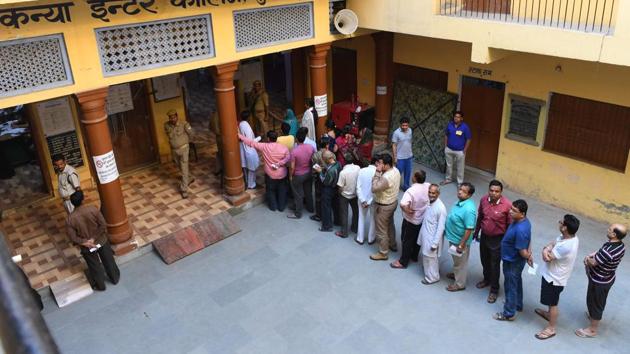
The voter turnout stood at 67.94% at 11pm, as reported by the Election Commission of India’s (ECI) official app. The highest turnout was reported from Manipur (78.19%) , where one seat went to polls, followed by Puducherry (77.49%) where voting took place on the lone seat of the Union Territory. The lowest turnout was reported from Jammu and Kashmir (45.64%), where two Lok Sabha seats went to polls.
The turnout numbers are provisional and likely to be updated as many people were waiting to cast their votes at polling stations.
The turnout in the second phase of the 2014 general elections was 69.6%.
Deputy election commissioner Sudip Jain said 1,000 ballot units, 769 control units and 2,766 paper trail machines were replaced due to glitches.
The poll watchdog announced that the total number of electors across India currently stood at 909 million, with nearly 10 million people added in the past two months. The seven-phase exercise ends on May 19 and the results for all 543 Lok Sabha seats will be declared on May 23.
{{/usCountry}}The poll watchdog announced that the total number of electors across India currently stood at 909 million, with nearly 10 million people added in the past two months. The seven-phase exercise ends on May 19 and the results for all 543 Lok Sabha seats will be declared on May 23.
{{/usCountry}}Violence was reported from West Bengal, where three Lok Sabha seats went to polls. The car of Communist Party of India (Marxist)’s leader Mohammad Salim, the incumbent MP and Left candidate in Raiganj, came under attack allegedly by supporters of the ruling Trinamool Congress (TMC).
“Several booths were captured by the TMC and the presiding officer and the state police personnel stood helplessly,” alleged Salim, who is facing a tough challenge from Congress’s former MP Deepa Dasmunshi, Bharatiya Janata Party’s (BJP) Debasree Chaudhuri and TMC candidate Kanaia Lal Agarwal.
The BJP alleged that TMC-backed troublemakers fired in the air outside a polling booth at Ghughudanga within Jalpaiguri constituency — which the BJP hopes to wrest from the TMC. Poll officials said they had no confirmation of the incident.
In Kalimpong under the Darjeeling constituency, which the TMC is trying to wrest from the BJP, a polling agent of the latter party, Topden Tshering Bhutiya, was attacked.
In Chopra in Darjeeling, security personnel fired tear gas shells and baton charged protestors who accused workers of the ruling party in the state of obstructing them from casting their votes. The protestors, who were blocking NH 31, also hurled crude bombs at the police, officials said.
And in Purulia, which goes to the polls on May 12, the body of a BJP worker was found hanging from a tree.
BJP general secretary Bhupender Yadav said the election commission has appointed special poll observers, yet on Wednesday the body of a BJP worker was found hanging from a tree. “We condemn this violence and expect the EC to seek a report on this killing,” he said.
As reports of clashes poured in, an additional 50 companies of paramilitary forces — each company comprises about 150 soldiers — was rushed to the eastern state, senior government officials who did not want to be named said. With the additional deployment, the total number of paramilitary forces in the state goes up to 330 companies and a total deployment of about 50,000 troops.
Senior government officials in New Delhi expressed concern over poll-related violence in West Bengal. “Despite best efforts, deployment of troops is often delayed by pliant state-government officials and local police officials,” a second senior official, who did not want to be named, said.
.“Let the election commission deploy central forces everywhere. We are not bothered,” said Bengal minister Sadhan Pande.
Clashes were also reported from Tamil Nadu, where elections were held on 38 Lok Sabha seats and 18 vacant assembly segments. A worker of the opposition Dravida Munnetra Kazhagam (DMK), MS Pandian, was hacked to death at Keerathurai in Madurai while violence erupted in Ambur and Gudiyattam assembly seats.
At least 20 houses were damaged in a clash between the Viduthalai Chiruthaigal Katchi (VCK — an ally of DMK) and the All India Anna Dravida Munnetra Kazhagam (AIADMK) workers in Chidambaram. Polling was temporarily halted at Solapur’s Shastri Nagar due to faulty EVMs.
Reports of glitches also came from Silchar in Assam, Mathura in Uttar Pradesh, Coimbatore in Tamil Nadu, and Bolangir in Odisha.
The second phase is crucial for opposition parties, which had cornered a lion’s share of these seats in 2014. Of the 95 seats that voted on Thursday, the National Democratic Alliance (NDA) won 33, the United Progressive Alliance (UPA) won 15 while non-NDA, non-UPA parties won 47 seats.
The largest chunk of seats are up for grabs in Tamil Nadu, where the ruling AIADMK has cobbled together a jumbo coalition, including the BJP, to stave off a strong challenge from the DMK-Congress alliance. In 2014, the AIADMK had won 37 of the 39 seats on offer but the party has since suffered an erosion in support following the death of chief minister J Jayalalithaa. The state is also witnessing crucial bypolls on 18 assembly seats – the results of which will have the potential of upsetting the state government. The AIADMK government commands a slim majority in the 234-member assembly currently.
Neighbouring Karnataka saw 14 seats go to polls with a turnout of 68.16%. The state is witnessing a straight contest between the ruling Congress-Janata Dal (Secular) alliance and the BJP. The BJP had won six of these seats the last time but is facing a stronger challenge from the coalition partners this time around.
In Maharashtra, 10 seats in the drought-hit central and eastern Maharashtra saw a turnout of 61.79%. The Congress-Nationalist Congress Party and the BJP-Shiv Sena coalitions are facing a third front in the form of the Vanchit Bahujan Aghadi, an outfit headed by BR Ambedkar’s grandson, Prakash Ambedkar.
In Uttar Pradesh, the BJP will look to retain control of all eight seats that voted on Thursday, though it is facing a tougher battle because of an alliance between traditional rivals Bahujan Samaj Party and Samajwadi Party.
In the north, Voting was especially low in Srinagar amid a boycott call by separatists, stray incidents of violence and a suspension of mobile internet. The capital city recorded a turnout of 14.1%, higher than the 2017 bypolls but lower than the 2014 general elections.