Residents of Ghaila village, 20 kms from the state capital, are paying the price for their proximity to a bustling city like Lucknow. A clean place 10 years back, it has turned into a ‘mountain of garbage’ as the Lucknow Municipal Corporation has dumped millions of tonnes of solid waste in a secluded area of this village.
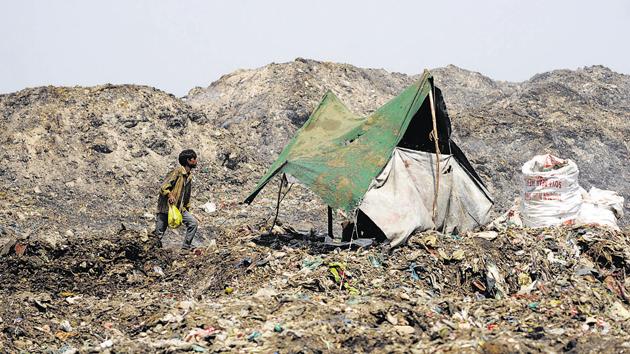
Spread over an area of 661.25 hectare, Ghaila – with a total population of 3,323 people – is a living example of poor solid waste management for any city in the world, courtesy lack of environmental understanding among civic agencies.
The 519 houses here are living amid stink, polluted air and polluted water. Before the villagers could realise the gravity of the damage the garbage had caused to their environment, tonnes of Lucknow’s filth was already piled up like towers in the village.
Residents of Ghaila organised a number of demonstrations and even chased away trucks of LMC, which were dumping garbage at the site. But that was not enough to keep the filth away from their village. They approached the National Green Tribunal and the pollution control Board. These bodies directed the municipal corporation not to dump waste in Ghaila.
As a result, LMC has been grappling with the problem of dumping the 1,500 metric tonnes of solid waste produced in the city at any new landfill site because the landfill site of Shivri is still not able to handle waste, even at its full operational capacity.
{{/usCountry}}As a result, LMC has been grappling with the problem of dumping the 1,500 metric tonnes of solid waste produced in the city at any new landfill site because the landfill site of Shivri is still not able to handle waste, even at its full operational capacity.
{{/usCountry}}The villagers say they are unable to bear the stink emanating from the filth. They had been protesting against the dumping of waste but the local administration along with LMC never paid heed to their demands.
Only after the interference by NGT and Pollution Control Board, the LMC promised to stop dumping the solid waste at Ghaila.
“Stopping the dumping is not enough, we need the treatment of such waste,” said Subhash Singh, a resident of Ghaila.
Read more: Waste management in a mess, Lucknow growing by heaps and bounds!
According to LMC’s environment engineer Pankaj Bhushan, “Municipal authorities need to prioritise public health and quality of life when transitioning to modern waste management systems. The corporation has invited expression of interest proposals from companies dealing in solid waste management to tell what LMC can do at a site like Ghaila. The companies can come out with a proposal to develop capping on filth.”
He said capping of filth would be done with clay in a scientific way. A park would be developed on 70 acre area where garbage has been dumped all these years. This will help decompose the garbage slowly. The park will feature an intricate system for capturing the gaseous results of decaying garbage.
“The trash of the past will be converted into a landscape as a usable and beneficial public space. We will show how a dead landfill can be beautifully reborn as a park,” said Bhushan.
He said another way of handling filth is composting of waste but the waste at Ghaila has a high amount of plastic and polythene content so this would reducing chances of composting here.
Municipal commissioner Udairaj Singh said, “Composting is the natural process of decomposing and recycling waste material into a humus-rich soil by successive action of bacteria, fungi, actinomycetes, or earthworms.”
But here, many common materials can be composted on-site, and many cannot. Those which can be composted are food wastes, leaves, grass clippings, plant trimmings, straw, shredded paper, animal manure, and municipal solid wastes. But plastic, polythene, biomedical waste cannot be composted, he added.
Environmentalist VK Joshi said, “Composts have some disadvantages if they are processed or used under inappropriate conditions. But unscientific dumping of waste must be avoided and the LMC must develop at least 10 landfill sites for a big city like Lucknow, where around 50 lakh people live at a time. The corporation should not depend on a single landfill site for dumping waste of an entire city. Resident welfare societies must also be encouraged to set up small solid waste plants in which waste of colonies can be recycled.”
Read more| Hazratganj: The heart of Lucknow needs a makeover