Venturing into Mumbai’s beaches or swimming in its waters may no longer be safe. Across beaches in the city, faecal coliform (FC) — a bacterium found in human and animal excreta — is between 100 and 1,000 times higher than a permissible limit set by law, according to a study by the National Environmental Engineering Research Institute (NEERI) in Nagpur. The study focused on the impact sewage discharges have on water quality on the west coast
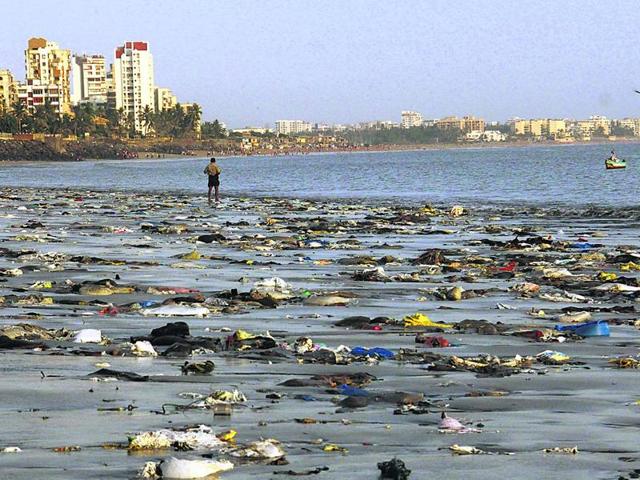
For the sea-loving Mumbaiite, this means even the slightest intake of this contaminated sea water while swimming could lead to gastrointestinal illnesses like nausea, vomiting, diarrhoea and stomach pain, headaches, fevers, respiratory infections and skin and eye irritation.
You aren’t any safer standing on the shore. The faecal bacteria also stay on sand and other sediments on beaches.
The FC count at Bandra – one of the city’s two major sub-marine outfalls that discharge treated sewage – stood at 15 million bacteria colonies per 100 millilitres (15 million Colony Forming Units/100ml), as against the permissible limit of 100 bacteria cells per 100 ml (100 CFU/100ml) in the receiving water body.
At the Worli outfall, the FC count in treated effluent was 3.1million CFU/100ml.
Similarly, at the Malad and Versova creek discharge points, FC counts were found to be 21 million CFU/100ml and 46 million CFU/100ml.
{{/usCountry}}Similarly, at the Malad and Versova creek discharge points, FC counts were found to be 21 million CFU/100ml and 46 million CFU/100ml.
{{/usCountry}}“Faecal contamination at discharge points is very high. Although the sewage does get diluted when it mixes with the sea and the creek water, the FC count is still 100 to 1,000 times higher at all the city’s beaches,” said Ritesh Vijay, the lead investigator at NEERI.
“The west coast is highly contaminated with bacteria. There is no treatment to remove the bacteria in the existing facilities,” he said.
What’s worse is sewage from nullahs and drains that flow into the sea and the creeks adds to the high bacterial concentration.
For instance, the FC count in sewage inside drains or nullahs is between 1 million CFU/100ml and 60 million CFU/100ml.
“The main issue of faecal coliform near the sea shores is open defecation and open discharge from drains. The quantity is less, but it will create problems,” said Rakesh Kumar, director, NEERI.
Kumar said NEERI has also recommended to the civic body that nullahs be connected to the sewage system wherever feasible and then treat the effluents.
“Secondly, all nullahs are connected to slums or slum redevelopment projects, and laying sewer lines won’t happen in the next 5-10 years. Till then, waste water can be treated in the nullahs itself before going into the sea,” said Kumar.
At present, the west coast receives untreated wastewater or sewage from drains and treated effluent only come from preliminary (Malad), primary (Worli and Bandra) and secondary (Versova) levels of wastewater treatment facilities (WWTFs).
For the study, coastal water quality was monitored at 12 locations along the west coast at 1km, 3km, 5km and 7km from the coastline, and at the Worli and Bandra outfalls.
Samples were also collected from 17 nullahs, and effluent from WWTFs discharging into creeks and the coast.
It was between 2001 and 2003 that the civic body commissioned 3.7km and 3.4km long sea outfalls at Bandra and Worli, 65 metres below the mean sea level, to discharge fully or partially treated sewage into the Arabian Sea.
The study also showed that Biochemical Oxygen Demand (BOD) – the concentration of oxygen required for aquatic life – does not comply with the standards set by the Central Pollution Control Board.
Levels of BOD from the Worli outfall that discharges 300 million litres per day (MLD) of treated effluent into the sea was 170mg/l as against 100mg/l.
At the Bandra outfall, which sends 350 MLD million litres of treated sewage every day, BOD level was 120mg/l.
Also, treated sewage discharged into the Malad (100MLD) and Versova (90MLD) creeks was found to be 160mg/l and 25mg/l as against the permissible limit of 20 mg/l.
Similar to faecal contamination, BOD levels from untreated sewage discharged through drains in Worli (150MLD) and Bandra (300MLD) reached almost twice the permissible limit – in the range of 65mg/l and 150mg/l, and from150mg/l to 280mg/l. At Malad (225MLD) and Versova (75 MLD), BOD levels were nearly five times the permissible limit – in the ranges of 125mg/l-290mg/l and 175mg/l-260mg/l.
With the civic body planning an ocean outfall system in Erangal at Malad, NEERI scientists simulated three scenarios by 2025 – no improvement in the existing sewage disposal, 50% improvement and 100% improvement – taking into account an increase in quantity of waste water generated by Mumbai.
With no improvement, FC count continued to stay high at 50 million CFU / 100ml in effluents from Worli and Bandra outfalls, and 30 million CFU / 100ml at Malad and Versova creeks. A 50% improvement would mean 5 lakh CFU / 100ml in treated effluent from sewage treatment facilities, and 100% improvement would continue to see a high FC count of 1 lakh CFU / 100ml in treated effluent in the absence of any provision for bacterial treatment.
Stay updated with all the Breaking News and Latest News from Mumbai. Click here for comprehensive coverage of top Cities including Bengaluru, Delhi, Hyderabad, and more across India along with Stay informed on the latest happenings in World News.
Stay updated with all the Breaking News and Latest News from Mumbai. Click here for comprehensive coverage of top Cities including Bengaluru, Delhi, Hyderabad, and more across India along with Stay informed on the latest happenings in World News.