In April, Kathmandu, Nepal’s capital and largest city, banned the use of vehicle horns. There was skepticism whether the rule will be enforced, but six months later there are reports that the city’s roads are quieter.
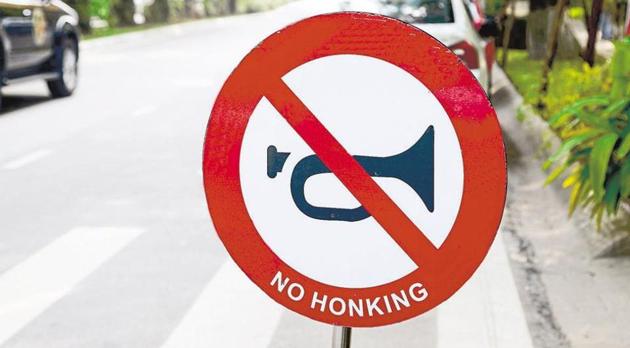
Should Mumbai follow Kathmandu’s example? Visitors to Mumbai have remarked that the city is incredibly noisy and one reason for this is the incessant honking by vehicles. A World Hearing Index — a global ranking created at Mimi and Charite University Hospital in Berlin — found that a Mumbai resident has the hearing ability of an individual almost 19 years older. HT had reported about this study.
Though there have been campaigns by the police to make the roads less noisy, the city’s efforts to rein in obsessive honkers have been unsuccessful. A study done by anti-noise campaigner Awaaz Foundation earlier this year, found that noise levels at Hutatma Chowk (Flora Fountain) was 97.1 dB, as loud as a blow dryer. At Mohammad Ali Road, where traffic noise is amplified by a road viaduct, sound levels touch 115dB, as loud as a concert. Vehicle horns are the source of this noise. Some silence zones — areas around hospitals, schools, where loudspeaker use is banned — are among the noisiest places in the city. The excessive noise causes more damage to the human body than just hearing loss; doctors have said that constant exposure to high sound levels can lead to psychological and physiological problems.
Sumaira Abdulali of Awaaz Foundation, who wrote the state chief minister in May about Mumbai’s traffic noise, has also tested noise levels inside homes in London and compared them to Mumbai. She found that even homes located on busy London roads are so quiet that noise levels are under 30dB — equivalent to the sound from a whisper — during the day. When the windows were covered in sound-restricting double glazed windows, the noise fell even further. This is because there is no honking.
{{/usCountry}}Sumaira Abdulali of Awaaz Foundation, who wrote the state chief minister in May about Mumbai’s traffic noise, has also tested noise levels inside homes in London and compared them to Mumbai. She found that even homes located on busy London roads are so quiet that noise levels are under 30dB — equivalent to the sound from a whisper — during the day. When the windows were covered in sound-restricting double glazed windows, the noise fell even further. This is because there is no honking.
{{/usCountry}}In contrast, noise levels in Mumbai homes located next to busy streets can be higher than 50dB, going up to 90dB during noisy festivals. The findings indicate that noise levels outside Mumbai hospitals are far more than outside London hospitals, although hospitals in both cities are located on busy roads carrying large volumes of traffic.
In the absence of noise limits or restriction on honking in India, busy traffic junctions have noise levels that are hazardous to health. The average noise level from vehicle horns in Mumbai is 110 decibels (dB) – that is as high as a live rock band. This is significantly above the estimation by the World Health Organisation (WHO) that says long- term exposure to noise levels from 85db to 90db is enough for hearing loss. “I find that horns are of no use anyway in Mumbai. If everybody is using it, it does not help,” said Abdulali. “It gives a false sense of security but makes driving more dangerous.” Abdulali gives the example of Peddar Road, an important north-south artery in Mumbai. The road is very noisy, largely because of honking. “At night there are hardly any vehicles but the honking continues,” said Abdulali.
While it is tempting to explain India’s obsession with vehicle horns as a cultural peculiarity, Nitin Dossa of the Western India Automobiles Association dismisses the notion. “Where it the horn use overseas. I use it here but not in London. Indians do not honk there,” said Dossa. “There is a fine in London for honking, we are poor at implementing rules.”
One reason that is offered to explain the need for vehicle horns are the conditions on Indian roads – pedestrians, stray animals, vehicles cutting lanes. But Kathmandu’s streets are as chaotic as those in Indian cities. There are jaywalkers, stray animals, shoppers on the road. The city does not have traffic lights. “If Nepal can ban vehicle horns, we can. It is an absolute nuisance and unnecessary,” said Dossa. In Kathmandu, police organised a campaign to bring changes in the motorists’ behaviour and fines were imposed to enforce the ban. “It is not because of culture; it is because of the lack of will to enforce a ban,” said Abdulali. “In a situation where every driving school instructor tells students that you cannot drive without using horns the habit is difficult to break.”
Stay updated with all the Breaking News and Latest News from Mumbai. Click here for comprehensive coverage of top Cities including Bengaluru, Delhi, Hyderabad, and more across India along with Stay informed on the latest happenings in World News.
Stay updated with all the Breaking News and Latest News from Mumbai. Click here for comprehensive coverage of top Cities including Bengaluru, Delhi, Hyderabad, and more across India along with Stay informed on the latest happenings in World News.