In what might throw light on the ancient culture and structure of human beings of the Harappan era, experts on Monday claimed to have collected DNA samples from skeletons at a site in Rakhigarhi, a village in Hisar district in Haryana, 169 km from Gurgaon.
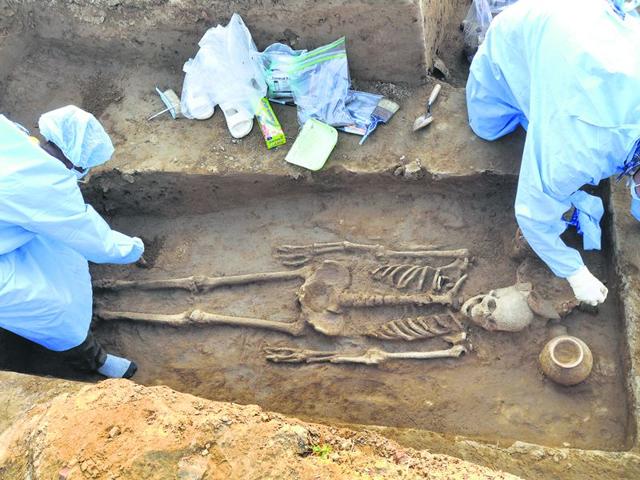
Professor Vasant Shinde, vice-chancellor, Deccan College Post-Graduate and Research Institute, a deemed university in Pune, and director of the current excavation at Rakhigarhi who is associated with the excavation work since 2001, said: “This is for the first time we collected DNA samples that hold all the answers about the lost ancient civilization.
With the help of the South Korean scientists, we have transported the human burials to Deccan College. Soon we will be able to throw light on their body structure, habits, environment and their population.”
Shinde added that earlier the team had unearthed a few human burials but failed to store DNA samples as they got contaminated.
The scientists also collected parasites from the burial soil as they can also provide DNA samples. The team will declare the result after examination of the samples.
The team has found nine mounds in the area, after which the total area of the Rakhigarhi site is around 350 hectares, which is 50 hectares more than Mohenjo-daro.
{{/usCountry}}The team has found nine mounds in the area, after which the total area of the Rakhigarhi site is around 350 hectares, which is 50 hectares more than Mohenjo-daro.
{{/usCountry}}Much of the Harappan site at Rakhigarhi remains buried under the present village. “It was earlier thought that early Harappan phase originated in Sind, in present-day Pakistan. In the past 10 years, we have discovered many sites in this part, which goes back to time even before the known Harappan civilization,”he added.
RS Fonia, joint director general, ASI, said: “We are tracking the climatic changes that took place in the area which is considered as one of the reason for the destruction of the civilization.”