In the book Angels and Demons by American author Dan Brown, a physicist at CERN successfully creates a substantial amount of antimatter and traps it in a portable magnetic canister. This is stolen by a rogue faction and since it can only remain stable for 24 hours, the story becomes a race against time to find the device before it wipes out the entire Vatican City.
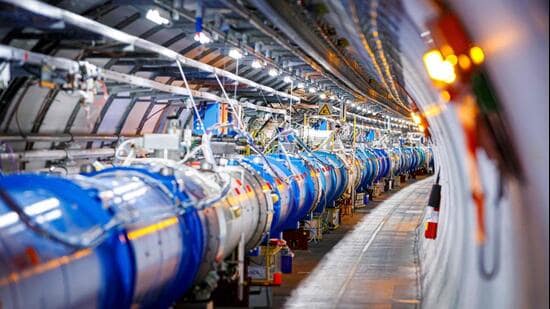
Part of Brown’s fiction became reality earlier this year when a lab at CERN successfully transported antimatter. Just a few months before the Large Hadron Collider (LHC) closed down for upgrades, CERN’s Baryon Antibaryon Symmetry Experiment (BASE) team, successfully trapped antimatter and ported it across their campus. Instead of a Stanley cup-sized canister like in Brown’s imagination, the container weighted 1000kg. The antimatter trapped – a mere 92 antiprotons -- was just about enough to self-annihilate a hundred atoms.
But even this little action is a major feat in particle physics and engineering. The reason is what makes antimatter such a villain favourite in fiction – it very tricky to stabilise and contain. “The moment it gets in contact with ordinary matter, it annihilates and is transformed into energy,” says Dr Christian Smorra, a physicist who leads the BASE-STEP team in the Antimatter Factory at CERN. He’s the one who built the transportation canister.
The case of the missing antimatter
{{/usCountry}}The case of the missing antimatter
{{/usCountry}}In current physics, scientists believe that for every fundamental matter particle in the universe, there exists a corresponding antiparticle with the same mass but opposite charge. A antielectron for an electron, an antihydrogen for a hydrogen atom.
If we follow this Standard Model of particle physics, the Big Bang should have produced an equal amount of matter and antimatter. There should be more instance of antimatter around us – at the macro level (like planets or aliens made of antimatter) or atomic level. For a reason that we don’t understand yet, the universe today is all matter and almost no antimatter. Where did the excess antimatter go? This asymmetry of matter and antimatter in the universe is called the Baryon Asymmetry Problem and that’s what the team at BASE is trying to solve. “We need to investigate antimatter particles to check if the symmetry holds or if there is an aspect missing in our understanding of the fundamental interactions in Nature,” says Dr Smorra.
The one thing we do know is that antimatter exists. Even humans or a humdrum banana produce antiparticles, but the moment the subatomic antiparticle comes in contact with air or the banana’s potassium, it self-annihilates. It’s a massive engineering hurdle to produce an antiparticle and harder still to keep them stable and trap them. “In a conventional ultra-high vacuum, let’s say 10^-9 mbar, which is one trillion times lower than atmospheric pressure, antiprotons can survive for about one second,” says Dr Smorra. A trap to hold antiproton requires at least 10 million times lower pressure than atmospheric pressure.
Producing antiparticles is so hard that CERN is the only lab in the world where humanity can produce, slow down and store antiatoms to study them. CERN fires high-energy protons into a metal cylinder made of iridium. The collision transforms into new matter and creates pairs of protons and antiprotons. Magnets filter out the unwanted particles, a decelerator slows down the antiproton and CERN’s Antimatter Factory stores these antiprotons in a storage ring, suspended in vacuum. “Antimatter has to be inside a vacuum surrounded by static electric field to preserve for scientific experiments,” Dr Smorra explains.
Since 1986, CERN developed penning traps – speciality tanks with extreme cryogenics to cool particles to a fraction of a degree, ultra-high vacuums to create chambers emptier than interstellar space , and superconducting magnets -- to keep the antimatter afloat so it doesn’t touch the container wall or even random particles that might have entered the chamber.
Currently the penning traps CERN has can store antiprotons for more than a year and antihydrogen for almost 16-odd minutes. However transporting them has been a problem as antiparticles are pretty sensitive to movement. Transportation is essential, Dr Smorra explains, as the Antimatter Factory cannot run precision experiments on the antiprotons it produces. They get disturbed by the magnetic field fluctuations at the Antimatter Factory. To get better precision measurements of antiprotons, they need to be transported.
Why transporting antimatter is a big step
That’s where Dr Smorra comes in. The physicist who did his PhD in penning traps wanted to create relatively smaller traps to transport antimatter. For six years he worked on the transportation idea, spending 2.5 million euros on personnel and scientific instruments, finally achieving success in March 2026. The portable Penning trap he has developed can be lifted by a forklift and is designed to fit on a lorry. Called the BASE-STEP, the 1000kg contraption is small enough to get through ordinary laboratory doors. Most of the tonne of weightage comes from its massive superconducting magnets which weigh 600kgs.
The trap uses cryogenic cooling with liquid helium to keep the superconductivity of the magnet. It also comes with a vacuum chamber, power reserves and an ability to absorb bumps on the road (upto 1 G-force of accelerations in all directions). That should be enough, says Dr Smorra, for European roads.
The aim is to transport antiprotons to other labs in Europe so they can run experiments, says Dr Stefan Ulmer, a particle physicist and BASE spokesperson. “We want to transport antimatter to our dedicated precision laboratory at the Heinrich Heine University in Düsseldorf,” he says.
The future of antimatter research
Though modern physics is built on the Standard Model, it’s just 100 years old and remains an incomplete understanding of the subatomic universe. There are still things we don’t know, or can’t account for. Perhaps there is new physics hidden deep in the subatomic world or in the dark recesses of the universe. Finding the answer would either upgrade our understanding of the universe or fundamentally alter it – both great research quests.
That’s the reason antimatter remains a favourite trope in science fiction. It’s used to blow things up, travel across galaxies or serve as a highly unstable unknown danger to protagonists. Interstellar travel and power in both Star Trek and Avatar movies are propelled by an antimatter reaction engine that releases insane amounts of energy.
However, with current technology, the villains of our imagination will have to accumulate all antiprotons for more than 10 billion years to reach an energy release similar to a nuclear bomb, explains Dr Smorra, adding that there are easier ways to make weapons of mass destruction than using antimatter and unfortunately, humans have already discovered that.
Not that this fact will deter hardcore science fiction writers and readers. After all, antimatter remains fascinating precisely because we know so little about antiparticles.
Shweta Taneja is an author and columnist based in Bengaluru. She tracks the evolving relationship between science, technology and modern society.