Two independent teams of researchers have answered the question as to why the warm gas-giant exoplanet WASP-107 b is so puffy. Data collected from NASA’s James Webb Space Telescope, combined with observations from NASA’s Hubble Space Telescope, revealed that the interior of the exoplanet WASP-107 b might be hotter, and the core might be much more massive than what was estimated previously due to only a little presence of methane (CH4) in the planet’s atmosphere, NASA said in a report on Monday.
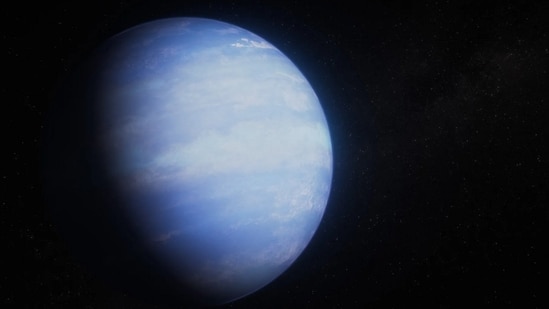
It is expected that the rise in temperature might be because of tidal heating caused by the planet’s non-circular orbit, it added.
“Based on its radius, mass, age, and assumed internal temperature, we thought WASP-107 b had a very small, rocky core surrounded by a huge mass of hydrogen and helium,” the report quoted Luis Welbanks from Arizona State University (ASU), on a paper published in Nature.
“But it was hard to understand how such a small core could sweep up so much gas and then stop short of growing fully into a Jupiter-mass planet,” he added.
ALSO READ | New "fiery" exoplanet discovered, found to display volcanic activity like Jupiter's Io
The team, however, combining observations from Webb’s NIRCam (Near-Infrared Camera), Webb’s MIRI (Mid-Infrared Instrument), and Hubble’s WFC3 (Wide Field Camera 3), was able to build a broad spectrum of 0.8- to 12.2-micron light absorbed by WASP-107 b’s atmosphere, the report said.
{{/usCountry}}The team, however, combining observations from Webb’s NIRCam (Near-Infrared Camera), Webb’s MIRI (Mid-Infrared Instrument), and Hubble’s WFC3 (Wide Field Camera 3), was able to build a broad spectrum of 0.8- to 12.2-micron light absorbed by WASP-107 b’s atmosphere, the report said.
{{/usCountry}}Using Webb’s NIRSpec (Near-Infrared Spectrograph), it also built an independent spectrum covering 2.7 to 5.2 microns. The high precision of the data allowed for not only the detection but also the measurement of the abundances of numerous molecules, including water vapour (H2O), methane (CH4), carbon dioxide (CO2), ammonia (NH3) among others, it added.
David Sing, the lead author of a parallel study published in Nature, said,"The fact that we detected so little, even though we did detect other carbon-bearing molecules, tells us that the interior of the planet must be significantly hotter than we thought.”
ALSO READ | NASA's Hubble Space Telescope finds water vapour in exoplanet 97 light years away from Earth
Researchers had previously suggested that tidal heating might explain the puffiness of WASP-107 b, but there was no evidence to support this hypothesis until the Webb results were obtained. After determining that the planet has sufficient internal heat to significantly churn its atmosphere, the teams recognized that the spectra could also offer a new method for estimating the size of the core.