The office meeting rooms are not what they used to be a few years back. A meeting of ten people once meant ten people around one table with one PC being linked to the central console for projecting data. Today, some sit in the office meeting room, some join from another city, while others log in from another country. This shift has changed what companies need from their meeting spaces. It has also put a new participant in the room, namely artificial intelligence.
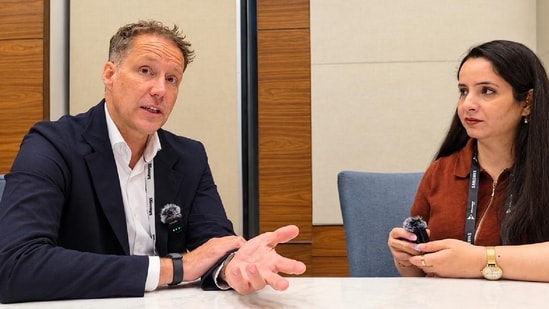
We recently sat down for a conversation with Holger Reisinger, Senior Vice President of the Enterprise Video Business Unit at Jabra, to talk about the rise of huddle rooms, the trust gap in AI meeting tools, and why he believes tomorrow's meeting rooms will be "awareness spaces" rather than just meeting spaces.
Small rooms, big decisions
During our conversation we touched upon the topic of meeting rooms in offices becoming smaller and how this rise of huddle rooms and small meeting spaces was changing the meeting room technology market.
For Reisinger, the smaller meeting space is where the action is. "The average meeting size is three and a half people, and most of these spaces are not equipped," he said. The result is a familiar confusion wherein employees run around looking for a room with proper audio and video, because eight out of 10 meetings now have at least one remote participant.
"At Jabra we say, 'small rooms, big decisions'," Reisinger said, adding, "Trust travels extremely fast in these small setups."
He also said that people now expect two things from these rooms. First, that they are equipped. Second, that they are easy to use.
Hybrid work has trained users to plug a headset or a camera into their laptop and start a meeting. Reisinger believes a company's meeting rooms should feel no different. "These meeting spaces that are now centrally designed and equipped should not behave much differently than what the user is used to with his or her laptop," he said.
AI is in the meeting, but trust is missing
On one hand we are seeing meeting room technology becoming more efficient. On the other hand, we are setting AI taking a seat at the table. According to recent Jabra research cited by Reisinger, 75% of respondents have used AI during a meeting or to process one afterwards. The catch, however, is trust. Only 30% of those users trust the data AI produces. "That's maybe the more concerning question behind it," he said. "There's no doubt that AI is a participant in the meeting."
Platform vendors are going further than transcription. Reisinger pointed to AI facilitators that can help a group run a brainstorming session, using context about what is happening in the room and what the meeting is meant to achieve.
{{/usCountry}}Platform vendors are going further than transcription. Reisinger pointed to AI facilitators that can help a group run a brainstorming session, using context about what is happening in the room and what the meeting is meant to achieve.
{{/usCountry}}He also flagged a growing "bring your own AI" trend, wherein employees use whichever tool they rely on for personal productivity. That raises governance questions, especially for large enterprises and government bodies. "You want to make sure that the data that ultimately gets listened to and transcribed, where it's going, how it's governed," Reisinger told HT Tech.
Humans still make the call
Interestingly enough, the most popular uses of AI in meetings today include automation, that is, note-taking, summaries and assigning action items. But Reisinger stressed that this only works if the technology sees and understands the whole room, including who said what.
“So provided that it sees and understands the room at full. It knows who was talking or saying what, um, because otherwise it's not useful. So back to my data point: only one-third trusting it,” he said.
Even when AI works well, the human stays central. People review the output, make the decisions, pass information to colleagues and move the data into other systems. "AI can help to automate things, so we can focus our effort on doing the human part of the work," he added.
Asked whether that means AI is here to stay but humans remain key, Reisinger agreed. "Absolutely. And particularly we are seeing that most of the rooms are not functioning in order to support that at full."
From losing time to losing data
A poorly equipped room has always carried a cost. Reisinger said that when someone cannot hear or be heard, recovering from that moment costs an average of 11 minutes in a one-hour meeting.
In the AI era, the stakes are higher. If audio is lost and AI cannot process it, the information is gone for good. "Maybe the key point of the conversation, or the decision that has been made, could be exactly the piece that wasn't captured," he said. "From losing time, it is now transforming to losing data. I would say that's the biggest impact."
He also explained that post-COVID room design focused on transport, that is, making sure people could see and hear each other. Today, the priority is capture. "Nowadays it's really about catchment. What's happening in that room? You need to have it at full in order to trust it and to really work with it."
Post COVID era: back to managed rooms
Looking back at the nearly five years since the pandemic, Reisinger described two distinct phases. During COVID, companies bought whatever equipment they could get their hands on to keep work moving. After COVID, uncertainty about how many people would return to the office led to a wave of flexible spaces. But that flexibility came at a cost, especially for large organisations.
"Everything that is not standardised, everything that is not managed centrally and controlled in a way that it really can scale for a larger organisation, is complicated for them," he said.
That said, the pendulum is now swinging back. Companies are moving away from bespoke, bring-your-own-device (BYOD) setups towards standardised rooms with defined infrastructure, so they can manage and maintain an ever-growing fleet of meeting spaces.
“So we are going away now, or seeing more of these bespoke or setups and these standardized rooms with a defined infrastructure in order to now also manage and maintain this ever-growing fleet of meeting spaces,” the Jabra executive added.
The meeting room of the future: an 'awareness space'
Looking three to five years ahead, Reisinger believes meeting rooms will stay central to human interaction. But he expects them to evolve from meeting spaces into what he calls "awareness spaces", with AI working before, during and after each meeting.
Before the meeting, the room checks that it is ready and matches how it is listed on the network. "It could be basic things like, 'Oh, it's a six-seater room, where have my two chairs escaped?'" he said. Or a missing whiteboard ahead of a brainstorming session.
During the meeting, the room goes beyond transmitting voices and framing faces. It could assess whether the meeting met its purpose, how engaged people were and how productive the session was.
After the meeting, the room captures what words alone miss. Reisinger gave the example of a product discussion where everyone points at the product, and where the engineer demonstrating it, not the CEO in attendance, is the real centre of the conversation. That context, along with footage and how people reacted, should be visible afterwards.
"That's what I call awareness space," Reisinger said. "It's going beyond the purpose. It has all the context and has all the things that have been communicated non-verbally."