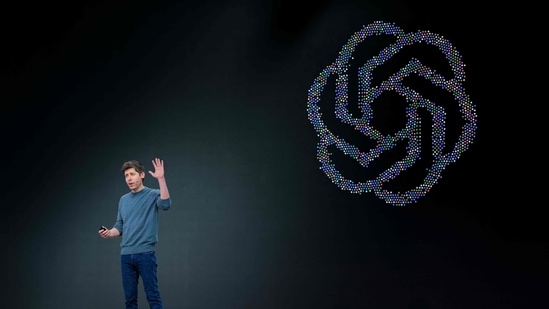
TUESDAY OCTOBER 6th 2026 may go down as one of the most consequential days in the history of mathematics. That was when OpenAI, an American artificial-intelligence firm, announced that its AI agents, powered by an unreleased model, had solved at least 372 long-standing mathematical problems in a matter of weeks. The findings, detailed in over 700 AI-generated papers, represent research at an unprecedented scale and speed.
Such a glut has left some queasy. The excitement of potential new mathematical truths
TUESDAY OCTOBER 6th 2026 may go down as one of the most consequential days in the history of mathematics. That was when OpenAI, an American artificial-intelligence firm, announced that its AI agents, powered by an unreleased model, had solved at least 372 long-standing mathematical problems in a matter of weeks. The findings, detailed in over 700 AI-generated papers, represent research at an unprecedented scale and speed.
Such a glut has left some queasy. The excitement of potential new mathematical truths is, for many researchers, freighted with concern for the future of their field. Unless more care is taken, they say, the mass production of mathematics will lead to more solutions but less understanding.
AI’s progress in mathematics has advanced rapidly. Just last month OpenAI claimed that the same internal model had solved the Navier-Stokes problem—one of the landmark Millennium Prize problems—in just 88 hours. Now hundreds of other significant puzzles have been cracked. They cover the entire mathematical corpus, from algebra and geometry to probability and logic, including many which have stumped experts for decades. The average computing power required for the autonomous mathematicians to arrive at a solution was equivalent to only about three hours of reasoning with models that the firm makes publicly available.
Although the remaining Millennium Prize problems remain unsolved, progress towards one or two does seem to have been made. Most notable among these is the Riemann hypothesis, which concerns the distribution of prime numbers. Also buried in the deluge is a claimed proof of a thorny conundrum called the 3D Kakeya maximal conjecture. Hong Wang, a mathematician at NYU’s Courant Institute, was awarded the Fields Medal—the maths equivalent of a Nobel prize—for her work on a closely related problem in July.
Precisely what breakthroughs have been made, and by what means, will probably take mathematicians years to work out; many of the papers run to over 100 pages. Only 127 of the solved problems are accompanied by a code guaranteeing logical consistency (a norm in the field), and the agents’ internal reasoning has been published for only ten of them. These 372 problems also represent a subset of 4,000 which OpenAI posed to its agents, although the company has not released data about which problems were beyond its capabilities. Such transparency would improve assessments of the technology’s abilities and limitations.
Some worry that such an approach is not conducive to long-term progress in mathematics. Not long after OpenAI’s solution to the Navier-Stokes problem last month, 28 Fields-medallists published an open letter warning that AI labs’ approach to mathematics was at odds with the field’s goals. In using open maths problems as a benchmark to test new models’ abilities, the letter-writers said, model-makers risked prematurely shutting down lines of inquiry without generating new techniques, questions or, ultimately, understanding. More than 8,000 of their colleagues have since signed on.
OpenAI claims to have taken note. In working out how to release its new discoveries, the firm says it drew on the recommendations of an independent advisory group, a team of nine esteemed mathematicians formed in the aftermath of the Navier-Stokes announcement. In addition to sharing some details of its models’ internal reasoning, OpenAI also promised to fund a series of conferences to aid understanding of the results.
All told, the scale of OpenAI’s release means its true impact will be clear only in hindsight. “The real importance of a problem is eventually measured by the new avenues it opens up and the light its proof sheds on other problems,” says Martin Hairer of EPFL, a Swiss university, who is a member of OpenAI’s advisory group as well as being a signatory of the Fields-medallists’ letter. For now, the mathematical problems AI is revealing are more existential than numerical.
One Subscription.
Get 360° coverage—from daily headlines
to 100 year archives.
Archives
HT App & Website