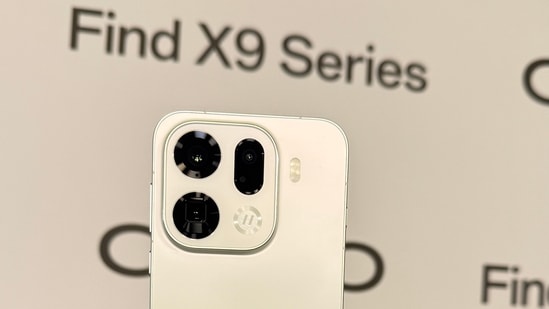
For years, OPPO’s Find X series existed largely outside India’s borders, known globally for design flourishes and camera experimentation. Today, that boundary is gone. The Find X line is not only in India, it is now central to the company’s premium strategy. And OPPO’s leadership is convinced that India is ready for it.
The shift isn’t accidental. The numbers paint a sharp turn in consumer behaviour. In Q3 2025, India’s premium smartphone segment surged by 40 percent, while the ultra-premium tier jumped 52 percent. OPPO finished the quarter as the No. 2 brand in overall shipments, with over 13 percent market share. As Goldee Patnaik, Head of PR and Communications at OPPO India, puts it, “ ₹1 lakh is no longer a psychological barrier. People are willing to spend, as long as the device actually delivers.”
“With 100 million OPPO users in the country and millions of Reno-series customers sitting on the upgrade ladder, the moment is ripe. EMI adoption, trade-in schemes, and easy financing are accelerating the shift even faster. The company’s broader view: India’s mass market has matured into a premium-first audience,” explains Patnaik.
That’s where Peter Dohyung Lee, Head of Product Strategy at OPPO, comes in. He sees the new Find X series as OPPO’s “benchmark for design, performance, and innovation.” And for the brand, innovation increasingly starts with AI.
OPPO calls the Find X9 an “AI phone,” but Lee is quick to separate the marketing buzz from the engineering. For him, AI isn’t about gimmicks. It’s about removing friction in everyday tasks. Noise cancellation tuned for crowded Delhi streets. AI summarisation directly after calls. On-device agents that combine a user’s private OPPO cloud data with Google’s Gemini to deliver personalised results. “ChatGPT can’t improve your photography, can’t optimise battery usage, and can’t make your calls clearer,” Lee says. “AI on a smartphone has to solve smartphone problems.”
The camera is OPPO’s strongest example. Computational photography has quietly become the brand’s signature edge, and this generation brings a more ambitious leap. The Find X9’s new Lumo Engine is OPPO’s deeply integrated imaging system, a multi-module pipeline that analyses sensor data, lighting, shadows, skin tones, and scene dynamics before delivering a frame. The company still uses Sony sensors, like many others, but insists that the post-capture software stack makes the real difference.
{{/usCountry}}The camera is OPPO’s strongest example. Computational photography has quietly become the brand’s signature edge, and this generation brings a more ambitious leap. The Find X9’s new Lumo Engine is OPPO’s deeply integrated imaging system, a multi-module pipeline that analyses sensor data, lighting, shadows, skin tones, and scene dynamics before delivering a frame. The company still uses Sony sensors, like many others, but insists that the post-capture software stack makes the real difference.
{{/usCountry}}Paired with Hasselblad co-engineered colour science, OPPO claims DSLR-level tonality in its “Master Mode”. In fact, the comparison is deliberate. Lee recounts the story of a professional photographer who used to rely on a DSLR, Lightroom, and a laptop workflow for final edits. When tested against OPPO’s AI Relighting and AI Eraser, the differences were marginal. “He told me he wasted his time,” Lee says. “One click was enough.”
India is getting special attention here: literally. OPPO has established an India-exclusive LUMO Lab, where engineers work with local photographers to tune image parameters for Indian skin tones, low-light conditions, humidity, air pollution, and outdoor colour accuracy. Air quality in particular, Lee notes, plays a direct role in image clarity and colour accuracy due to the way particulate matter scatters light. The India-specific tuning is already reflected in different imaging configurations for Indian versus Chinese Find X units.
The Find X9 extends the imaging push into another pain point: shaky hands. The series’ 10x zoom demo in Goa made an impression because AI stabilisation kicks in aggressively. “Despite shaky hand movement, the results hold,” Lee says.
Battery optimisation is the next battlefield. OPPO insists the conversation shouldn’t be about milliamp hours but days of use. The company says its AI-driven power management allows two days of battery life for normal users and more than a full day for heavy users. The system adjusts background processes, temperature, and real-time performance loads based on behaviour rather than brute-force hardware alone.
The broader strategy is simple: keep users inside OPPO’s ecosystem long enough to trust the bigger story. That ecosystem, however, is still evolving. While OPPO’s Enco earbuds and tablets are well-reviewed, they’ve never received the same spotlight as the phones. Patnaik acknowledges that this needs to change, and that efforts are underway to build stronger visibility across product categories: TWS, tablets, wearables, watches, and more.
But ultimate growth will come from staying relevant in premium. OPPO believes the market is no longer about affordability but accessibility, trust, and design confidence. Offline retail still accounts for over half of India’s smartphone sales, and OPPO’s retail presence gives it an advantage. People may research online, but they buy offline; especially for flagship phones.
“We have strong mindshare with retailers,” Patnaik says. “That makes a difference at the point of sale, where decisions actually happen.”
The Find X9 builds on the momentum of the Find X8, and Lee confirms the series will continue to launch in India consistently, breaking old patterns of sporadic availability. Coupled with a faster flagship release cadence and tighter integration with partners like Google and MediaTek, OPPO wants to position the Find X series as a premium mainstay in India, not a rare cameo.
Inside OPPO’s India strategy is a clear narrative: the brand sees premium growth not as a bubble but a long-term structural shift. Indian consumers are upgrading faster, holding premium devices longer, and expecting flagship-grade experiences across photography, battery, UI, and AI. OPPO believes it can deliver all of it, and do so with features tuned specifically for India.