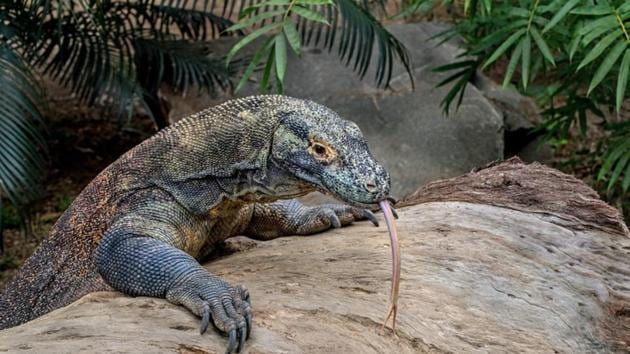
There’s nothing cuddly about the 5,000 or so Komodo dragons that still roam the wild. They’re aggressive, venomous predators that can reach 10 feet long and weigh more than 150 pounds. They’ve been known to occasionally attack humans, sometimes fatally. Nonetheless, growing numbers of tourists are flocking to Komodo island to see them. And starting next year, they’ll pay up to $1,000 for the privilege.
This new ‘membership fee,’ announced Monday, is intended to reduce over-tourism, and perhaps save Komodo’s signature species in the process. If it works, it could act as a model for some of the world’s most ecologically sensitive sites, and the local communities that too often fail to see the benefits of the global ecotourism boom.Until recently, the idea that Komodo, a 150 square-mile mountainous rock in the middle of the Indonesian archipelago, might become a tourist attraction was far-fetched. It was sparsely populated for centuries, known almost exclusively to locals. In the early 20th century, rumors of giant crocodiles inhabiting the island reached a Dutch explorer who promptly travelled to Komodo and shot one. A few years later, he was followed by an American whose travels reportedly inspired the original King Kong film, and resulted in the Bronx Zoo’s first, brief Komodo dragon exhibit (the star attractions died soon after arrival).Over the next half century, interest in the lizards drew a small but growing number of adventurous tourists. By 1980, their numbers were big enough that the Indonesian government established Komodo National Park to protect the dragons. Locals, who had been making a living on the island for hundreds of years, weren’t consulted on the park, its boundaries – or most distressingly – the government’s plans to relocate them. The mandate to create a pristine conservation area set the stage for decades of disputes over tourism, resource access and indigenous rights.
That’s not an isolated problem. Most of the world’s national parks were created in part by evicting communities to create ‘people-free’ environments that could be marketed to tourists. In Tanzania, such efforts are widely blamed for displacing the Masai from their ancestral lands; in the Amazon, indigenous locals complain that the bounty generated by ecotourists flows to everyone but them. A recent study in the Congo Basin found that conservation measures had displaced whole villages, leading to economic distress, violent conflict, human-rights abuses, and a decline in populations of endangered species, including elephants and chimps, due to increased poaching.On Komodo, the tensions historically haven’t run that high. Poaching has been largely confined to the deer that the dragons hunt, not the lizards themselves. Meanwhile, the isolated and restricted range of the giant lizards has made it easier to pursue a successful conservation strategy, especially compared to failed efforts to support other signature Indonesian species, including critically endangered orangutans.But thanks to a tourist boom, that uneasy balance is becoming harder to sustain. In 2018, 176,000 people visited Komodo, up from 44,000 in 2008. That influx has led to problems familiar to other ecotourist zones: Trash is piling up, poaching is on the rise and locals are increasingly frustrated that the government is granting valuable development rights to outsiders. Meanwhile, dragon populations are in a slow but perpetual decline.
{{/usCountry}}That’s not an isolated problem. Most of the world’s national parks were created in part by evicting communities to create ‘people-free’ environments that could be marketed to tourists. In Tanzania, such efforts are widely blamed for displacing the Masai from their ancestral lands; in the Amazon, indigenous locals complain that the bounty generated by ecotourists flows to everyone but them. A recent study in the Congo Basin found that conservation measures had displaced whole villages, leading to economic distress, violent conflict, human-rights abuses, and a decline in populations of endangered species, including elephants and chimps, due to increased poaching.On Komodo, the tensions historically haven’t run that high. Poaching has been largely confined to the deer that the dragons hunt, not the lizards themselves. Meanwhile, the isolated and restricted range of the giant lizards has made it easier to pursue a successful conservation strategy, especially compared to failed efforts to support other signature Indonesian species, including critically endangered orangutans.But thanks to a tourist boom, that uneasy balance is becoming harder to sustain. In 2018, 176,000 people visited Komodo, up from 44,000 in 2008. That influx has led to problems familiar to other ecotourist zones: Trash is piling up, poaching is on the rise and locals are increasingly frustrated that the government is granting valuable development rights to outsiders. Meanwhile, dragon populations are in a slow but perpetual decline.
{{/usCountry}}The local government’s initial response was predictable: It announced that Komodo island would be closed for all of 2020 to protect the lizards, while about 2,000 residents were to be relocated. Thankfully, public pressure opposing that plan appears to have had an effect. This week, the government changed its mind and announced it was imposing the membership fees instead.
That should reduce the number of tourists visiting Komodo, while providing money to bolster conservation efforts. But a longer-term solution will require ensuring that benefits flow more directly to local communities – for instance, by giving them significant shareholdings in tourist concessions and extending their rights to manage and benefit from wildlife. That’s a lesson that plenty of other ecotourism hotspots should heed. Fewer people may end up seeing Komodo’s dragons. But the dragons themselves will have the chance to thrive. And so, ideally, will the locals.
(This story has been published from a wire agency feed without modifications to the text.)
Follow more stories on Facebook and Twitter
Catch your daily dose of Fashion, Taylor Swift, Health, Festivals, Travel, Relationship, Recipe and all the other Latest Lifestyle News on Hindustan Times Website and APPs.
Catch your daily dose of Fashion, Taylor Swift, Health, Festivals, Travel, Relationship, Recipe and all the other Latest Lifestyle News on Hindustan Times Website and APPs.