Karl Deisseroth has won the 2026 Nobel Prize in Medicine along with German scientists Peter Hegemann and Georg Nagel for discoveries that led to optogenetics, a technique that lets researchers control the activity of specific nerve cells using light. But science was not always his only interest.
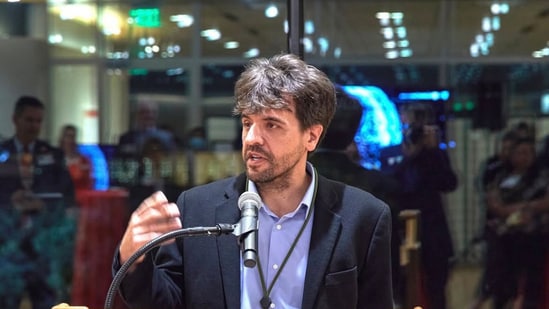
Before becoming a Nobel-winning neuroscientist, Deisseroth had wanted to be a writer. He told The Guardian that writing was his “first love”.
How Karl Deisseroth found his way to neuroscience
Born in Boston in 1971, Deisseroth grew up in a family with strong scientific roots. His father was a physician and professor, while his mother was a high school chemistry teacher. But science was not his only early interest. According to Stanford Medicine, he was an avid reader of prose, poetry and science and initially dreamed of becoming a writer. He was also known for having an extraordinary memory.
His path eventually turned towards understanding the mind. He studied biochemical sciences at Harvard before joining Stanford's MD-PhD programme. He earned a PhD in neuroscience in 1998 and an MD in 2000. During his medical training, a psychiatry rotation changed the direction of his career.
(Also Read: Who is Karl Bushby? Man who walked the world for 28 years, covered nearly 50,000 km returns to UK)
{{/usCountry}}(Also Read: Who is Karl Bushby? Man who walked the world for 28 years, covered nearly 50,000 km returns to UK)
{{/usCountry}}Deisseroth had initially planned to become a neurosurgeon. But after encountering patients with severe psychiatric illnesses during his psychiatry rotation, he began questioning how much remained unknown about the brain and mental health. The experience made him reconsider his plans and drew him towards psychiatry and neuroscience, according to Karolinska Institutet.
How Karl Deisseroth’s research transformed neuroscience
According to Stanford Medicine, the breakthrough that eventually earned Deisseroth the Nobel Prize began with an unlikely source: algae. Peter Hegemann and Georg Nagel had studied light-sensitive proteins called opsins in algae and other microorganisms. Deisseroth and his colleagues saw that these proteins could be used to control the activity of nerve cells and began developing the technique for neuroscience.
In 2005, Deisseroth and his team showed that shining blue light on genetically modified nerve cells could make them fire. The approach became known as optogenetics, giving researchers a way to control specific groups of nerve cells with light and study how they affect the brain and behaviour.
The importance of the technique lies in its precision. Instead of simply observing which parts of the brain become active, researchers can manipulate particular groups of nerve cells and examine what happens. Optogenetics has since been used to study neural circuits involved in memory, behaviour and emotions, as well as conditions such as depression, addiction and Parkinson's disease.
Deisseroth has continued to work at the intersection of neuroscience and psychiatry. He is a professor of bioengineering and psychiatry and behavioural sciences at Stanford and remains a practising psychiatrist. His research continues to explore how brain circuits are involved in behaviour and neuropsychiatric conditions, according to his Stanford profile.
From writer at heart to Nobel laureate
Deisseroth's journey is striking partly because his earliest ambition was not to become one of the world's most celebrated neuroscientists. His first love, as he described it, was writing. Decades later, his work has given scientists a new language for understanding the brain.
(Also Read: Why is Dussehra celebrated differently across India? From Mysuru to Bastar, traditions explained)
When the Nobel call came in the early hours of October 5, Deisseroth was still awake. A self-described night owl, he had been working late before lying down when the call from Stockholm arrived. Stanford reported that he missed the first call before his wife answered the second The recognition, he said, was a complete surprise.
The award has made his name part of a major discovery in modern neuroscience. But his journey began with something much simpler, a love for words, the human mind and questions about how people think and experience the world.