The stunning attack on Israel by Hamas from air, land and sea represents a staggering failure in Israeli intelligence and what has been regarded as one of the most sophisticated border surveillance system in the world, experts have said.
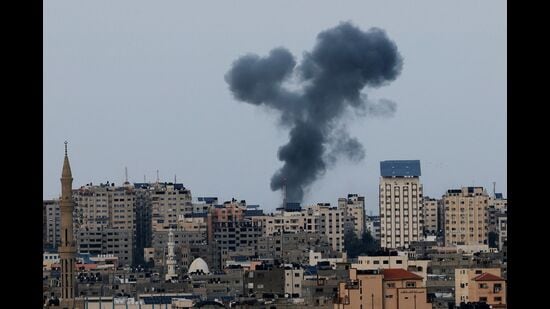
Dozens of Hamas fighters on Saturday crossed into Israel through the heavily fortified border between the two sides under the cover of rocket fire. At least 700 people have been killed in the deadliest assault on the country, surpassing the surprise attack during the Yom Kippur war, which took place exactly 50 years ago and led to the deaths of a little over 300 people. The militant group has also taken several Israeli soldiers and civilians hostage. More than 400 were killed on the Gaza Strip in Israeli retaliation after Prime Minister Benjamin Netanyahu declared war.
Hamas's attack multifront infiltration – they entered via the land, sea and even air – likely required months of highly complex planning. From Israeli response, it appears that it either had no information or missed the signs on an upcoming attack, despite multiple warnings.
"The [Israel-Gaza] wall is not just a physical barrier, it's a complex network of sensors, drones and cameras, backed up by a network of informants within Gaza itself. That this entire system failed so substantially and with such a cost in Israeli lives - both civilians and security personnel - is a huge shock to Israelis across the political spectrum," said Dr. Rob Geist Pinfold from Durham University, in an interaction over email with HT.
{{/usCountry}}"The [Israel-Gaza] wall is not just a physical barrier, it's a complex network of sensors, drones and cameras, backed up by a network of informants within Gaza itself. That this entire system failed so substantially and with such a cost in Israeli lives - both civilians and security personnel - is a huge shock to Israelis across the political spectrum," said Dr. Rob Geist Pinfold from Durham University, in an interaction over email with HT.
{{/usCountry}}Israel's biggest ally, the US, which has the most widespread intelligence network in the world and sent nearly $3 billion to the country in defence aid last year, had no tactical-level information. “It’s shocking to me that they were able to do it without Israel or the United States picking up on it,” Martin Indyk, a former US ambassador to Israel and a fellow at the Council on Foreign Relations told Bloomberg.
"There is always tension near the border but nothing that would prompt the scale of attack we have seen. This points to very good operational security on the part of Hamas and excellent deception strategies as this attack would have been months in the planning. For Israel, it’s a massive intelligence blow. Despite HUMINT (human intelligence), ELINT (electronic intelligence), and COMINT (communication intelligence) superiority, as well as a wealth of open sources to draw on, they did not put the picture together," Clive Jones, director at Durham University’s Institute for Middle Eastern and Islamic Studies (IMEIS) told HT.
This crisis comes at a time of political upheaval in Israel. The country is being led by the most right-wing government in history, with Netanyahu having partnered with far-right and ultra-nationalist parties to end a political crisis that led to five elections in four years.
Questions are now being raised about whether Israel’s army and intelligence services were distracted by domestic infighting. In September, opposition leader Yair Lapid had warned that Israel, is approaching a violent, multi-front confrontation,” according to “all the heads of the security establishment – the Israel Defence Forces, the Shin Bet, the police, the intelligence agencies.”
The new war follows months of rising violence in the occupied West Bank and tensions around Gaza's border and at contested holy sites in Jerusalem. Before Saturday, the conflict had killed at least 247 Palestinians, 32 Israelis and two foreigners, including combatants and civilians, this year, according to Israeli and Palestinian officials.
“The real problem here is likely that the Israelis simply did not believe that Hamas would risk a cross-border infiltration,” said Aaron David Miller, senior fellow at the Carnegie endowment for international peace and a former state department Middle East negotiator told Bloomberg. “The lack of sufficient Israeli forces in that area was a grievous failure.”
The failure likely will taint the legacy of Netanyahu, who has posited himself as tough on terrorism. “The last intel failure on this scale was 50 years ago, when Egypt and Syria attacked Israel on Yom Kippur. That war contributed to the downfall of the government - led by Golda Meir and her Labour Party. Labour had previously led every government in Israel prior to this. Subsequently, it has led government for less than 10 years and now only has 4 seats in the 120-seat Knesset. The same could happen to Netanyahu's Likud,” Dr. Pinfold said.
“He also knows that an Israeli attack in the Gaza strip that produces mass casualties on the Palestinian side will change international dynamic of this war, that is, at present, largely sympathetic to Israel,” added professor Jones.
(With inputs from agencies)