...
...
Next Story

First detailed images of faraway world Ultima Thule released, NASA says it’s shaped like ‘snowman’

The New Horizons spacecraft on Tuesday flew past Ultima Thule, which was discovered via telescope in 2014 and is the farthest and potentially oldest cosmic body ever observed by a spacecraft.

Updated on: Jan 3, 2019, 16:01:06 IST
Agence France-Presse | By
Prefer HTon Google
Advertisement

The first detailed images beamed back from the US agency’s New Horizons mission allowed scientists to confidently determine the body was formed when two spheres, or “lobes,” slowly gravitated towards each other until they stuck together -- a major scientific discovery.
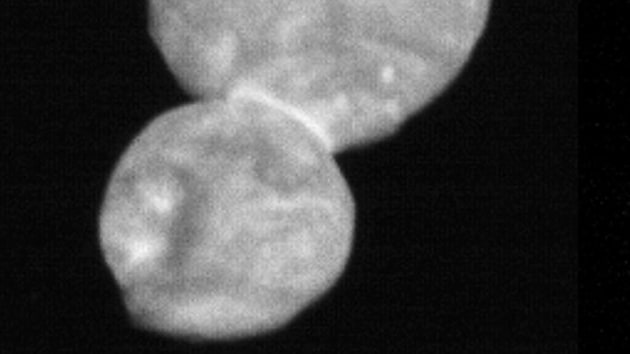
Four billion miles from the sun floats Ultima Thule, an icy celestial body that NASA scientists announced Wednesday is aptly shaped like a giant snowman. (Jim Bridenstine)

The New Horizons spacecraft on Tuesday flew past Ultima Thule, which was discovered via telescope in 2014 and is the farthest and potentially oldest cosmic body ever observed by a spacecraft.

Before that flyby, the only image scientists had was a blurry one showing Ultima Thule’s oblong shape, resembling something like a bowling pin or a peanut.

“That image is so 2018... Meet Ultima Thule!” said lead investigator Alan Stern, doing little to hide his joy as he revealed a new sharper image of the cosmic body, taken at a distance as close as 17,000 miles (about 27,000 kilometers) with a resolution of 140 meters per pixel.

“That bowling pin is gone -- it’s a snowman if anything at all,” Stern said during a NASA briefing.

Ultima Thule’s surface reflects light about as much as “garden variety dirt,” he said, as the sun’s rays are 1,600 times fainter there than on Earth.

The body is roughly 19 miles long and completes its own rotation in about 15 hours. NASA dubbed the larger lobe Ultima, and the other, which is about three times smaller, Thule.

“This is the first object that we can clearly tell was born this way” Stern said, instead of evolving as a sort of “bi-lobe.”

“This really puts the nail on the coffin now. We know that this is how these kinds of objects in many cases form.”

- ‘A time machine’ -

Some 4.5 billion years ago a cloud of frozen pebbles began to join forces, gradually forming two bodies -- Ultima and Thule.

Slowing turning, they eventually touched at each other at what mission geology manager Jeff Moore called an “extremely slow speed” -- maybe just one to a few miles per hour.

If such a meeting occurred between two cars in a parking lot, he said, no driver would bother writing it up. The lobes, according to Moore, are really just “resting on each other.”

“New Horizons is like a time machine, taking us back to the birth of the solar system,” Moore said. “We are seeing a physical representation of the beginning of planetary formation, frozen in time.”

Carly Howett, another researcher of the mission, noted that “we can definitely say that Ultima Thule is red,” perhaps due to irradiation of ice.

NASA researchers promised fresh announcements would drop Thursday, including on the composition and atmosphere of Ultima Thule, as new images with even more precise resolution have come through.

ico/mdo/mdl

 
ABOUT THE AUTHOR
HT News Desk

Follow the latest breaking news, major developments and agenda-setting stories from India and around the world with the newsdesk at Hindustan Times. Operating round the clock, the desk brings together experienced editors, reporters and correspondents to deliver fast, accurate and contextual reporting across subjects that influence public policy, governance, business, society and international affairs. The HT News Desk covers politics, elections, government policies, the economy, business and markets, science and technology, the environment, law and order, infrastructure, education, climate issues and geopolitics, while closely tracking developments across states, institutions and global capitals. The team also leads coverage of major breaking news events, policy announcements, court proceedings, natural disasters, public emergencies and significant international developments. Reports published by the newsdesk are based on information gathered from reporters on the ground, official statements, government agencies, court records, regulatory filings, recognised institutions and other authoritative sources. Stories undergo editorial scrutiny and verification processes to ensure accuracy, fairness and relevance, and are updated as events evolve and additional information becomes available. Whether covering a key political decision in New Delhi, an economic policy shift affecting millions, a landmark court ruling or a major global event, the HT News Desk aims to provide readers with reliable, fact-based journalism that delivers not only the latest developments but also the context and analysis needed to understand their wider implications.

Get the latest World News, breaking headlines and global updates from the US, UK, Pakistan, Bangladesh, Russia and other countries. Follow major international events on Hindustan Times.
SHARE THIS ARTICLE ON
Notifications

Get breaking alerts directly from the newsroom

Notifications are on!You'll be notified when news breaks