
Hamas has indicated it is open to accepting President Trump’s peace plan for Gaza but is asking for more time to review its conditions, Arab mediators said, as the militant group faces intensifying pressure from Muslim governments to agree to the Israel-backed proposal to end the devastating war.
The militant group has told mediators it has reservations about some of the terms of the 20-point plan, including the stipulation that it disarm and destroy its weapons, a demand it has
Hamas has indicated it is open to accepting President Trump’s peace plan for Gaza but is asking for more time to review its conditions, Arab mediators said, as the militant group faces intensifying pressure from Muslim governments to agree to the Israel-backed proposal to end the devastating war.
The militant group has told mediators it has reservations about some of the terms of the 20-point plan, including the stipulation that it disarm and destroy its weapons, a demand it has previously rejected. Hamas also says that releasing all 48 hostages within 72 hours, as laid out in the Trump plan, would be difficult because it has lost contact in recent weeks with some other militant groups holding a number of them, the mediators said.
Hamas officials, who met with mediators in the Qatari capital Doha on Tuesday, argued that Trump’s plan leaves Palestinians without a credible path to statehood and includes several loopholes that would permit Israel to resume the war. Qatar, Egypt and Turkey have urged Hamas to respond positively to the plan by Wednesday evening local time, the Arab mediators said.
Officials from the three Middle East countries met with Hamas officials a day after Trump announced the plan while standing next to Israeli Prime Minister Benjamin Netanyahu at the White House.
People mourn over the body of a Palestinian killed in Israeli strikes, at a hospital in the central Gaza Strip.
Trump warned then that the militant group would be wiped out unless it agreed to his peace proposal and on Tuesday said Hamas had three or four days to agree to the deal, adding that its members would “pay in hell if they don’t sign.”
The U.S.-designated terrorist organization is also under pressure from leaders in Doha, Cairo and Turkey’s Ankara, the capitals with which it has the closest ties, to accept the terms of the agreement.
Over the past few days, all three nations have warned the group’s leaders that this is their last chance to end the war in Gaza, the mediators said. They have told Hamas that if the group rejects the Trump deal, it will no longer receive diplomatic support from them, the officials said.
A Hamas official didn’t say how the group would respond to the Trump plan but noted that it would be open to any proposal to halt the war, while also ensuring the Palestinian people’s right to defend themselves.
The diplomatic pressure piling on Hamas is compounding the impact of military force on it in Gaza, where Israel has expanded its operations against the group last’s remaining strongholds. The mediators say there are signs the group is cracking. For instance, they say, Hamas has dropped its demand that Israel withdraw entirely from the Philadelphi corridor, which runs along the border with Egypt in southern Gaza, and buffer zones between the enclave and Israel.
Israel has killed a succession of top Hamas leaders over the past year. It targeted Hamas political leaders in a strike on Qatar last month, but most of them survived, including Khalil Al-Hayya and Zaher Jabarin. Those leaders steer the group’s international relations and help raise funds but don’t join in fighting like the military wing in Gaza. Meanwhile, the Islamist group is facing a cash crunch that is making it harder for it to pay its members—weakening its command and control over its rank and file, The Wall Street Journal has reported.
Palestinians in Gaza are demanding a reprieve from the fighting, which has killed more than 66,000 people, according to local health authorities, who don’t specify how many were combatants. Hundreds of thousands have been displaced multiple times by the war which began after Hamas attacked southern Israel on Oct. 7, 2023, killing about 1,200 people and taking around 250 hostage.
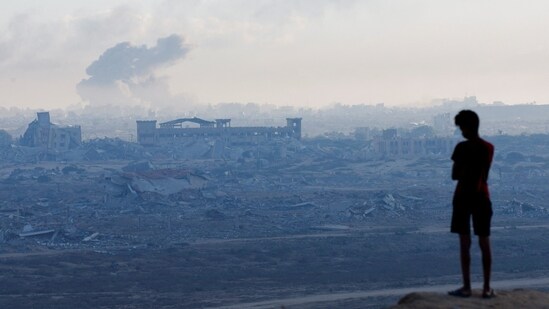
Palestinians have faced persistent shortages of food and large parts of the enclave have been reduced to rubble by the fighting.
“I heard of the plan,” said Reem Salha, a mother of five children whose family has been displaced several times in Gaza by the fighting and who has struggled to find enough food, said of the U.S. initiative. “What we want is for the war to stop and put an end to our suffering.”
While Hamas has enjoyed a degree of support in the Muslim world since the beginning of the war, it was caught by surprise by how quickly a number of countries came out to back the Trump plan, the Arab mediators said. Foreign ministers of Saudi Arabia, Jordan, the United Arab Emirates, Indonesia, Pakistan, Turkey, Qatar and Egypt said they supported the U.S. efforts. They called for a full withdrawal of Israeli forces from Gaza, as well as for the enclave’s reconstruction. They said they would work with the U.S. to end the war and called for the renewal of peace negotiations that would lead to a Palestinian state.
Cars burned following a rocket attack from the Gaza Strip in Ashkelon, southern Israel, on Oct. 7, 2023.
Trump’s peace plan, if adopted, would see the president chair a “Board of Peace” to oversee the interim governance of Gaza. Aid would flow into the enclave and an Arab-led stabilization force would enter to keep order. Israeli forces would, over time, withdraw from the battlefield while maintaining a security buffer zone around Gaza. And Hamas would lay down its arms while forever renouncing its leadership role.
Arab officials say that the biggest hurdle to the deal would be to get Hamas to agree on disarming and destroying its weapons production facilities and tunnels, as well as accepting indefinite rule by an administration appointed and supervised by Trump.
Hamas is likely to try to buy time by engaging in talks over some of these conditions, hoping to push Netanyahu to dilute some of his demands, Arab mediators said. Israel helped shape the Trump plan, the Journal has reported, and pushed for several amendments that appeared in the final draft. The Israeli leader is also under pressure to agree to a deal that would see the remaining hostages released and end a war for which his government has drawn international criticism.
Many elements of the Trump plan have been a part of numerous cease-fire proposals throughout the war. Some of its conditions have been accepted or rejected at various stages by both Israel and Hamas.
Write to Summer Said at summer.said@wsj.com
One Subscription.
Get 360° coverage—from daily headlines
to 100 year archives.
Archives
HT App & Website