NASA’s Voyager 1, launched 49 years ago, is expected to reach a milestone on November 18, when it will be 16.09 billion miles (25.89 billion kilometres) from Earth, meaning it will cross the one-light-day distance mark. At that distance, light takes 24 hours to travel between Earth and the spacecraft, the equivalent of one light-day.
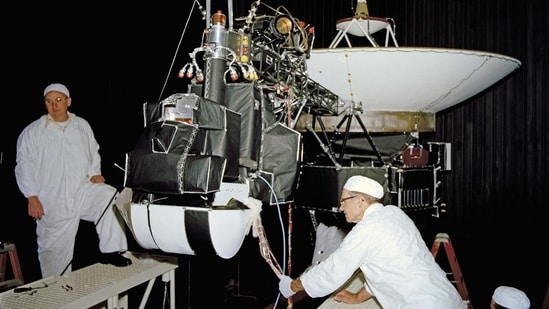
The farthest human-made object in space, the probe is travelling at a speed of 28,000 mph. It was also the first spacecraft to enter interstellar space in August 2012, closely followed by its twin, Voyager 2, in December 2018.
Known for taking the iconic “Pale Blue Dot” photograph of Earth, Voyager 1 would have crossed a distance of roughly 16.09 billion miles on November 18 to reach the one light-day mark.
All about NASA's Voyager 1 and 2
NASA's Voyager 1 and 2 were launched in 1977, taking advantage of a once-every-175-year planetary alignment of Jupiter, Uranus, Saturn, and Neptune - the four largest planets in our solar system.
{{/usCountry}}NASA's Voyager 1 and 2 were launched in 1977, taking advantage of a once-every-175-year planetary alignment of Jupiter, Uranus, Saturn, and Neptune - the four largest planets in our solar system.
{{/usCountry}}By the 1980s, the two went their separate ways at Saturn. Voyager 2 continued to travel towards Uranus and Neptune, while Voyager 1 headed towards a star, Gliese 445, more than 17 light-years away from Earth.
Voyager 2 remains the only spacecraft to have explored all four giant planets of our solar system-Jupiter, Saturn, Uranus, and Neptune-at close range. The first human-made object to fly past Uranus and Neptune, it discovered a 14th moon at Jupiter. Additionally, it found 10 new moons and two rings at Uranus, and five moons, four rings and a “Great Dark Spot” at Neptune.
The twin probe will cross the one “light-day” mark after nine years, in November 2035.
A 'Golden Record'
Both Voyager spacecrafts carry a Golden Record, a 12-inch phonograph disc designed to represent humanity and life on Earth. Each record contains spoken greetings in 55 languages, 27 musical selections, 116 images, and a collection of sounds from Earth.
The record is enclosed in a protective cover engraved with diagrams indicating the position of our Sun relative to 14 pulsars, along with instructions explaining how to play the disc. To preserve its contents against the radiations of space, the record was made of copper with gold plating, while its protective cover was constructed from aluminium.
Voyager 1 went incommunicado for 2 days
Voyager 1 didn't call mission control for two days in October, setting off alarms of panic. The Deep Space Network didn't receive a signal from the probe on October 18, and 19.
However, before engineers could send commands to troubleshoot the issue, the spacecraft re-established communication on October 20 and signalled back. No further communication disruptions have been reported since then.