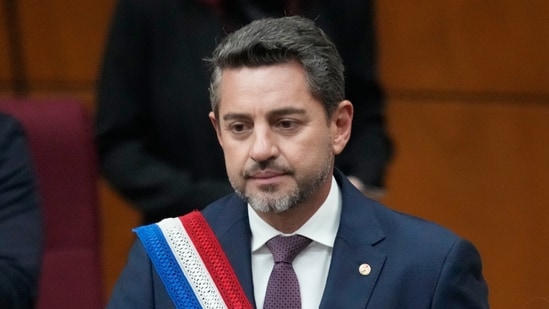
Paraguay's Vice President Pedro Alliana was sworn in as president on Friday after the Senate voted to impeach and remove his predecessor, Santiago Peña, amid a major banking crisis.
Peña was placed under house arrest shortly after the vote over the collapse of Ueno Bank. All 44 senators present voted in favour of his removal, accusing him of misconduct in office.
The crisis began after financial regulators seized Ueno Bank on Tuesday, leaving nearly three million customers unable to access their savings or use their bank cards.
Prosecutors ordered Peña to remain under house arrest until he appears before the economic crimes and anti-corruption unit. The attorney general's office confirmed his detention to The Associated Press.
Prosecutors also ordered the arrest of former central bank chief Carlos Carvallo, who was appointed by Peña. It was not immediately clear whether Carvallo had been taken into custody.
Impeachment and arrest
Lawmakers accused Peña of using his political influence to direct hundreds of millions of dollars in public funds into Ueno Bank while regulators failed to act on concerns about risky lending to companies linked to the bank's owners.
{{/usCountry}}Lawmakers accused Peña of using his political influence to direct hundreds of millions of dollars in public funds into Ueno Bank while regulators failed to act on concerns about risky lending to companies linked to the bank's owners.
{{/usCountry}}The impeachment charges also focused on Peña's former stake in Ueno's holding company, which he sold under pressure last year, and his appointment of a former Ueno executive to lead the central bank.
Lawmakers further alleged that the state pension fund deposited $355 million at Ueno, exceeding legal limits.
Peña denied the allegations.
In a farewell message before the Senate vote, he said he hoped his departure would prevent further political instability.
"I do not want my presence to be a cause of greater division or instability," he wrote.
Who is the new president?
Vice President Pedro Alliana was sworn in as Paraguay's new president on Friday. He will serve the remainder of Peña's term, which ends in August 2028.
The 52-year-old is a veteran member of the conservative Colorado Party. He previously served as governor of Ñeembucú province in southern Paraguay and as speaker of the lower house of Congress.
Alliana has promised not to "abandon" the millions of customers affected by the crisis.
However, Alliana is also facing scrutiny. Prosecutors are investigating him, while lawmakers shelved an opposition attempt to impeach him on Thursday.
Several senior officials in Peña's government, including his interior minister, chief of staff, legal adviser and political adviser, also resigned during the crisis.
What is the Ueno Bank controversy?
Ueno Bank grew rapidly to become Paraguay's fifth-largest bank by deposits, with more than $800 million in public funds helping fuel its expansion.
The bank attracted a large customer base through digital banking services and promotional offers. More than two-thirds of Paraguay's adults reportedly signed up for its services.
However, concerns over its financial health grew amid allegations of risky lending to companies connected to its owners.
Leaked internal reports raised questions about loans to related businesses and the bank's ability to meet its financial obligations.
The bank's connections to the government also came under scrutiny. Peña had previously held a stake in its holding company, while his administration appointed a former Ueno executive to lead the central bank responsible for regulating it.
The state pension fund's $355 million deposit at Ueno, allegedly exceeding legal limits, became another major focus of the impeachment proceedings.
When regulators seized the bank on Tuesday, customers suddenly lost access to their accounts, savings and payment cards. The disruption affected millions of people, including workers whose pension funds had money deposited at the bank.
Some depositors began receiving their money back on Thursday. The central bank said deposits were insured up to approximately $37,000, covering nearly all Ueno customers, and described the collapse as an isolated incident.
Meanwhile, prosecutors have charged 27 people, including Ueno's controlling shareholder, Miguel Vázquez, with offences including breach of trust and attempted fraud. Six bank directors are in pretrial detention.
Authorities have also seized luxury cars, a yacht and small aircraft linked to Vázquez as part of the investigation.