With fighters and helicopters onboard Chinese aircraft carrier Liaoning conducting more than 100 take-offs and landings south of Okinawa this month and rattling Tokyo, all eyes are on the May 24 QUAD summit to counter the growing naval challenge in the Indo-Pacific.
While QUAD summit agenda is expected to be worked out this week through diplomatic channels, the Chinese carrier task force exercised that close to Japan for the first time, setting off alarm bells in Tokyo as the PLA Navy's muscle-flexing remains focused on Taiwan and Japan.
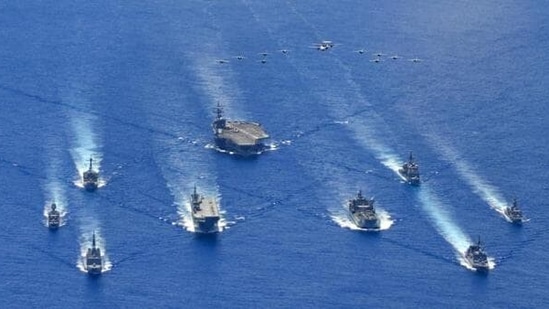
Just as the PLA Navy is testing its long-range capabilities and acquiring long sea legs in the Indo-Pacific, the QUAD navies are seized of the challenge ahead with US Navy deploying top-of the line Arleigh Burke class destroyers, guided missile cruisers and nuclear-powered aircraft carrier USS Ronald Reagan at Yokosuka naval base near Tokyo and Sasebo Naval Base in Nagasaki to handle armed emergency in Taiwan.
The key change in US naval strategy in the Indo-Pacific is induction of anti-submarine warfare-capable MH-60R helicopter-carrying destroyers that can carry out long-range surveillance of Chinese warships and pose a threat to PLA submarines. The newly inducted US warships have built-in hangers for the ASW helicopters, revealing that the focus of the Biden administration is the Taiwan emergency and the Indo-Pacific. The MH-60R is a highly versatile helicopter with the capability to take out any sub-surface threat in the Indo-Pacific, particularly South China Sea.
The MH-60R helicopter is with all the QUAD navies, with the Indian Navy expected to induct the first of the 24 ordered helicopters in early 2023 from the US. The Indian Navy's Delhi, Kolkata and Visakhapatnam class of destroyers are all designed to carry two ASW helicopters to deter any prowling enemy submarine. Two MH-60Rs have already been delivered to the Indian Navy last year and are being used for training Indian Navy pilots at San Diego in the United States.
{{/usCountry}}The MH-60R helicopter is with all the QUAD navies, with the Indian Navy expected to induct the first of the 24 ordered helicopters in early 2023 from the US. The Indian Navy's Delhi, Kolkata and Visakhapatnam class of destroyers are all designed to carry two ASW helicopters to deter any prowling enemy submarine. Two MH-60Rs have already been delivered to the Indian Navy last year and are being used for training Indian Navy pilots at San Diego in the United States.
{{/usCountry}}While US, Japan and Australia are countering the PLA naval challenge in Pacific and far Pacific, the Indian Navy is steadily building up strength in the Indian Ocean with the INS Vikramaditya aircraft carrier expected to resume naval operations next month after a major overhaul. With a second, and more powerful aircraft carrier, INS Vikrant, expected to be commissioned on August 15, the Indian force projection will be formidable in the Indo-Pacific with two ballistic missile submarines and newly inducted Scorpene attack submarines. The third ballistic missile submarine is already under fitment with national security planners now focused on India building nuclear-powered conventional attack submarines to take out distant naval threats in the Indo-Pacific.
With QUAD navies conducing inter-operability advanced exercises under the Malabar banner each year and now having commonality of military hardware, such Boeing P8I aircraft and MH-60R helicopters, the Indo-Pacific theatre will become more transparent to counter any naval challenge from an adversary like China.