Western countries and Japan together have roughly 500 million doses of coronavirus vaccines that can be immediately redistributed to poorer nations and, by the end of 2021, this surplus stock will balloon to 1.2 billion, according to a new analysis of global vaccine utilisation and supply set to be released next week.
The assessment, by science analytics company Airfinity, quantifies for the first time the stocks – available today and expected supply – that can be shared by high income countries without jeopardising their own vaccination campaigns.
These doses can greatly address a huge inequity in supply: University of Oxford’s Our World in Data estimates that as on September 2, a mere 1.8% of the population in low-income countries received at least one dose. In high-income countries, this proportion is 64%.
The new findings on surpluses are based on the analysis of supplies to the US, the UK, the European Union, Canada and Japan and their vaccination rates, and assume that these countries will keep giving doses to eligible populations (in most cases, everyone above the age of 12) with booster shots six months later.
“The world has reached a tipping point when it comes to vaccine availability and production. For large Western countries, the challenge is no longer supply, but demand. The global supply chain is successfully increasing production and our detailed forecast shows that high income countries can have confidence that there is plenty of vaccine coming and this should reduce the need for stockpiling,” said Airfinity’s co-founder and CEO Rasmus Bech Hansen in an email to HT.
{{/usCountry}}“The world has reached a tipping point when it comes to vaccine availability and production. For large Western countries, the challenge is no longer supply, but demand. The global supply chain is successfully increasing production and our detailed forecast shows that high income countries can have confidence that there is plenty of vaccine coming and this should reduce the need for stockpiling,” said Airfinity’s co-founder and CEO Rasmus Bech Hansen in an email to HT.
{{/usCountry}}“How these stocks are distributed, where they go and whether they are resold or donated is ultimately a political decision. With these numbers, I believe the world has a better basis for making these critical allocation decisions and avoid wasted doses,” Hansen added.
In addition to worsening socioeconomic inequality between the Global North and South, this disparity threatens to drag on the pandemic. Experts see continued risk of the Sars-CoV-2 mutating if it keeps spreading in vulnerable populations.
In terms of supplies, the report notes that production has scaled up rapidly. “Manufactures are currently producing 1.5 billion doses per month, and this is expected to continue growing,” the company said in its assessment.
If the doses of World Health Organization-approved vaccines produced in China are considered, the number available for donation rises to 1.6 billion by the end of this year. To put this into perspective, these many doses are enough to fully vaccinate over 70% of the population in Sub-Saharan Africa, where, at present, less than 3% of the people have been immunised. This region has till now received only 60 million doses, according to Unicef’s Covid-19 Vaccine Market Dashboard’s latest update on August 20.
To be sure, the surpluses in the Airfinity report include some doses already pledged.
For instance, G7 countries and EU have pledged 1 billion doses for donation by June 2022. Of this, Airfinity’s assessment found 13% has been delivered.
The report estimates that 11.3 billion doses are required to vaccinate the world’s population and forecasts output to reach that by the end of this year itself. Last month, the total number of Covid-19 vaccines produced in the world surpassed 6 billion.
Airfinity added that the report has been endorsed by the International Federation of Pharmaceutical Manufacturers and Associations (IFPMA), a Geneva-headquartered trade association that represents pharmaceutical firms around the world.
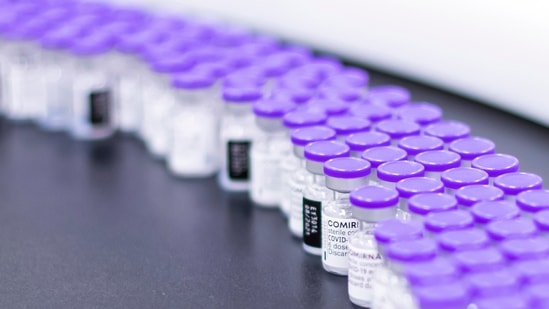
The forecast adds that redistribution plans need to take into account logistical challenges since most of the surplus doses — 69% — will be mRNA vaccines made by Moderna and Pfizer-BioNTech. Both need to be kept frozen.
“Forecasted supply is calculated from purchased doses only and excludes any call option (i.e. the option to expand the deal),” the report says, and adds that it assumes no vaccine facility pauses production.